APR vs APY is one of the most important comparisons in personal finance because the two rates measure opposite sides of money. APR shows what borrowing costs. APY shows what saving or investing earns after compounding. Confusing the two can make a loan look cheaper than it is or a savings account look less powerful than it becomes over time.
The difference matters more when rates are high enough for small percentage gaps to affect real decisions. As of the latest April 2026 FDIC data published through FRED, the U.S. national savings deposit rate was 0.38%, while the national rate for a 12-month CD was 1.53%. The next decision for consumers is not only which rate is higher, but whether the quoted rate is APR or APY.
APR stands for annual percentage rate. It shows the yearly cost of borrowing money.
APR is used for credit cards, mortgages, personal loans, auto loans and business loans. A loan with a 12% APR usually costs more than one with an 8% APR, as long as the loan amount, fees and repayment period are similar.
APR may include more than the interest rate. Some loans also include fees, which means the APR can be higher than the advertised interest rate. That is why APR is often the better number to use when comparing loans.
For credit cards, APR matters when a balance is not paid in full. Paying the full balance by the due date usually helps avoid interest on purchases.
APY stands for annual percentage yield. It shows how much money a savings account or deposit can earn in one year after compounding.
APY is used for savings accounts, high-yield savings accounts, money market accounts and CDs. For example, a $10,000 deposit earning 4.00% APY would earn about $400 in one year before tax, assuming the rate stays the same.
The key difference is compounding. Compounding means interest is added to the balance, and future interest is then calculated on the larger amount. APY makes this easier to compare by showing the total annual return in one figure.
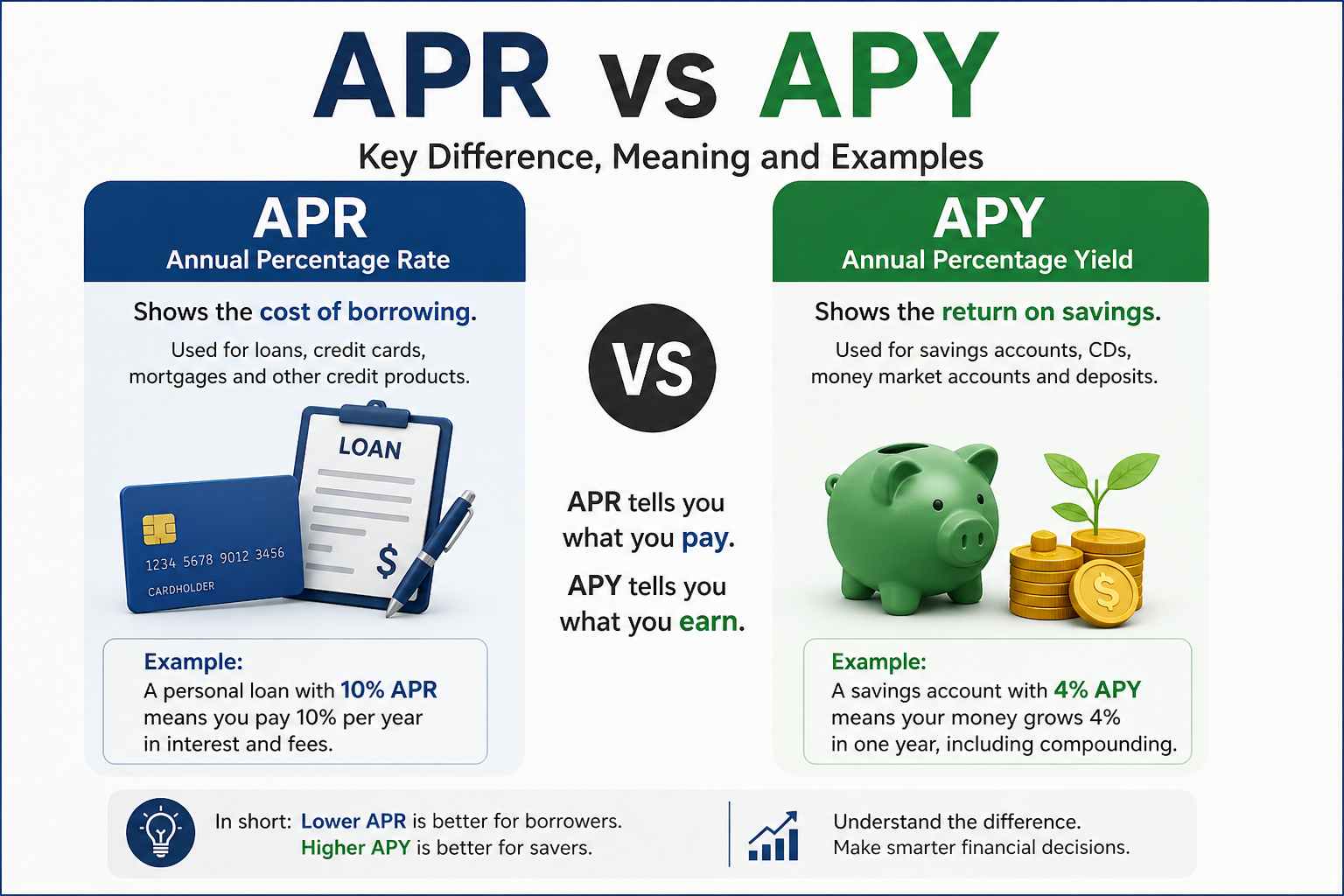 APR and APY both express annual percentages, but they answer different financial questions.
| Feature | APR | APY |
|---|---|---|
| Full term | Annual percentage rate | Annual percentage yield |
| Main use | Borrowing | Saving or deposit accounts |
| Best for | Loans, credit cards, mortgages | Savings accounts, CDs, money market accounts |
| Direction preferred | Lower is better | Higher is better |
| Compounding impact | Often not fully reflected in the headline rate | Reflected in the annual yield |
| Practical question | “How much will this debt cost?” | “How much will this money earn?” |
The simplest distinction is this: APR is the price of using someone else’s money. APY is the reward for letting someone else use yours.
Consider a simplified one-year loan of $10,000 with 8.00% interest and a $200 loan fee. If the full principal remains outstanding for the year, the borrower pays about $800 in interest plus $200 in fees. The total borrowing cost is $1,000, equal to about 10.00% of the original loan amount.
That is the practical reason APR matters. The quoted interest rate may be 8.00%, but the cost of credit can be higher once fees are included. For amortising loans, the exact APR calculation depends on payment timing and outstanding balance, but the principle is the same: APR is designed to make the true borrowing cost easier to compare.
For credit cards, the cost can become even more expensive because interest may be calculated daily and added to the balance. A cardholder who carries a balance for several months pays interest not only because the APR is high, but because unpaid balances continue to generate finance charges.
Now consider a $10,000 savings deposit earning 4.00% APY. If the money remains in the account for one year, the saver earns about $400 before tax. The account balance rises to around $10,400, assuming no withdrawals, no fees and no rate changes.
If the account quotes an interest rate instead of APY, the final result can vary depending on how often the bank compounds interest. Daily compounding generally produces a slightly higher annual return than annual compounding at the same nominal interest rate. APY removes that confusion by expressing the compounded return as one annual figure.
This is why savers should compare APY, not only the stated interest rate. A bank paying interest monthly may produce a different annual return from a bank paying interest daily, even when the headline rate looks similar.
APR often looks lower because it usually does not show the full effect of compounding in the same way APY does. This is especially important in credit cards, where interest can be calculated using a daily periodic rate. The CFPB notes that some card issuers calculate interest daily and add that interest to the previous day’s balance, which means interest can compound daily.
That does not mean APR is misleading. It means APR and APY are built for different purposes. APR standardises borrowing costs. APY standardises deposit earnings. A borrower should not compare a loan APR with a savings APY as if they measure the same thing.
Use APR when comparing the cost of borrowing money, such as:
Credit cards
Mortgages
Personal loans
Auto loans
Business financing
A lower APR usually means cheaper borrowing, but only when the loan amount, fees and repayment term are similar.
Use APY when comparing where to keep or grow cash, such as:
Savings accounts
High-yield savings accounts
Money market accounts
Certificates of deposit
A higher APY usually means better earnings, but it should not be the only factor.
Neither is automatically better. APR is better for comparing borrowing costs, while APY is better for comparing savings returns. Borrowers generally want a lower APR. Savers generally want a higher APY.
Banks use APY because it reflects compounding. This gives savers a clearer view of how much interest they can earn over one year if the balance remains in the account.
Lenders use APR because it standardises borrowing costs over one year. It can include the interest rate and certain fees, making it easier to compare different loan offers.
APY reflects interest earned. It generally does not include separate account fees, bonuses or non-interest rewards. A high APY can still be less attractive if monthly fees reduce the account’s net benefit.
They can be close, especially when there is no compounding or when interest is paid once annually. The more frequently interest compounds, the more APY can differ from the stated interest rate.
APR and APY are simple terms with significant financial consequences. APR helps borrowers understand the annual cost of credit. APY helps savers understand the annual return after compounding. One belongs on the debt side of the household balance sheet. The other belongs on the savings side.
The practical rule is clear: seek the lowest responsible APR when borrowing and the highest suitable APY when saving. The difference between the two is not just technical. It shapes how quickly debt grows, how efficiently cash earns interest and how accurately consumers compare financial products.