Published on: 2026-04-06
Updated on: 2026-04-06
Choosing between a Roth IRA and a 401(k) is a critical step in building a long-term investment strategy. Both accounts are designed to help individuals build retirement wealth, but they differ in taxation, contribution limits, investment flexibility, and withdrawal rules. For investors, the decision is not simply about picking one account over the other. It is about understanding how each fits into a broader retirement planning strategy, especially in 2026, as inflation, interest rates, and tax policies continue to evolve.
A Roth IRA offers tax-free withdrawals, while a 401(k) provides tax-deferred growth.
Employer matching makes a 401(k) especially valuable for salaried employees.
Roth IRAs offer greater control over investment strategies and asset selection.
401(k) plans allow higher contributions, making them ideal for long-term wealth accumulation.
Combining both accounts can improve tax diversification and retirement flexibility.
A Roth IRA is an individual retirement account funded with after-tax income, meaning you contribute money that has already been taxed. In exchange, your investments grow tax-free, and qualified withdrawals in retirement are tax-free.
This structure makes the Roth IRA particularly attractive for investors focused on long-term compounding and preserving future purchasing power. Because taxes are handled upfront, investors eliminate uncertainty about future tax rates on their investment gains.
Tax-free growth and withdrawals
No required minimum distributions (RMDs), allowing assets to compound longer
Broad access to investments such as stocks, ETFs, and bonds
Income limits that may restrict eligibility for higher earners
From a strategic perspective, Roth IRAs are often used to hold higher-growth assets. For example, allocating funds into equity ETFs tracking major indices allows investors to maximise tax-free capital appreciation over time.
Consider an investor who consistently contributes to a Roth IRA and invests in a diversified portfolio of global equities. Over 25–30 years, compounding can significantly increase the portfolio value. Because withdrawals are tax-free, the investor retains the full benefit of growth, which can be particularly valuable during retirement when managing income streams.
A 401(k) is an employer-sponsored retirement plan that allows employees to contribute a portion of their salary before taxes are applied. This reduces current taxable income and allows investments to grow on a tax-deferred basis.
One of the most compelling features of a 401(k) is employer matching, which can significantly enhance long-term returns. In many cases, employers match a percentage of employee contributions, effectively increasing the total invested capital.
Pre-tax contributions that reduce current taxable income.
Employer matching contributions (subject to company policy).
Higher annual contribution limits compared to IRAs.
Investment options are typically limited to a selection of mutual funds or index funds.
From a portfolio-building perspective, a 401(k) is often used as the foundation of retirement savings, particularly for individuals with stable income.
An employee earning $80,000 annually contributes 10% of their salary into a 401(k). If their employer matches 50% of contributions up to a certain level, the investor benefits from additional capital without increasing personal contributions. Over time, this creates a compounding effect that significantly accelerates portfolio growth.
After understanding how each account works individually, the key distinction becomes clear: the timing of taxation.
A Roth IRA requires taxes to be paid upfront, allowing all future growth to be tax-free.
A 401(k) defers taxes until withdrawal, reducing the current tax burden.
This difference plays a central role in tax planning and investment strategy. If tax rates rise in the future, Roth IRA holders benefit from having today’s rates locked in. Conversely, if an investor expects to be in a lower tax bracket during retirement, a 401(k) may be more efficient overall.
In reality, predicting future tax policy is difficult. As a result, many experienced investors prioritise tax diversification, using both account types to hedge against uncertainty.
Contribution limits determine how much capital you can allocate each year and directly influence long-term portfolio growth.
Roth IRA: In 2026, you can contribute up to $7,500 across all traditional and Roth IRAs combined, or your taxable compensation for the year if it is lower. If you are age 50 or older, the limit rises to $8,600. Roth IRA eligibility also depends on income. In 2026, contributions begin to phase out at a modified adjusted gross income (MAGI) of $153,000 to $168,000 for single filers and heads of household, $242,000 to $252,000 for married couples filing jointly or qualifying surviving spouses, and $0 to $10,000 for married individuals filing separately who lived with their spouse at any time during the year.
401(k): In 2026, the employee elective deferral limit is $24,500, excluding employer contributions. If you are age 50 or older, you can contribute an additional $8,000 catch-up amount, for a total of $32,500. If you are ages 60 to 63, the higher catch-up limit is $11,250, which brings the total possible employee contribution to $35,750, if your plan allows it.
The higher contribution limits of a 401(k) make it more suitable for individuals aiming to invest aggressively, while a Roth IRA can complement that strategy by offering tax-free withdrawal potential for eligible investors. For investors with sufficient income, using both accounts can improve tax diversification and retirement flexibility.
The choice between these accounts depends on several factors, including income level, career stage, and expectations about future tax rates.
A Roth IRA is generally more suitable for investors who:
Expect higher income and tax rates in the future.
Want predictable, tax-free retirement income.
Prefer flexibility in managing investments and withdrawals.
A 401(k) may be more appropriate for those who:
Want to reduce current taxable income.
Have access to employer-matching contributions.
Aim to contribute larger amounts annually.
Importantly, these decisions should not be made in isolation. They should align with broader financial goals, such as wealth preservation, risk tolerance, and time horizon.
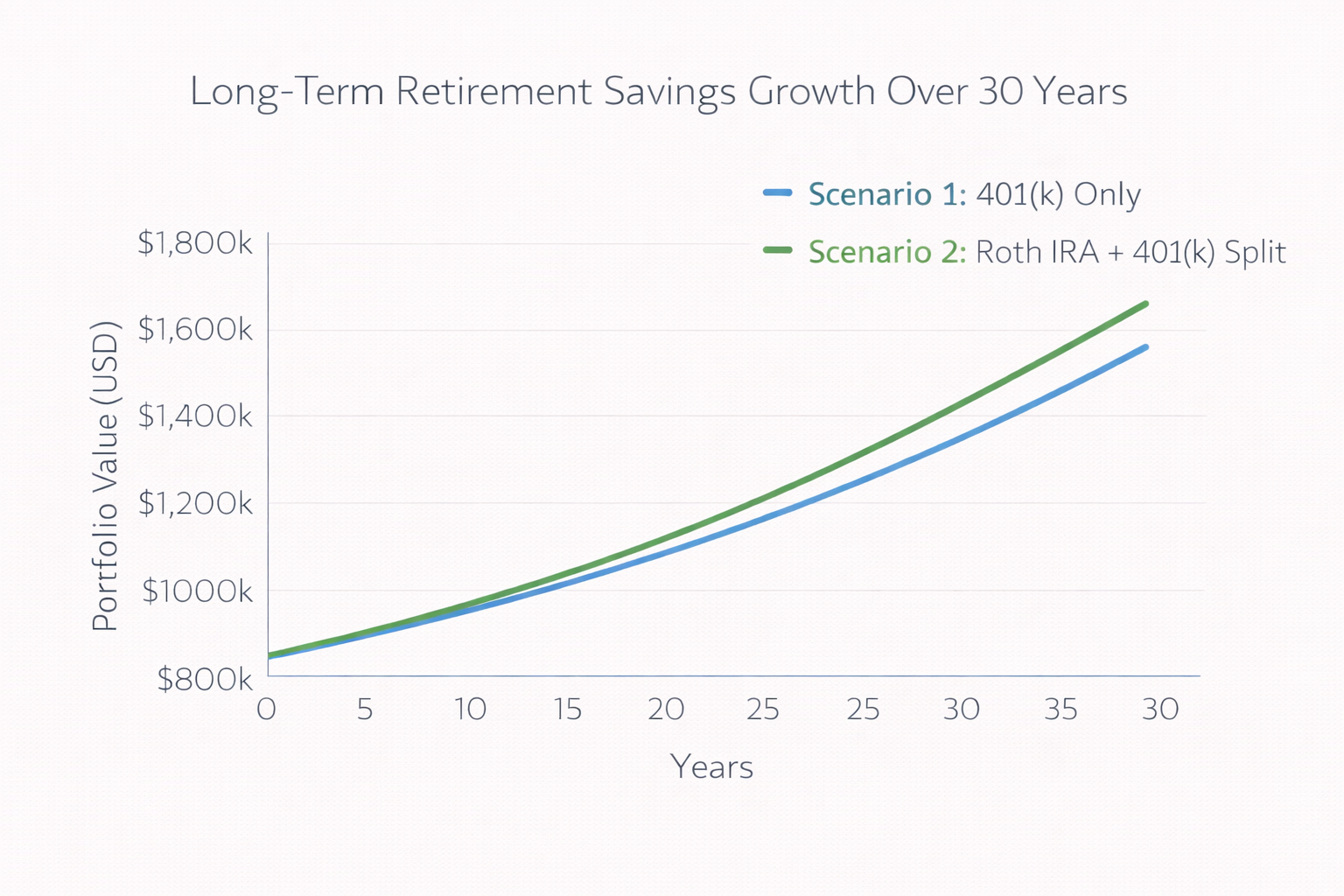
Rather than choosing one account exclusively, many investors follow a structured allocation strategy that maximises the benefits of both.
Contribute enough to your 401(k) to receive the full employer match.
Allocate additional funds to a Roth IRA for tax-free growth.
Increase 401(k) contributions once the Roth IRA is maximised.
This approach allows investors to:
Capture “free” employer contributions.
Build a pool of tax-free assets.
Scale total retirement savings efficiently
Over time, this balanced strategy can provide greater flexibility when withdrawing funds, particularly in managing taxable income during retirement.
Even with access to these accounts, investors often make avoidable mistakes that impact long-term performance.
Ignoring employer matching, which reduces potential returns
Overemphasising short-term tax savings without considering future implications
Failing to build tax diversification across different account types
Holding overly conservative investments that limit long-term growth
Delaying contributions and missing out on compounding.
Avoiding these pitfalls can significantly improve the effectiveness of a retirement strategy.
Neither account is inherently better, as each serves a different purpose within a retirement strategy. A Roth IRA offers tax-free withdrawals, while a 401(k) provides immediate tax savings and employer-matching contributions. The best option depends on your income, tax expectations, and long-term financial objectives.
Yes, you can contribute to both accounts within the same year if you meet eligibility requirements. This allows investors to benefit from both tax-free growth and tax-deferred contributions, creating a more flexible and diversified retirement income strategy over time.
Early withdrawals may result in taxes and penalties depending on the account type. However, Roth IRA contributions can typically be withdrawn penalty-free, offering more flexibility than a 401(k), which generally has stricter withdrawal rules and conditions.
No, taxes are paid only once when contributions are made with after-tax income. After that, both the invested amount and any gains can be withdrawn tax-free in retirement, provided the account meets the required conditions and holding period.
Employer matching is highly valuable because it effectively increases your investment without additional effort. It provides an immediate return on your contributions and can significantly enhance long-term portfolio growth through compounding, making it one of the most important benefits of a 401(k).
A Roth IRA and a 401(k) are complementary tools rather than competing options. While one focuses on tax-free growth and future income certainty, the other provides immediate tax advantages and higher contribution capacity. Understanding their differences and using them strategically together helps investors build a more resilient, tax-efficient portfolio that adapts to changing economic conditions and supports long-term financial goals.
Disclaimer: This material is for general information purposes only and is not intended as (and should not be considered to be) financial, investment or other advice on which reliance should be placed. No opinion given in the material constitutes a recommendation by EBC or the author that any particular investment, security, transaction or investment strategy is suitable for any specific person.