Published on: 2026-05-21
Jubilant FoodWorks share price fell sharply after Q4 FY26 results as investors looked past the profit jump and focused on weaker Domino’s India store-level demand.
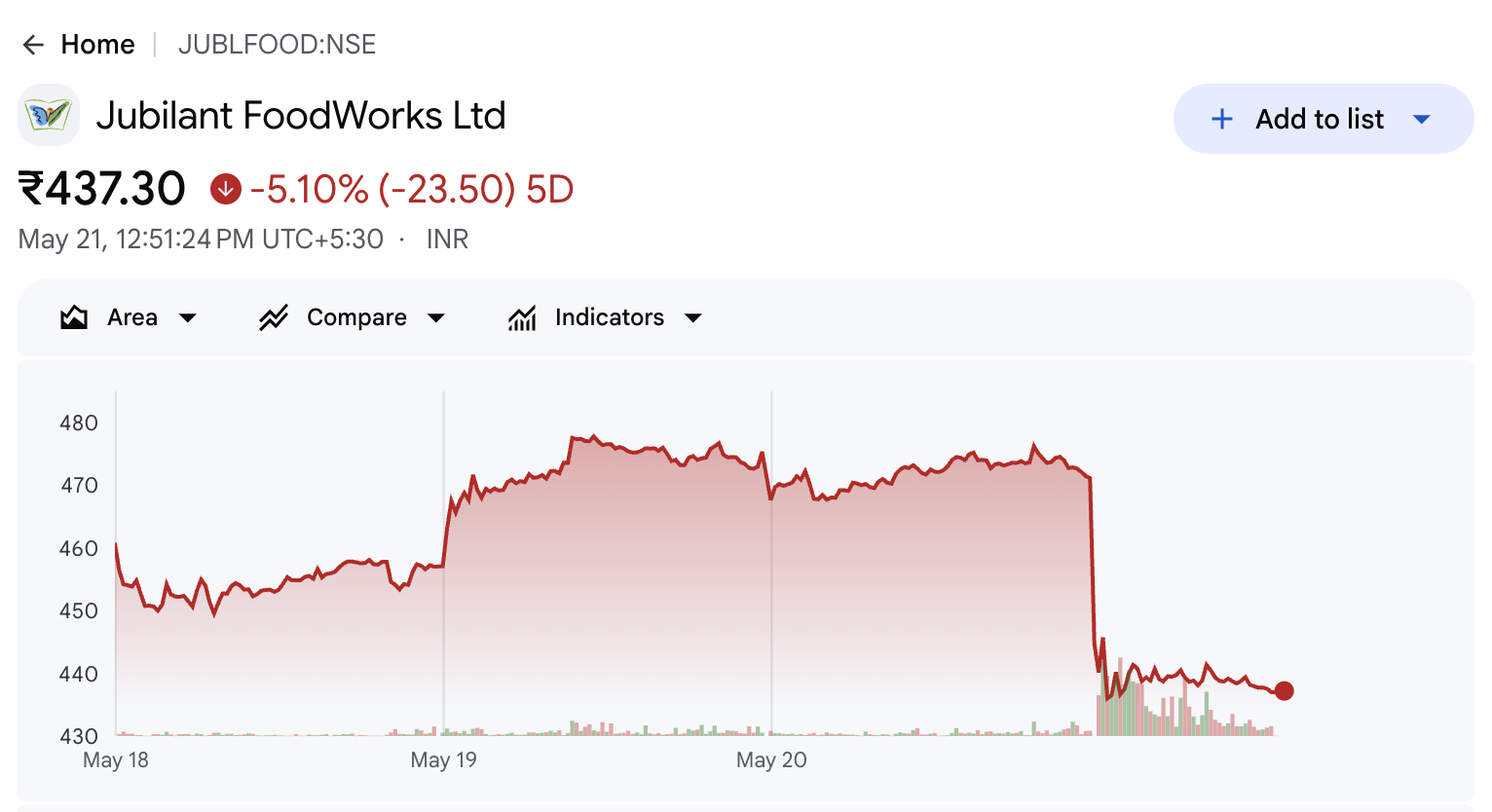
Shares of Jubilant FoodWorks Ltd (NSE: JUBLFOOD), one of India’s largest listed quick-service restaurant operators, fell as much as 8% on May 21, moving towards the ₹434 level and closer to its 52-week low of ₹408.80. The decline came despite a strong headline profit number for the March quarter.
For Q4 FY26, consolidated net profit rose 66.2% year on year to ₹79.79 crore from ₹48.01 crore. Consolidated revenue from operations increased 19.1% to ₹2,505.8 crore. At first glance, those numbers suggested a resilient finish to the financial year. The market, however, focused on what the headline growth did not show clearly: Domino’s India like-for-like growth slowed to just 0.2%.
The Q4 print showed a clear split between consolidated performance and domestic operating momentum. Jubilant FoodWorks delivered stronger group-level numbers, but the core India business remained under pressure.
Key operating signals from the quarter included:
Consolidated revenue rose 19.1% year on year to ₹2,505.8 crore, supported by international growth, store expansion and scale.
EBITDA increased 23.7% year on year to ₹484.9 crore, while EBITDA margin expanded 69 basis points to 19.4%.
Standalone revenue rose only 6.2% year on year to ₹1,686 crore, showing slower growth in the domestic business.
Standalone net profit declined 14% to ₹42.5 crore, raising concerns over India operating leverage.
Domino’s India LFL growth was just 0.2%, signalling weak incremental demand from existing stores.
For a QSR company, new store additions can lift revenue, but like-for-like growth is the cleaner test of demand quality. In Q4, that signal was weak, which explains why investors focused more on Domino’s India than the stronger consolidated profit number.
| Metric | Q4 FY26 | Market Read |
|---|---|---|
| Consolidated revenue from operations | ₹2,505.8 crore | Up 19.1% YoY |
| Consolidated net profit | ₹79.79 crore | Up 66.2% YoY |
| EBITDA | ₹484.9 crore | Up 23.7% YoY |
| EBITDA margin | 19.4% | Expanded 69 bps |
| Standalone revenue | ₹1,686 crore | Up 6.2% YoY |
| Standalone net profit | ₹42.5 crore | Down 14% YoY |
| Domino’s India LFL growth | 0.2% | Weak existing-store demand |
| Q4 net store additions | 69 | Expansion-led support |
| Total store network | 3,663 | Scale remains intact |
Full-year consolidated revenue reached ₹9,544.1 crore, up 17.2% over FY25. The company is still growing, but the share price reaction shows that investors are now asking whether the growth is coming with enough quality, pricing power and store-level efficiency.
Domino’s India remains one of the strongest QSR brands in the country, supported by delivery scale, digital ordering and a broad store network. But Q4 showed demand was uneven.
Like-for-like growth of 0.2% means mature stores were nearly flat compared with the previous year. That is a serious signal for a business that depends on higher store throughput to support margins and justify premium valuations.
The company has continued using affordability-led measures, value offerings and customer acquisition initiatives to protect order momentum. These actions can support frequency, but they may also weigh on average bill value if consumers remain price-sensitive. In a cost environment shaped by food, packaging, labour and energy inflation, weak LFL growth makes margin recovery harder.
LPG supply disruption added pressure during the quarter, but it does not fully explain the weak operating print. Management estimated that LPG issues affected Domino’s India LFL growth by 30 to 40 basis points. Supply had largely normalised by Q1 FY27, and the company is reducing operational exposure by moving more stores towards electric ovens and piped natural gas.

The key point is that even after adjusting for the LPG impact, Domino’s India growth remained soft. The market treated the disruption as a temporary issue, but the weak LFL number as a deeper demand concern.
The company has also clarified earlier market speculation around LPG dependence, stating that claims of more than 95% outlet dependence were not based on its disclosures and that the actual proportion is lower.
The main concerns were similar across the Street: weak same-store sales, slower domestic earnings recovery, inflation in key operating costs and limited near-term triggers for a rerating.
Morgan Stanley had already downgraded Jubilant FoodWorks to Equal-weight from Overweight and cut its target price to ₹486 from ₹693 after the weak Q4 business update. The downgrade reflected rising concerns over earnings growth, demand softness and limited upside catalysts.
Management continues to target medium-term Domino’s India LFL growth of 5% to 7% and margin improvement of around 200 basis points by FY28. Those targets now form the benchmark for future performance. The market will need evidence that the company can move from near-flat LFL growth towards that range without relying too heavily on discounts or store additions.
Jubilant FoodWorks has decided not to renew its Dunkin’ India franchise agreement after December 31, 2026. The company is exploring options including store sales or transfer of franchise rights, and has said the decision is not expected to have a material financial or operational impact.
Dunkin’ contributed only about 0.61% of revenue and reported a loss of nearly ₹191 million in FY25. Strategically, the exit is sensible. It allows management to focus capital and execution on Domino’s, Popeyes, Hong’s Kitchen and international markets.
Still, portfolio cleanup alone will not drive a share price recovery. Domino’s India must deliver stronger demand quality.
Jubilant FoodWorks has support from international markets and newer growth platforms. Domino’s Turkey recorded stronger LFL growth, while Popeyes India continued to build scale and improve restaurant economics. These businesses help diversify the group and support consolidated growth.
But they do not replace the importance of Domino’s India. The domestic pizza business remains the most visible earnings driver and the key reason investors have historically assigned a premium valuation to Jubilant FoodWorks.
Jubilant FoodWorks share price fell because the market looked beyond the 66.2% profit growth and focused on weaker operating signals. Consolidated revenue and profit improved, but Domino’s India LFL growth of 0.2%, lower standalone profit and cost pressures created a more cautious reading of Q4 FY26.
The company still has scale, strong brands and a wide store network. The next test is execution. For the share price to stabilise, Jubilant FoodWorks needs stronger same-store sales, firmer average bill values and clearer margin resilience in its core India business.