Published on: 2026-03-31
Updated on: 2026-03-31
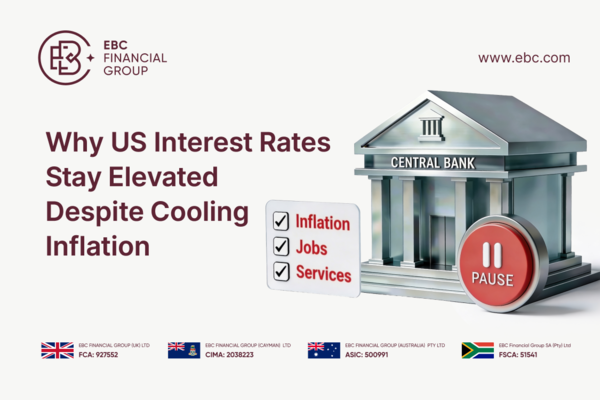
The Federal Reserve has maintained its policy rate in the 3.50%-3.75% range, despite a significant decline in inflation following the 2022 surge. The January 2026 Federal Open Market Committee (FOMC) statement left the target range unchanged and reiterated the Committee’s position: it will “carefully assess incoming data” and remains “strongly committed” to achieving 2% inflation.
At first glance, this appears to be a disconnect. Inflation is no longer accelerating, yet monetary policy remains restrictive. In early 2026, this divergence explains why rate expectations fluctuate with each significant data release. The focus is not solely on the rate, but on the Federal Reserve’s underlying objectives.
The Federal Reserve’s objective is not to reward progress, but to ensure that inflation remains contained for a sufficient period to prevent resurgence through wages, services, or renewed demand. Consequently, “cooling inflation” does not automatically result in rate cuts.
The easiest way to understand the Fed’s posture is to think in two phases.
Phase one is getting inflation down from a shock. That was the 2022-2024 chapter.
Phase two represents the final stage, where inflation appears nearly stable but resists further improvement. Central banks risk-averse outcomes if they ease policy prematurely during this period.
By late 2025, headline Consumer Price Index (CPI) inflation was 2.7% year-on-year, measured December to December. While this appears close to normal, inflation need not be elevated to pose policy challenges; persistent or “sticky” inflation that fails to improve remains problematic.
This is the risk the Federal Reserve seeks to mitigate. Reversing a premature easing cycle can significantly damage central bank credibility. When data show improvement but lack sufficient confirmation, the Federal Reserve typically opts for patience.
The inflation progress is real. Even early 2026 data pointed to further cooling. The Financial Times reported the January 2026 CPI at 2.4% year on year, with core inflation. However, the Federal Reserve’s focus extends beyond the most recent data point; it prioritises the durability of the disinflation process.
One reason is composition. Goods inflation can cool quickly when supply chains normalise, and demand rotates. Services inflation, especially shelter-linked components, tends to cool slowly and can reheat more easily.
Another reason is that inflation is not only a price story. It is a behaviour story. When labour markets remain tight and demand remains resilient, firms are more willing to pass through costs. This is why the Fed wants confirmation across multiple months, not a single friendly print.
In summary, while inflation has improved, the Federal Reserve seeks a consistent series of data indicating that inflation is moving toward the target and remains stable at that level.
The Fed’s mandate is maximum employment and price stability. That sounds balanced, but the mandate creates a specific problem in the last mile.
If inflation remains above target, the Federal Reserve has justification to maintain current rates. Conversely, if the labour market weakens, there is a rationale for rate cuts. When both conditions occur simultaneously, the Federal Reserve prioritises risk management and refrains from aggressive easing unless inflation is convincingly contained.
The January 2026 statement leaned on familiar balancing language, saying decisions will depend on “incoming data, the evolving outlook, and the balance of risks.” That mindset has global spillovers. When the market prices fewer cuts, short-dated yields can move quickly and the dollar often firms.
There is a second layer under the inflation story that explains why “high rates” can persist.
It is the question of neutrality.
In plain English, neutral is the rate that neither stimulates nor restrains. If neutral is higher than markets assume, then “restrictive” might be less restrictive than it looks. That would justify holding rates up, even if inflation is not alarming.
The neutral rate is significant for traders because it determines the long-term policy destination, thereby redefining what constitutes “normal” monetary conditions after the Federal Reserve concludes its inflation response.
This is where the Fed’s own projections are useful. The Summary of Economic Projections shows wide dispersion in views, including on longer-run rates. The dispersion is the message. It signals genuine uncertainty about where the economy’s speed limit sits now.
This is one of the most misunderstood parts of the “why are rates still high” question.
The Fed controls the policy rate corridor. It does not directly control overall financial conditions. Markets do.
Financial conditions may loosen due to rising equity prices, narrower credit spreads, increased risk appetite, or a weaker US dollar. In such scenarios, the Federal Reserve becomes cautious that markets are effectively easing conditions independently.
This dynamic is one reason the Federal Reserve exercises caution with forward guidance. If it signals rate cuts too explicitly, markets may ease conditions prematurely, potentially undermining progress on inflation.
This is also why you often see the Fed keep rates steady even as inflation cools. Holding rates steady can be a way of leaning against an overly enthusiastic market.
Even in a rates-focused year, balance sheet policy remains part of the stance.
Federal Reserve policy encompasses more than the federal funds target range; it also includes the pace of balance sheet reduction and the evolution of liquidity conditions.
This matters for two reasons.
First, balance sheet policy can exert a tightening effect without changes to the policy rate. If reserves decline or funding pressures increase, liquidity conditions may become less accommodative.
Second, it affects the long end differently from the front end. The front end trades the Fed’s rate path. The long end also trades term premium, supply, and investor risk appetite. Balance sheet dynamics can influence those channels.
In a 2026 environment where markets are sensitive to any shift in the “path,” it's worth reminding readers that the Fed’s stance is more than a single number.
The Federal Reserve does not explicitly frame its policy as protecting financial markets, nor does it intend to do so. Nevertheless, it remains attentive to the same vulnerabilities observed by other market participants.
The Fed’s November 2025 Financial Stability Report highlighted that survey respondents most frequently cited policy uncertainty, geopolitical risks, higher long-term rates, persistent inflation, and the risk of a sharp decline in asset prices, potentially linked to a turn in AI sentiment.
When applied judiciously, this information provides valuable context for market commentary.
This does not imply that the Federal Reserve is maintaining rates due to developments in artificial intelligence. Rather, it recognises an environment where risks can shift rapidly. With inflation remaining above target, such a backdrop provides further justification for a cautious approach.
FX
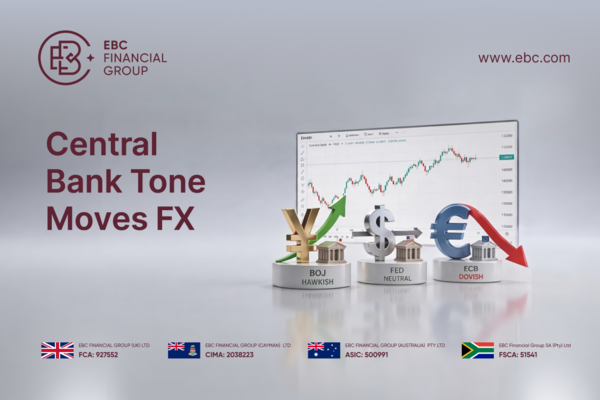
If the Fed stays restrictive while other major central banks lean softer, rate differentials tend to support the dollar. USD weakness needs a catalyst, usually a clear downshift in inflation or a sharper jobs slowdown. When data come in hotter, markets often price fewer cuts, front-end yields rise, and the dollar firms.
Gold
Elevated policy rates present a challenge for gold, as it does not generate yield. However, gold’s performance is not solely determined by interest rates; it can remain resilient during periods of heightened uncertainty, as risk premia may offset the negative carry. The most effective approach is to monitor real yields and the US dollar while assessing whether risk sentiment is contributing an additional premium.
Oil
Higher rates can cool demand expectations at the margin, but oil remains a supply- and geopolitical-market-first. In a higher-for-longer world, demand becomes a steady drag, while supply headlines drive spikes. Traders should treat “rates” as the background filter, not the trigger.
Equity indices
Higher discount rates tend to compress valuations, particularly for long-duration growth assets. Simultaneously, robust economic growth supports corporate earnings. When the Federal Reserve maintains its policy stance, equity markets often oscillate between expectations of a soft landing and concerns about persistent inflation. A policy pause does not equate to market stability; instead, it frequently results in heightened sensitivity to new data releases.
Rates
A hold is not calm. It is sensitivity. The front end trades the expected timing of cuts. The long end trades growth, term premium, and supply risk. In this kind of regime, the curve can move sharply without any change in the policy rate, simply because expectations have shifted.
To maintain the ongoing relevance of this analysis, consistently apply four key indicators:
What changed in core inflation versus the last print
What changed in the momentum versus the trend
Did that shift “cuts priced” even slightly
Which market reacted first, and which market confirmed it
The last point matters. Sometimes FX leads. Sometimes rates lead. Sometimes equities lead, and the Fed has to lean against it. The leadership itself is information.
Rates can stay elevated even as inflation cools because the Fed is trying to avoid a relapse and protect credibility in the last mile. With inflation still close enough to target to tempt optimism, but not close enough to declare victory, the safest move is to wait.
For traders, the opportunity is not the level of rates. It is the direction of expectations. In a world where the Fed is cautious and policymakers are not fully aligned on the destination, the market will continue to reprice the path. That repricing is where the risk and the trade sit.
This material is for information only and does not constitute a recommendation or advice from EBC Financial Group and all its entities (“EBC”). Trading Forex and Contracts for Difference (CFDs) on margin carries a high level of risk and may not be suitable for all investors. Losses can exceed your deposits. Before trading, you should carefully consider your trading objectives, level of experience, and risk appetite, and consult an independent financial advisor if necessary. Statistics or past investment performance are not a guarantee of future performance. EBC is not liable for any damages arising from reliance on this information.