Published on: 2025-10-13
Updated on: 2025-12-10
Before the Medline IPO even prices, it has already become a litmus test for how much risk investors are willing to take on in late-cycle healthcare and in private-equity exits. A defensive business, a heavy debt load, and a macro tape shaped by tariffs and rate cuts make this far more than "just another listing".
Medline now has formal IPO terms on the table. The medical-supplies giant is looking to raise to $5.37 billion on the Nasdaq, with an indicated price range of $26–$30 a share.
At that range, the deal implies an equity valuation of roughly $48–$55 billion, making it the largest U.S. IPO of 2025 and one of the largest PE-backed offerings on record.
| Item | Detail |
|---|---|
| Deal size | Up to $5.37 billion (179 million shares) |
| IPO price range | $26–$30 per share |
| Implied equity value | Roughly $48–$55.3 billion at the indicated range |
| Exchange / ticker | Nasdaq Global Select Market / MDLN |
| Use of proceeds | Primarily to repay debt and for general corporate purposes |
| Sponsors | Blackstone, Carlyle, Hellman & Friedman (majority owners) |
| Revenue 2024 | $25.5 billion net sales; net income $1.2 billion |
| Revenue 9M 2025 | $20.6 billion net sales; net income $977 million |
| Product portfolio | ~335,000 SKUs across medical-surgical and related categories |
| Global footprint | 20+ manufacturing sites, 60+ distribution centres, 100+ countries |
Early reporting in late 2024 suggested Medline was exploring a $5+ billion raise with a potential valuation near $50 billion, subject to market conditions.
As of December 2025, those plans have crystallised into a live transaction. Medline is marketing 179 million shares at $26–$30 each, targeting proceeds of up to $5.37 billion and a valuation reaching about $55.3 billion, making it the biggest U.S. IPO of the year.
Deal documents and press reports suggest Medline plans to set the IPO price in mid-to-late December 2025, with trading anticipated to begin on the Nasdaq under ticker MDLN shortly thereafter.
The primary underwriters are Goldman Sachs, Morgan Stanley, BofA Securities, and J.P. Morgan, backed by an extensive syndicate of over 40 banks, aligning with the magnitude of the transaction and its significance for the 2025 league tables.
Earlier in 2025, Medline and other issuers paused IPO plans when new U.S. tariffs triggered a sharp risk-off move and a pullback in offerings. Since then, the global IPO market has rebounded, with Q3 2025 deals and proceeds significantly higher year-on-year, and U.S. issuance on track for its strongest year since 2021.
That improving window, supported by expectations of further Federal Reserve rate cuts, with the fed funds rate now in the mid-3% range after several reductions in 2025, provides a more forgiving backdrop for a large, income-generating healthcare name.
Medline's S-1 and subsequent disclosures show a business that has compounded steadily:
2024 net sales: $25.5 billion; net income: $1.2 billion; Adjusted EBITDA: $3.4 billion (margin ~13%).
H1 2025: net sales $13.5 billion, up about 10% year-on-year; net income $0.7 billion.
9M 2025: net sales $20.6 billion and net income $977 million, both up versus the prior year.
The company discloses two main segments:
Medline Brand (higher-margin branded products), just under half of net sales but over 80% of segment Adjusted EBITDA.
Supply Chain Solutions (distribution and logistics) accounts for just over 50% of net sales, yet it holds a smaller portion of EBITDA.
That mix matters: the IPO asks public investors to pay a premium not just for sheer volume, but for the higher-margin branded piece that drives most of the profit pool.
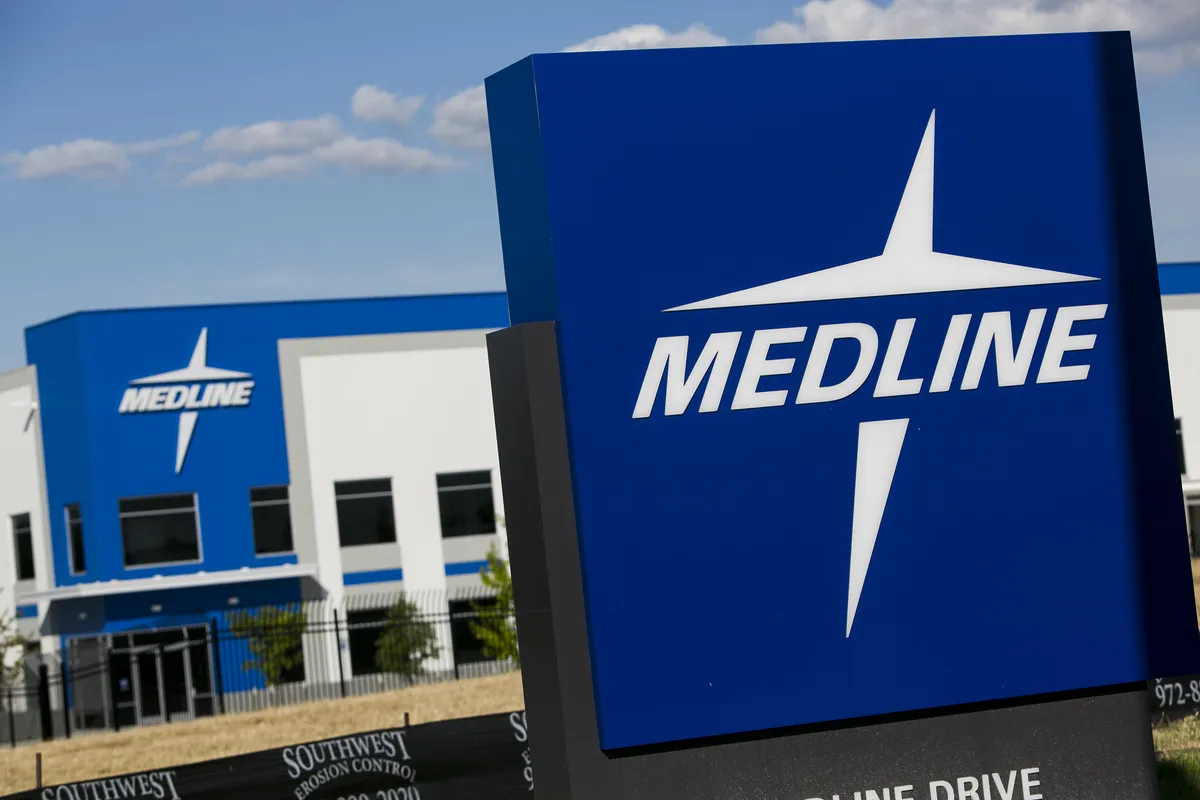
Medline Industries, LP, is a privately held healthcare supply company headquartered in Northfield, Illinois. It offers a wide range of medical and surgical products (gloves, gowns, exam tables, wound care, infection prevention), supply chain services, clinical solutions and analytics to hospitals, clinics, labs, and home care agencies globally.
Founded in 1966 by Jim and Jon Mills, Medline traces its roots back to garment manufacturing and small hospital supply operations, gradually growing through vertical integration and acquisitions over the decades.
Gradually, the company built out a broad catalogue. Today, Medline lists roughly 335,000 products, a large share of which are Medline-branded, selling into more than 100 countries through a mix of direct distribution and channel partners.
In June 2021, a consortium led by private equity firms Blackstone, Carlyle, and Hellman & Friedman acquired a majority stake in Medline in a deal valued at approximately $34 billion. That buyout helped consolidate institutional ownership and set the stage for a future exit via public markets.
Medline is not a first-time issuer. It went public in 1972 and was taken private again by the Mills family in 1977. The 2025 deal is, in effect, a "re-IPO", backed this time by private equity.
From a process standpoint, Medline confidentially filed for a U.S. IPO in December 2024, publicly unveiled its S-1 on October 28, 2025, with updated financials and a clear outline of proceeds usage.
A $5 billion raise and $50 billion valuation would easily place Medline among the largest U.S. IPOs of the year. With IPO markets reviving in 2025, few private companies of this scale remain unpublished.
While healthcare equities have lagged the broader S&P 500 since 2023, valuations are now relatively cheap, and investors are rotating back into the sector as a defensive, cash-generating play.
A large, profitable, non-drug, non-device healthcare platform like Medline offers exposure to utilisation and demographics rather than binary clinical risk, exactly the kind of profile many long-only funds want in a late-cycle tape.
Beyond its headline sponsor group (Blackstone, Carlyle, H&F), Medline has lined up cornerstone investors, suggesting interest in up to $2.35 billion of the offering. The roster reportedly includes big global active managers and sovereign money.
Members of the Mills family and related entities have also signalled plans to buy additional shares in the IPO, which helps align interests and supports bookbuilding.
Medline's combination of manufacturing, distribution logistics, product breadth and analytics-oriented services offers a diversified base. This complexity can be an advantage (higher switching costs, integrated operations) if managed well.
With U.S. IPO activity rebounding but still below the 2021 boom, a large, non-tech listing like Medline stands out on the calendar.
If the deal works, it sends a supportive signal for other PE-backed issuers on deck. If it struggles, bankers will have to recalibrate expectations for 2026 exits.
| Category | Points | Details |
|---|---|---|
| Strengths / Pros | Scale and capacity | Medline has a large manufacturing and distribution footprint, with 20+ plants, 60+ DCs and ~335,000 SKUs sold across 100+ countries. |
| Product diversity & vertical integration | It manufactures many of the goods it distributes, supporting margins and supply resilience. | |
| Recurring revenue & services | Multi-year supply agreements, logistics solutions and value-added services support more stable cash flow than pure spot product sales. | |
| Strong private equity support | Sponsors bring capital, governance, and IPO execution know-how, useful in a volatile macro environment. | |
| Market gaps & fragmentation | The global med-surg supply market remains fragmented, leaving room for Medline to gain share and bolt on smaller distributors. | |
| Risks / Challenges | Leverage and valuation stretch | Pre-IPO, Medline carries mid-teens billions of debt, close to 5x 2024 Adjusted EBITDA, and is asking for a high-teens EV/EBITDA multiple at the top of the range, a premium to many peers. |
| Tariff and policy risk | Higher U.S. tariffs on products from China and other sourcing hubs are expected to cut fiscal-2025 income before taxes by $325–$375 million, with a further $150–$200 million drag in 2026. | |
| Macro / rate sensitivity | If the Fed slows or reverses cuts and risk sentiment fades, IPO valuations could compress quickly, especially for leveraged issuers. | |
| Operational execution post-IPO | Medline must keep integrating acquisitions and managing a complex global supply chain while also delivering deleveraging and margin targets. | |
| Lock-up overhang | Large sponsor positions and family stakes mean significant supply could hit the market once lock-ups expire, potentially capping upside. |
The table above summarises Medline's operational advantages and key IPO risks investors should weigh before listing.
| Case | Implied equity valuation* | Key assumptions | Main risks |
|---|---|---|---|
| Base / "clean issue" | $50–$52 billion | Pricing lands mid-range, book multiple times covered, modest day-one premium. | Macro jitters into pricing; tariff noise; healthcare rotation stalls. |
| Bull / upside | $56–$60+ billion (including first-week pop) | Strong demand from long-only and momentum accounts; rotation into healthcare accelerates; Fed stays dovish. | Valuation rich vs distributors; any disappointment on growth or margins could trigger a sharp de-rating. |
| Bear / downshift | $40–$46 billion | Pricing toward/below bottom of range or smaller size; investors push back on leverage and tariff drag. | Deal downsized or delayed; wider IPO market wobbles; post-IPO trading becomes technical and choppy. |
*Equity valuation ranges above are rough, based on the current field range and public commentary about potential re-sizing.
Should Medline perform effectively and the markets stay favourable, it may surpass predictions. But the margin for error is thin given the scale of expectations.

Here is a checklist of key metrics and disclosures that often determine how the public markets judge an IPO:
Growth Rates & Margins
Revenue Breakdowns
Customer Concentration & Retention
Capital Expenditure and Working Capital Disclosures
Debt & Leverage Structure
Tariffs and Policy Risk
Lock-up Expiry and Overhang
For most retail investors, access to pre-IPO Medline shares remains restricted to:
Certain private-market platforms or feeder funds often have high minimums and complex fee structures.
Co-investment or secondary stakes in funds that already hold Medline exposure.
These are sophisticated, illiquid vehicles; capital is at risk, and timelines are uncertain.
You can gain indirect exposure by investing in:
Blackstone (BX)
Carlyle (CG)
Hellman & Friedman exposure via certain listed vehicles or funds
For Blackstone and Carlyle, Medline is one asset among many, but a successful IPO and aftermarket performance would still be a meaningful mark-up for their funds.
For most investors, the more sensible path is to wait for Medline to list, watch the first few days or weeks of trading, and then decide whether to build a position once:
Price action has settled
Research coverage from the lead banks is available
Management has delivered its first quarterly update as a public company.
This approach sacrifices some upside if the stock gaps higher, but avoids the worst of IPO-day volatility and allocation uncertainties.
Over time, Medline is likely to be included in:
Broad U.S. equity and S&P-linked ETFs;
Healthcare sector and medical-supplies / distribution ETFs.
That route offers diversified exposure to the theme rather than a single-name bet.
Medline has filed for an IPO, intending to list on the Nasdaq under the ticker MDLN and is marketing up to 179 million shares at a proposed price range of US$26–30. While some IPO calendars cite a tentative pricing date of December 16–17, 2025, no official date has yet been confirmed.
Based on the filed terms, Medline plans to sell 179 million shares at $26–$30 each, targeting up to $5.37 billion in gross proceeds. That makes it the largest U.S. IPO of 2025 by deal size.
Medline generated $25.5 billion in net sales and $1.2 billion in net income in 2024, with Adjusted EBITDA of $3.4 billion. In the first nine months of 2025, net sales reached $20.6 billion and net income $977 million, both up year-on-year.
The deal is significant because it is poised to be 2025's largest U.S. IPO and one of the biggest private-equity-backed offerings ever. It also gives public investors access to a core piece of the healthcare supply chain that has historically been privately owned.
In conclusion, Medline's IPO is more than a big healthcare listing; it's a stress test for the late-2025 equity market.
If Medline delivers on growth, deploys IPO proceeds to reduce leverage, and navigates tariff and policy uncertainties, MDLN can trade at a premium to peers.
For most investors, the disciplined approach is simple: read the S-1, watch the price action into and after listing, and size exposure in line with your risk budget rather than the headline hype.
Disclaimer: This material is for general information purposes only and is not intended as (and should not be considered to be) financial, investment or other advice on which reliance should be placed. No opinion given in the material constitutes a recommendation by EBC or the author that any particular investment, security, transaction or investment strategy is suitable for any specific person.