Published on: 2026-01-07
Updated on: 2026-01-07
Stock indexes can rise even when many stocks are not participating. This occurs because many significant indexes are influenced by company size, meaning a few substantial stocks can move the index more than numerous smaller ones.
Market breadth solves that problem by measuring participation. It tells you whether a move is being supported by many stocks or carried by a small group, which helps you judge how durable the trend may be.
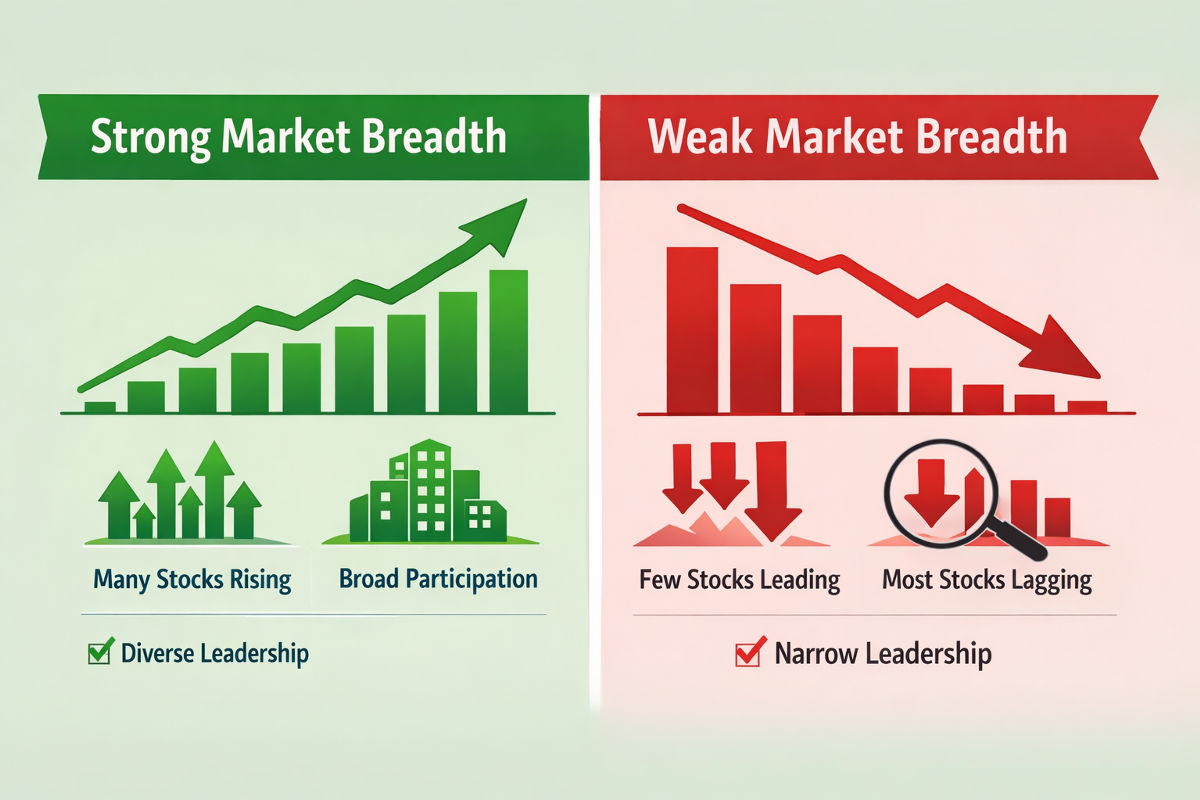
Market breadth is a way to answer one practical question: How many stocks are actually contributing to the market's direction? Price tells you where the index is.
Breadth indicates the extent of participation behind the movement, revealing whether numerous stocks are backing the price change or if a select few leaders are driving it.
Strong breadth: lots of names advancing (and fewer declining), which usually makes the trend more durable.
Weak breadth: gains are narrow, so the price can be more vulnerable if the leading names stall.
In a size-weighted index, the largest stocks can lift the index even if most stocks are flat or falling. When that happens, the headline number can look strong while the average stock struggles.
Breadth acts like a quick health check. It allows you to determine if buyers are engaged throughout the market or if they are focused on a specific theme.
Breadth often weakens before the index visibly breaks down, because participation tends to shrink quietly. This does not predict an immediate drop, but it can signal that conditions are becoming less forgiving.
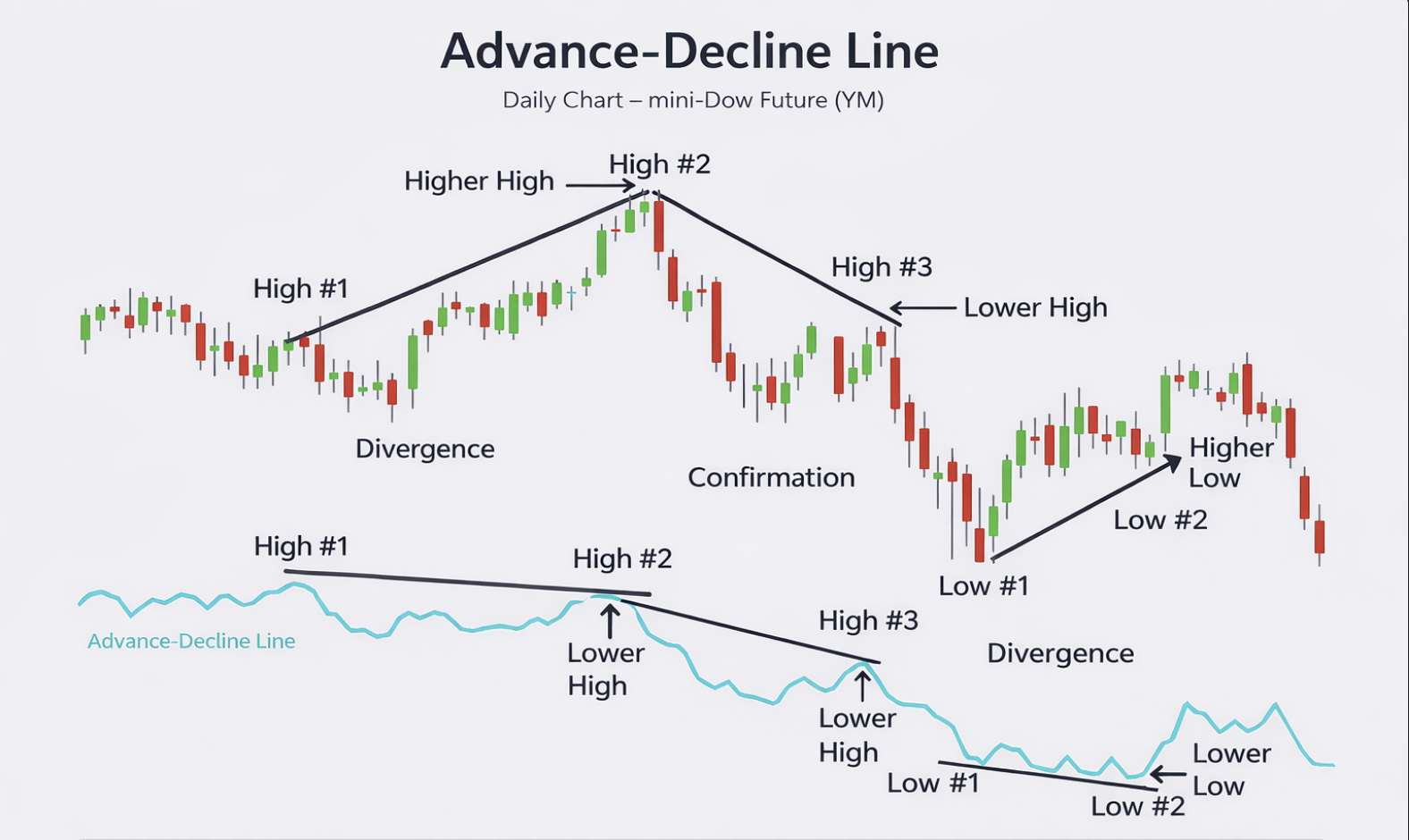
It compares the number of stocks that finished higher versus the number that finished lower over a given session (or period).
Healthy: More advancers than decliners on most days.
Weak: More decliners than advancers on most days.
Warning sign: The index increases as gainers fail to maintain pace over time.
It indicates the number of stocks that are experiencing a long-term upward trend.
Healthy: A large share of stocks stay above their 200-day average.
Weak: Only a small share of stocks remain above their 200-day average.
Warning sign: The index is near highs, but fewer stocks remain in long uptrends.
It measures the number of stocks reaching new highs compared to those reaching new lows over a specific timeframe.
Healthy: New highs are common and spread across sectors.
Weak: New lows stay elevated even when the index looks stable.
Warning sign: New highs shrink to a small cluster of stocks.
It compares a traditional size-weighted index with an equal-weighted variant where each stock holds more uniform significance.
Healthy: Equal-weight performance keeps pace with cap-weight performance.
Weak: Cap-weight performance pulls far ahead, which suggests a narrower set of winners.
| Market condition | What you see in price | What you often see in breadth | What it usually means |
|---|---|---|---|
| Broad uptrend | Index rises steadily | Many stocks rise, and leadership rotates | A healthier, more resilient rally |
| Narrow uptrend | Index rises, often led by a few names | Fewer advancers, fewer new highs, weaker equal-weight | A rally that depends on fewer leaders |
| Broad selloff | Index falls hard | Many stocks break down together | Risk is high, and correlations rise |
| Choppy market | Index moves sideways | Breadth swings but does not trend | A mixed environment with lower clarity |
Breadth is most useful for adjusting risk in a calm, step-by-step way. It is less useful as a precise market-timing tool.
If price is rising and breadth is improving, conditions are generally supportive for staying invested.
If price is rising but breadth is weakening, conditions may be getting riskier, so it can make sense to reduce aggressive bets.
If price is falling and breadth is deteriorating, conditions are usually defensive, making capital preservation more important.
If price is falling but breadth improves, selling pressure may be easing, and the market may be stabilising.
You can reduce position size when breadth weakens, rather than selling everything.
You can diversify exposure when leadership narrows, because concentration risk increases.
You can tighten risk controls when new lows increase, because weak stocks tend to remain weak in downturns.
Treating breadth as a guarantee of what happens next, because markets can stay narrow for long periods.
Relying on one indicator, because each breadth tool captures a different angle of participation.
Ignoring index structure, because a size-weighted index can hide check breadth only after volatility rises, because breadth is most valuable when conditions still look calm.
Checking breadth only after volatility rises, because breadth is most valuable when conditions still look calm.
Compare the cap-weighted index to its equal-weight counterpart to see whether the average stock is keeping pace.
Check whether the advance–decline line is confirming index highs, because confirmation suggests broad participation.
Monitor the percentage of constituents above the 200-day moving average to gauge whether weakness is isolated or widespread.
Review new highs versus new lows to identify whether leadership is expanding beyond the largest names.
Lastly, use these tools to scale risk up or down in steps rather than making all-or-nothing calls, since breadth works best as a regime indicator.
Market breadth measures how widely stocks participate in a market move, rather than focusing only on the index level.
A size-weighted index can rise when a small number of mega stocks rise sharply, even if many smaller stocks are flat or falling.
The advance–decline view is often the easiest, because it simply asks whether more stocks went up than down.
Weak breadth does not guarantee a crash, but it often signals that the market is more dependent on a smaller group of leaders and may be less robust.
In conclusion, Market breadth is crucial because it indicates whether the market's strength is widespread or focused. A market can look strong on the surface while its internal participation quietly weakens.
For beginners, the goal is not perfect prediction. The goal is improved decision-making, because breadth can help you stay confident in healthy trends and be more cautious when the market's foundation starts to narrow.
Disclaimer: This material is for general information purposes only and is not intended as (and should not be considered to be) financial, investment or other advice on which reliance should be placed. No opinion given in the material constitutes a recommendation by EBC or the author that any particular investment, security, transaction or investment strategy is suitable for any specific person.