Published on: 2026-08-05
Updated on: 2026-08-05
AMD reported record quarterly revenue of $11.54 billion on August 4, 2026, projected about $13 billion for Q3, yet its stock fell 8.82% after hours. The quarter beat the FactSet consensus without clearing the expectations created by a 21% five-session rally.
Flat 56% gross-margin guidance and weaker cash conversion shifted attention from how fast AMD is growing to how much profit and cash that growth can produce.
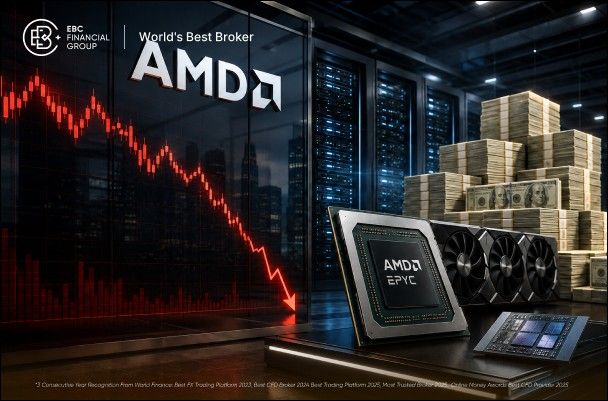
Q2 revenue beat the FactSet consensus by about 2%, too little to sustain a share price that had climbed 21% in five sessions.
Q3 revenue guidance reached $13 billion, while gross margin stayed at 56%, showing that higher sales are not yet lifting gross profit per dollar of revenue.
Data-centre revenue doubled to $6.72 billion, yet free cash flow fell 39% sequentially as capital expenditure more than doubled.
SpaceX’s Nvidia-only decision raised the pressure on Helios, which must now convert strong AI demand into large, profitable deployments.
AMD beat the FactSet consensus by a thin margin. Adjusted earnings reached $1.66 a share against the $1.62 estimate, while revenue of $11.54 billion exceeded the expected total of about $11.3 billion by roughly 2%.
AMD shares had already climbed 21% in five sessions, including 7% on earnings day, building on an earlier AI-infrastructure rally. The after-hours drop erased that entire regular-session gain and pushed AMD below its previous close. The rally had already priced in a much larger surprise.
The sell-off therefore did not signal a weak quarter. It reflected the gap between a modest earnings surprise and a share price positioned for exceptional execution.
AMD expects third-quarter revenue of approximately $13 billion, 13% above Q2 and 41% higher than a year earlier. The midpoint also exceeded the FactSet consensus near $12.54 billion.
Gross-margin guidance remained at 56%, matching the second quarter. AMD is forecasting another sharp revenue increase without improving its gross-margin rate.
Q2 profitability had strengthened. Non-GAAP operating margin rose from 25% to 27%, while operating expenses declined from 31% to 29% of revenue. Q2 efficiency improved. Q3 guidance offered no further margin gain.
The distinction is critical. AMD did not issue weak revenue guidance, as several early reports suggested. The forecast exceeded published estimates, while the unchanged gross-margin outlook reduced the financial value of that upside.
Data-centre revenue increased 107% to $6.72 billion and now represents 58% of AMD’s total sales. With the segment generating more than half of company revenue, slower data-centre growth would hit AMD harder than before.
The quarter-on-quarter comparison shows where the quality gap emerged.
| Metric | Q1 2026 | Q2 2026 |
|---|---|---|
| Revenue | $10.25B | $11.54B |
| Gross margin | 55% | 56% |
| Operating margin | 25% | 27% |
| Free cash flow | $2.57B | $1.56B |
| Capital spending | $389M | $808M |
Revenue and operating margins improved, yet free cash flow fell as capital expenditure more than doubled. Free-cash-flow margin also dropped from 25% to 14%.
AMD is generating record data-centre revenue while committing substantially more capital to support it. Stronger cash flow must follow that spending. Continued revenue expansion with declining cash conversion would make each new dollar of growth less valuable.
Elon Musk said SpaceX would build its AI infrastructure exclusively on Nvidia and called the Vera Rubin platform the best AI computer available. The announcement reinforced concern that strong demand for AI chips does not guarantee customers will move away from Nvidia’s broader platform.
Nvidia’s advantage extends beyond hardware performance. CUDA includes compilers, libraries, optimisation tools and deployment infrastructure already used across data centres and cloud platforms. AMD’s open ROCm platform provides its own runtimes, libraries and framework integrations, though it narrows the software barrier only if large workloads run without sacrificing reliability or performance.
SpaceX represents one competitive setback, not a verdict on AMD’s wider pipeline. AMD says Helios is being deployed by Anthropic, Meta, Microsoft, OpenAI and Oracle, while the Anthropic agreement covers up to 2 gigawatts of MI450 systems.
AMD has proved it can secure major AI customers. Helios now has to turn those wins into large, profitable deployments.
AMD’s revenue beat consensus by only about 2% after a 21% five-session rally. The earnings surprise was too small to sustain a share price already positioned for a much stronger result.
No. The $13 billion midpoint exceeded the FactSet consensus near $12.54 billion and implied 41% annual growth. The concern came from gross-margin guidance remaining at 56%.
Free cash flow fell because operating cash flow declined from $2.96 billion to $2.37 billion while capital expenditure more than doubled to $808 million. Higher revenue and margins were outweighed by weaker cash generation and heavier investment.
Not by itself. SpaceX reinforced Nvidia’s ecosystem advantage, while AMD still has major Helios deployments involving Anthropic, Microsoft, Meta and OpenAI.
AMD’s next report must show that gross margin can rise above 56%, free cash flow can recover and Helios deployments can reach meaningful scale. Another revenue record without stronger margins or cash generation would confirm the concern behind the sell-off.