Published on: 2026-04-09
Updated on: 2026-04-09
In 2026’s fast-moving stock market, understanding the right order type can make a significant difference between capturing gains and missing opportunities. Two popular order duration types, GTC (Good ‘Til Cancelled) and GTD (Good ‘Til Date), allow traders to control how long their orders remain active. Selecting the right option can help investors automate trades, manage risk, and align execution with market events.
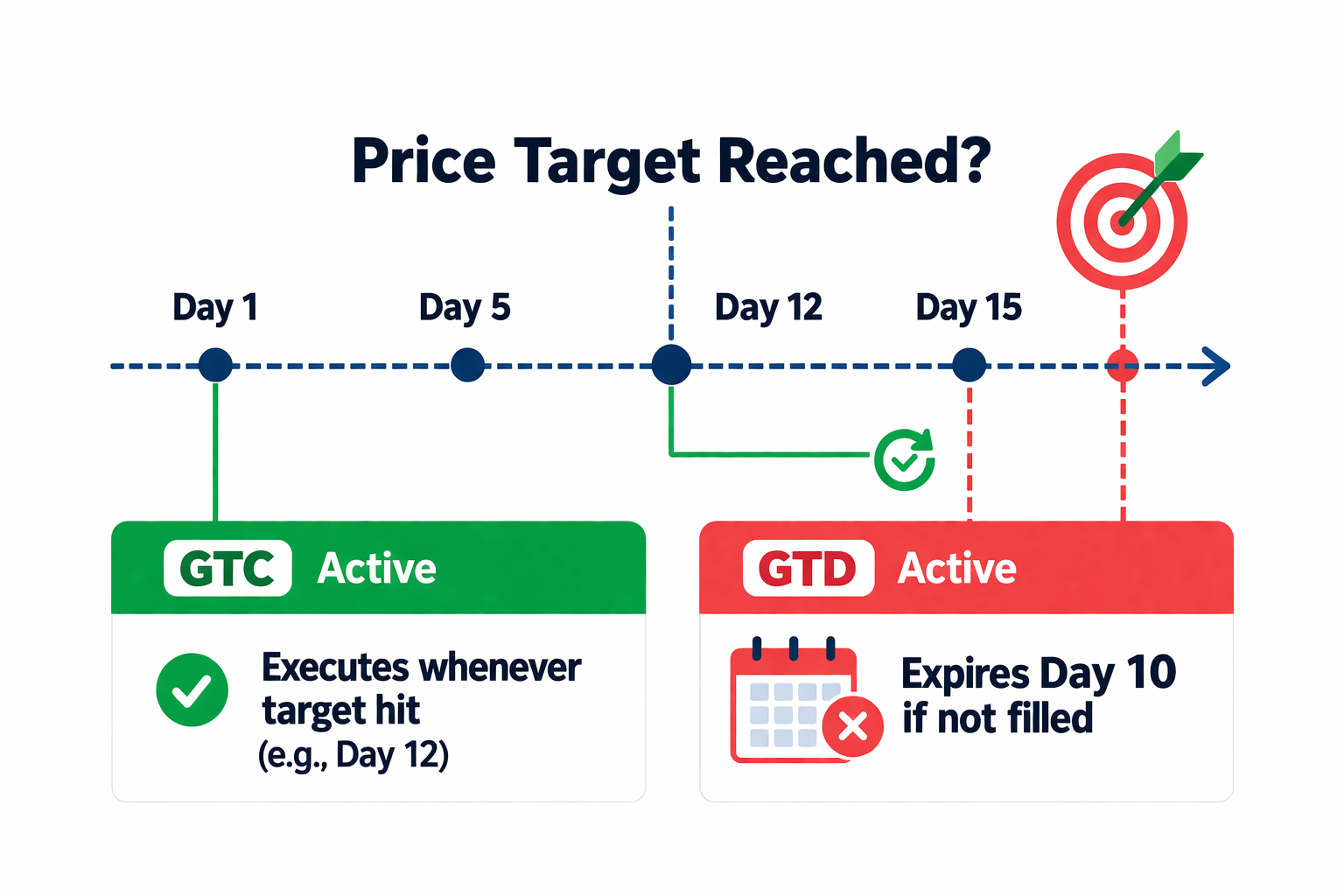
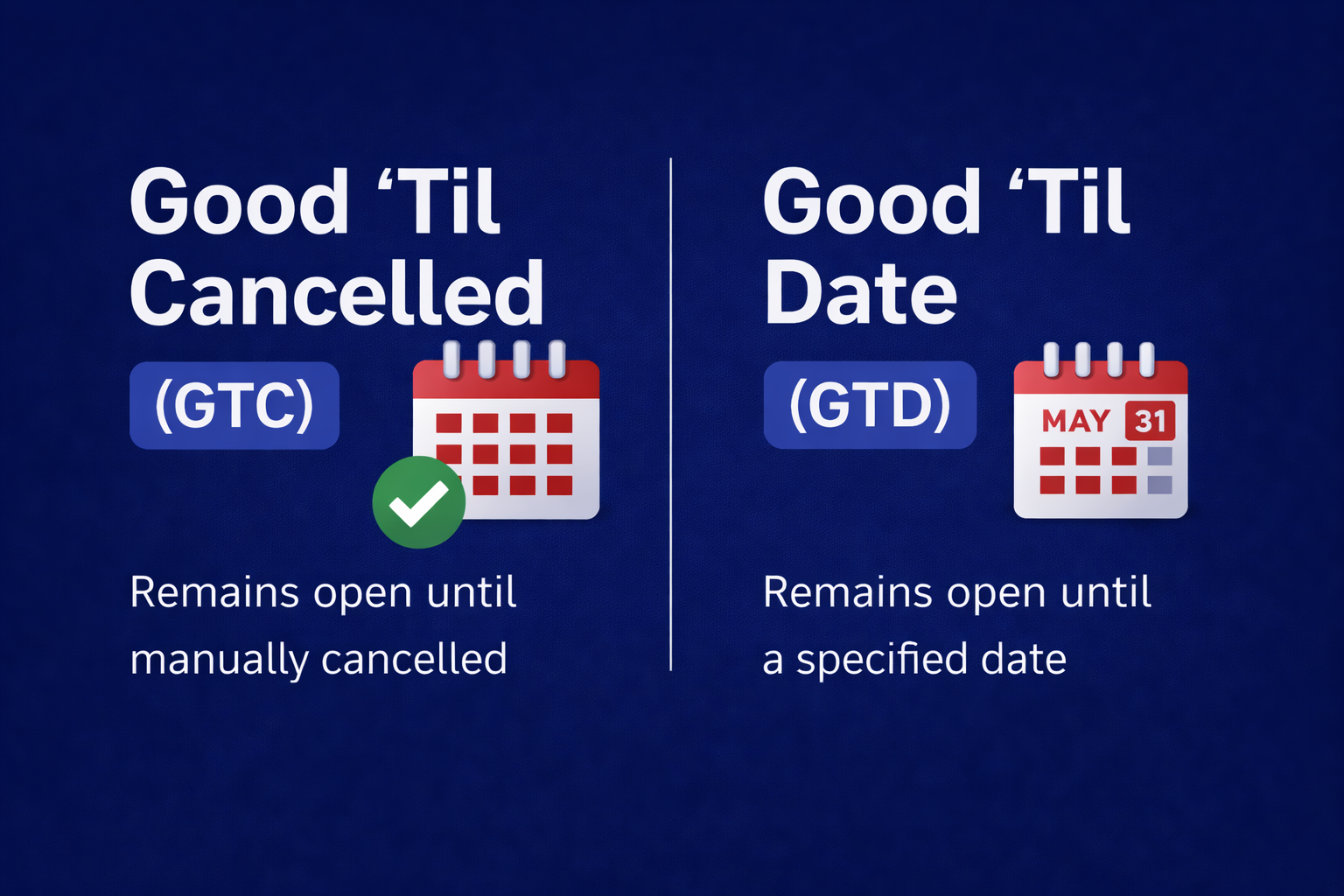
GTC orders remain active indefinitely until executed or cancelled, making them ideal for long-term strategies.
GTD orders expire on a specific date, providing precise control over short-term or event-driven trades.
The choice depends on trading style, market volatility, and investment goals.
Using these orders strategically reduces the need for constant market monitoring.
Real-world examples, like AAPL and TSLA trades in 2026, illustrate the practical benefits of each order type.
A GTC order stays active until it is either executed or manually cancelled by the trader. Unlike day orders, which expire at the end of the trading session, GTC orders allow investors to target specific price points over an extended period.
Example:
Suppose an investor wants to buy Apple Inc. (AAPL) at $170 while it trades at $180 in April 2026. By placing a GTC limit order at $170, the order remains active until AAPL reaches that price or the trader cancels it, even if it takes weeks or months.
Advantages of GTC Orders:
Reduces the need for daily monitoring.
Ideal for long-term investors targeting specific price levels.
Useful during periods of market volatility to automatically capture dips.
Considerations:
May execute during short-term price fluctuations.
Investors should review open GTC orders periodically to ensure alignment with evolving market conditions.
Actionable Tip:
Check GTC orders monthly, especially during periods of high market volatility, to ensure they remain aligned with your investment strategy.
A GTD order is active only until a specific expiration date. If the order isn’t executed by that date, it is automatically cancelled. This feature is particularly valuable for trades tied to short-term events or market catalysts, such as earnings reports, economic data releases, or geopolitical developments.
Example:
An investor anticipates Tesla Inc. (TSLA) might drop to $650 before its May 15, 2026, earnings release. By setting a GTD order expiring on May 14, the order avoids post-earnings volatility and executes only if the target price is reached within the intended timeframe.
Advantages of GTD Orders:
Offers precise control over execution timing.
Limits exposure to prolonged market uncertainty.
Ideal for event-driven strategies where timing is critical.
Considerations:
May expire unfilled if the price target isn’t reached.
Requires careful planning to align expiration dates with anticipated market movements.
Actionable Tip:
Align GTD expiration dates with market events, such as earnings releases or central bank announcements, to avoid unintended execution or missed opportunities.
Targeting a long-term price level, e.g., buying SPY ETF on a dip during a 2026 market correction.
Reducing daily trading management.
Capturing market swings over weeks or months without manual intervention.
Trading around time-sensitive events, like quarterly earnings or macroeconomic releases.
Implementing strategies with strict deadlines to control exposure.
Avoiding unintentional executions during extended volatility periods.
Technically, no. While "cancelled" is in the name, most brokerage firms have a maximum limit, typically 30, 60, or 90 days. If the order isn't filled by then, the broker will automatically purge it. It is a good idea for traders to check their "Open Orders" tab once a month.
Yes. Most platforms allow you to "Replace" or "Modify" an order. However, keep in mind that changing the price or quantity may reset your priority in the order queue. In high-volume markets, this "reset" could mean someone else gets filled before you if the price briefly touches your target.
This is a great "pro-level" FAQ. Generally, if a stock undergoes a split or a dividend adjustment, the broker will automatically adjust the price and quantity of a GTC order to reflect the new market reality. However, some brokers may simply cancel the order and ask the user to resubmit it.
It depends on your strategy. A Day Order is better for active day traders who don't want the risk of an order executing overnight while they aren't watching. GTC is better for investors who have a firm "buy" or "sell" price in mind and are willing to wait weeks for the market to reach it.
Usually, no. Standard GTC and GTD orders are typically restricted to Regular Trading Hours (RTH). To trade outside these hours, you usually have to select a specific "Extended Hours" toggle, regardless of the expiration date you've chosen.
In the modern era of commission-free trading, there is usually no extra cost. You are only charged (or not charged) based on the execution of the trade itself, not the "Time-in-Force" instruction you chose.
GTC and GTD orders are essential tools for traders looking to automate and optimize their strategies. GTC orders offer flexibility for long-term price targets, while GTD orders provide control for event-driven or time-sensitive trades. Understanding the nuances of these order types, combined with market context, can enhance decision-making and execution efficiency.
Disclaimer: This material is for general information purposes only and is not intended as (and should not be considered to be) financial, investment or other advice on which reliance should be placed. No opinion given in the material constitutes a recommendation by EBC or the author that any particular investment, security, transaction or investment strategy is suitable for any specific person.