Published on: 2026-04-03
Updated on: 2026-04-03
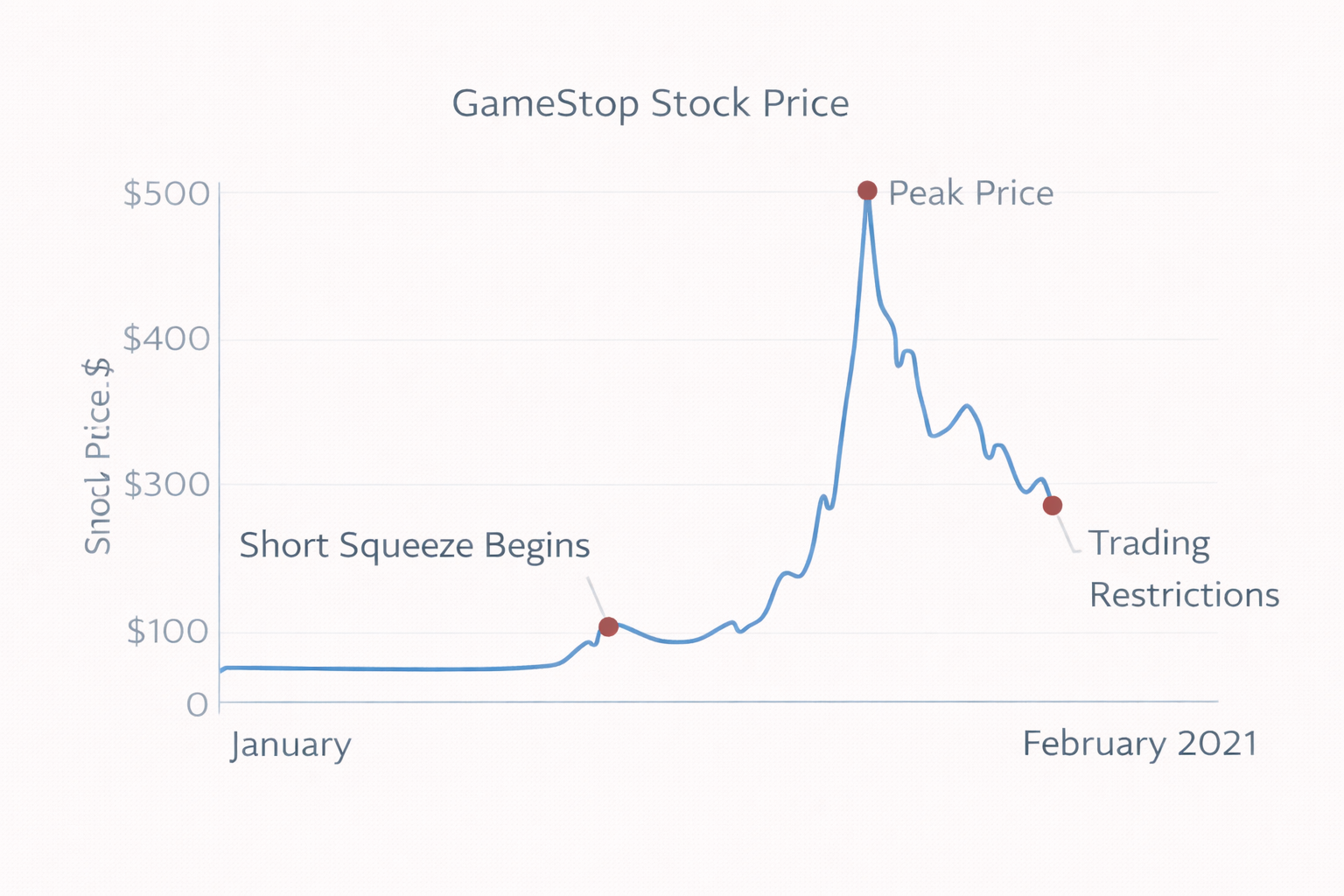
In January 2021, GameStop surged from under $20 to nearly $500 within weeks, triggering billions in losses for hedge funds and forcing trading restrictions across major platforms. What initially appeared to be a retail-driven rally quickly evolved into a real-world stress test of modern financial market structure, exposing how liquidity, clearing systems, and investor behaviour can interact under extreme conditions.
Market structure can amplify volatility during periods of stress.
Clearing and settlement systems are critical to maintaining market stability.
Liquidity constraints can affect both brokers and traders.
Behavioural forces can drive prices far beyond fundamental value.
Effective risk management must account for both structural and psychological risks.
Prior to the squeeze, GameStop exhibited exceptionally high short interest, exceeding 100% of its publicly available float. This reflected a heavily crowded trade, where multiple institutional investors held similar bearish positions.
Hedge funds, including Melvin Capital, viewed GameStop as a structurally declining business due to the rise of digital distribution. However, this consensus positioning created systemic vulnerability; any upward price movement could force rapid unwinding.
Retail investors, many from r/WallStreetBets, identified this imbalance and began aggressively purchasing shares and call options.
This introduced two important dynamics:
Direct buying pressure on the stock
Indirect pressure via options hedging by market makers
These forces combined to create the conditions for rapid, self-reinforcing price escalation.
As GameStop’s price began rising, short sellers were forced to buy back shares to limit losses. This additional demand pushed prices higher, triggering further short covering.
At the same time, market makers who sold call options hedged their exposure by purchasing the underlying stock. As prices rose, hedging activity intensified, adding further upward momentum.
Together, these mechanisms created a powerful feedback loop that drove the stock’s rapid ascent.
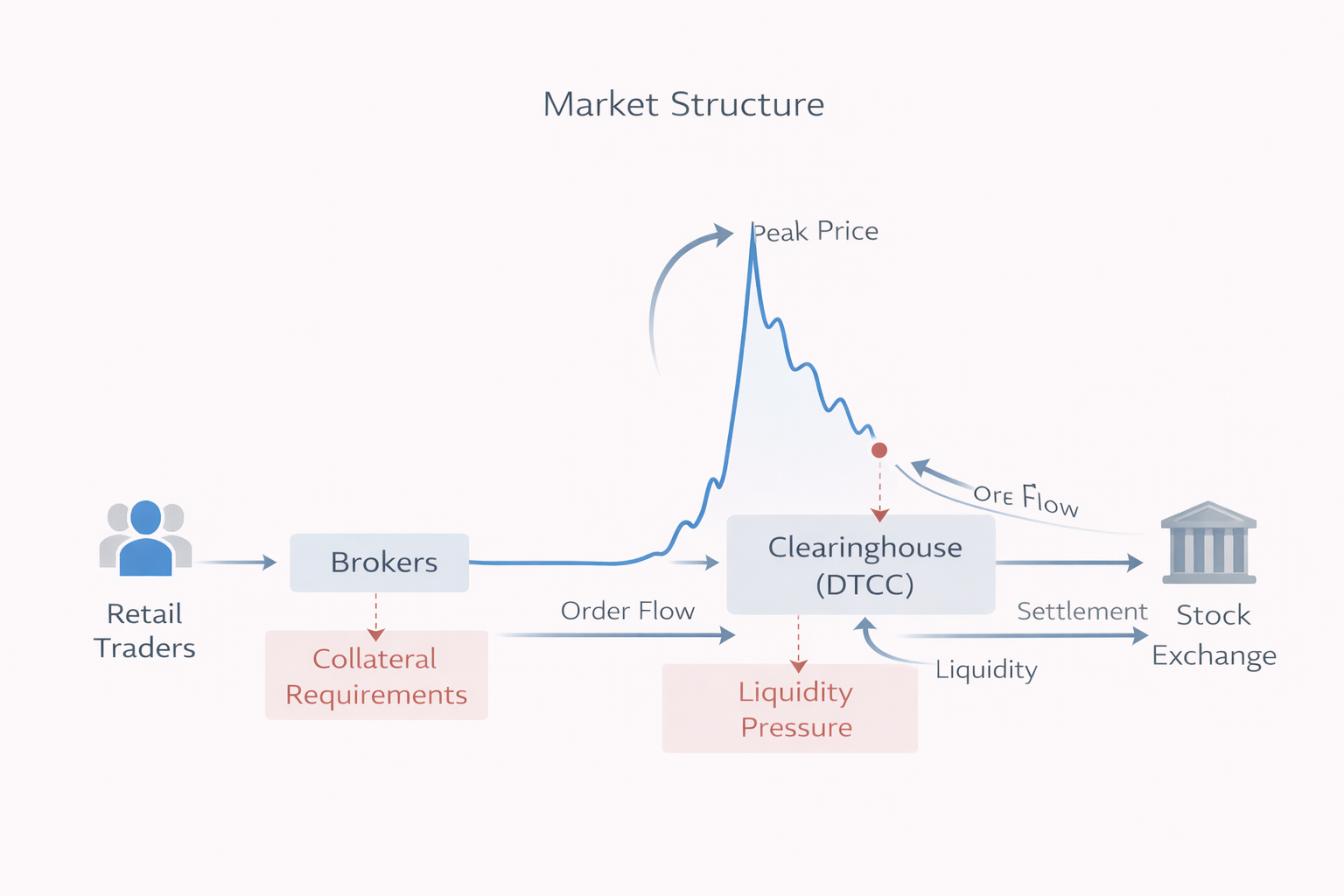
The GameStop episode is best understood as a breakdown in how different components of the financial system interact under pressure.
Organisations such as the Depository Trust & Clearing Corporation (DTCC) are responsible for ensuring that trades settle even if one party defaults.
During periods of extreme volatility, clearinghouses increase collateral requirements to manage risk exposure. In the case of GameStop, these requirements rose sharply due to:
Elevated price volatility
Concentrated trading activity
Increased counterparty risk
Importantly, clearinghouses do not anticipate risk—they respond to it. This reactive framework can create sudden liquidity demands across the system.
Retail brokers, such as Robinhood, were required to meet these heightened collateral requirements.
To manage this pressure, some brokers restricted the purchase of GameStop shares. While controversial, these actions were largely driven by:
Limited immediate access to capital
The need to comply with clearinghouse requirements
Risk management obligations to maintain operational stability
This highlighted the dependency of retail trading platforms on broader market infrastructure.
As volatility surged, market liquidity deteriorated significantly.
This environment led to wider bid-ask spreads, execution delays, and increased price dislocations.
The severity of the GameStop event was amplified by weaknesses in risk management at multiple levels.
Hedge funds underestimated:
The dangers of crowded trades
The speed of sentiment-driven price movements
The asymmetric risk of short positions
The experience of Melvin Capital demonstrated how quickly losses can escalate when positioning becomes one-sided.
Retail participants also faced significant challenges:
Entering positions at elevated price levels
Limited understanding of volatility and liquidity risks
Absence of disciplined exit strategies
While early participants benefited, many late entrants incurred substantial losses during the subsequent decline.
The GameStop phenomenon was not purely structural, it was also deeply psychological.
Fear of Missing Out (FOMO): Rapid price increases attracted new participants
Herd Behaviour: Investment decisions were influenced by collective sentiment
Narrative Investing: The “retail versus institutional” storyline amplified engagement
These behavioural forces contributed to price movements that diverged significantly from underlying fundamentals.
The GameStop episode highlighted the emergence of “meme stocks”—companies whose trading activity is driven largely by social media and online communities rather than fundamentals. Platforms like r/WallStreetBets amplified retail participation, creating rapid, sentiment-driven price surges.
From a market structure perspective, meme stocks can strain liquidity, increase volatility, and amplify hedging flows, as brokers and market makers adjust to sudden surges in demand. This phenomenon illustrates a shift in modern markets: investor attention and collective behaviour can now significantly influence price movements, alongside traditional fundamental factors.
Although the GameStop episode occurred in 2021, its implications remain highly relevant in today’s market environment.
Retail participation remains elevated across global markets.
Options trading volumes continue to influence price dynamics.
Regulatory scrutiny of brokers and market practices has increased.
Digital platforms enable faster distribution of information and misinformation.
Even in 2026, similar conditions can emerge in assets with:
High short interest
Concentrated positioning
Strong narrative-driven momentum
For modern investors, the GameStop episode offers several actionable insights:
Avoid excessive exposure to crowded trades.
Monitor positioning indicators such as short interest.
Assess liquidity conditions before entering volatile assets.
Apply disciplined position sizing to manage downside risk.
Establish clear entry and exit strategies in advance.
The GameStop episode demonstrated that market risk is no longer driven solely by fundamentals or macroeconomic factors. Structural dynamics and behavioural forces can dominate price action, particularly in digitally connected markets where information spreads rapidly, and participation barriers are low.
The squeeze was driven by a combination of excessive short interest, aggressive retail buying, and options-related hedging by market makers. These forces created a feedback loop that rapidly pushed prices higher.
Brokers faced sharply increased collateral requirements from clearinghouses, which required immediate capital. To manage liquidity risk and meet regulatory obligations, some platforms temporarily restricted buying activity.
Clearinghouses ensured that trades could settle despite extreme volatility. By increasing collateral requirements, they reduced systemic risk but also contributed to liquidity pressure on brokers.
A gamma squeeze occurs when market makers hedge call option exposure by buying the underlying stock. As prices rise, additional hedging increases demand, accelerating upward price movement.
Yes, similar conditions can arise in assets with high short interest and strong retail participation. While regulatory changes may mitigate some risks, structural and behavioural dynamics remain present in modern markets.
The GameStop short squeeze was not merely a speculative anomaly; it was a structural stress test that revealed how modern financial systems behave under pressure. As markets continue to evolve, understanding these underlying structures is essential. It demonstrated that liquidity, clearing mechanisms, and investor psychology can collectively drive extreme market outcomes.
Disclaimer: This material is for general information purposes only and is not intended as (and should not be considered to be) financial, investment or other advice on which reliance should be placed. No opinion given in the material constitutes a recommendation by EBC or the author that any particular investment, security, transaction or investment strategy is suitable for any specific person.