Published on: 2026-03-24
Meme stock mania is back in 2026, and this time the market cannot pretend it is a surprise. The infrastructure that powered the first wave never disappeared.
Retail traders still have zero-commission trading apps, instant access to market commentary, and an options market capable of turning online buzz into a violent price swing within a single session.
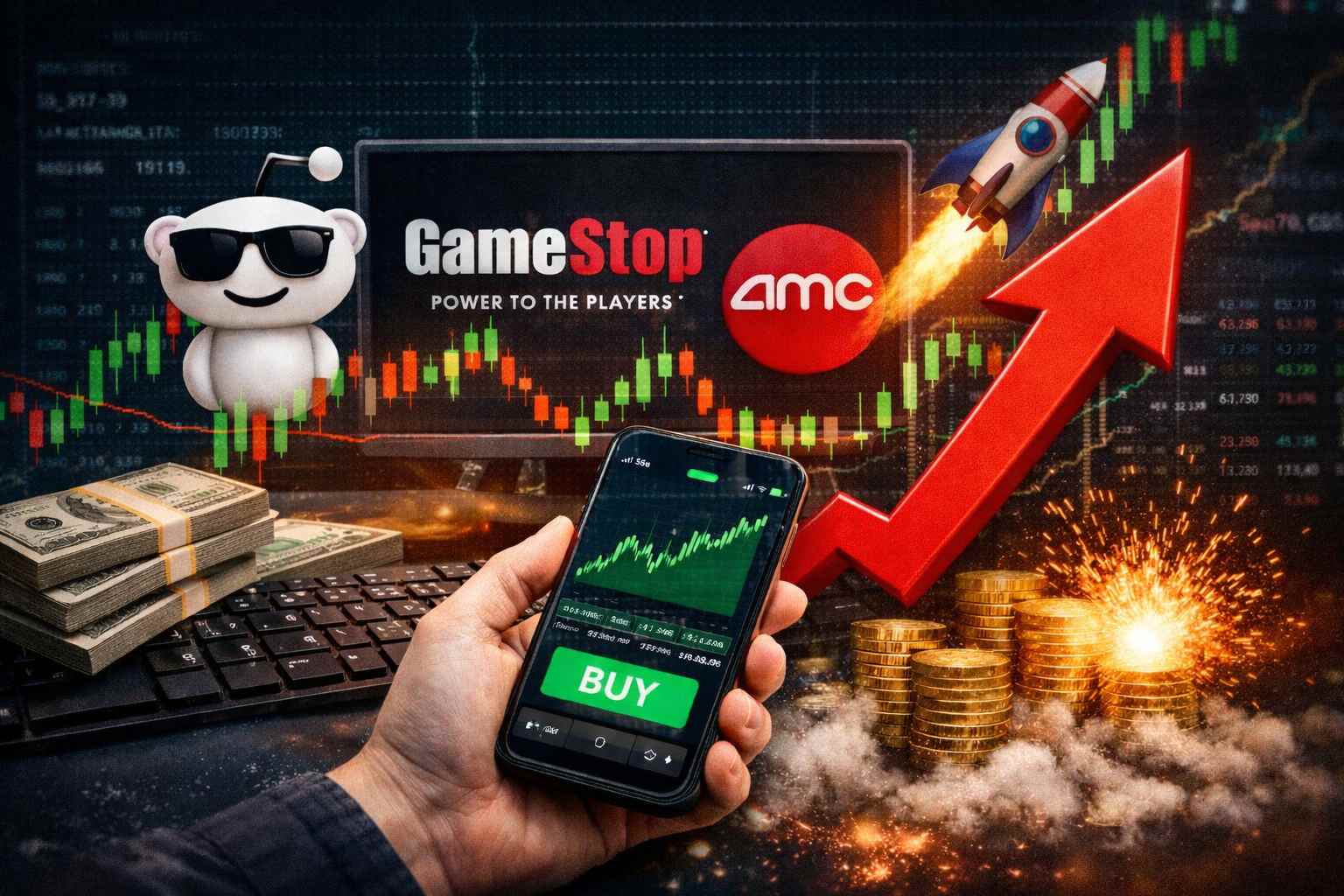 A new wave of meme stocks, such as Opendoor and Kohl's, emerged as recently as 2025. That year, retail trading hit new highs, rising almost 60% from the year before and about 17% above the peak during the 2021 meme-stock craze.
Meme stock mania happens when retail investors use social media to work together and push a stock’s price far above its real value. This is driven by viral hype and group excitement, not by careful financial analysis.
A meme stock is any public company whose price is driven higher by online buzz and retail excitement rather than by its earnings, growth, or financial health. The cycle usually follows the same pattern:
A stock with high volatility, high short interest, or a strong online following starts trending
Retail traders pile in through shares and short-dated call options
Price jumps quickly, drawing in momentum traders and late arrivals
Market makers hedge options exposure by buying stock, adding more upward pressure
Short sellers may begin covering, which can intensify the move
The momentum eventually fades, liquidity thins, and the stock reverses hard
Importantly, fundamentals still matter, but they are not the main factor at first. First comes visibility, then liquidity, and fundamentals are often a distant third, if they matter at all early on.
The current era of meme stocks began in January 2021, when retail traders on Reddit’s WallStreetBets forum joined forces to buy GameStop, a heavily shorted video game retailer at the time.
The GameStop saga became a global market event that inspired the 2023 film "Dumb Money," and figures like Keith Gill, known online as Roaring Kitty, emerged as focal points for a loosely coordinated community that shared research, trading strategies, and a deep skepticism of Wall Street orthodoxy.
It was widely dismissed at the time as a one-off anomaly. It was not. The same playbook has been repeated multiple times since, across different tickers, different sectors, and now, even different asset classes entirely.
The simple reason is that the systems and tools that made meme stock mania possible never disappeared.
The retail surge of the pandemic years did not vanish once volatility cooled. Many traders stayed active, better informed, and more familiar with how market structure works. Some lost money and learned caution. Others gained confidence and stayed engaged.
The conditions that support meme stock mania are still firmly in place:
Zero-commission trading keeps participation friction low
Social media spreads trade ideas instantly
Mobile apps make execution immediate
Options access gives retail traders leverage once reserved for professionals
Market data and commentary are now widely available in real time
On busy trading days, retail investors can make up almost 40% of stock trading and up to 50% of options trading. This is not just a small part of the market, it is a major force in daily price changes.
The movement has grown larger, and now it targets more than just struggling retail companies.
GameStop, Trump Media (DJT), and Reddit (RDDT) remain among the heavy hitters for 2026, but the list has expanded to include AI turnaround plays like Intel (INTC) and high-growth fintechs like SoFi.

In 2026, investor confidence has returned. Better economic conditions, stronger growth expectations, and a move toward more cyclical investments have encouraged people to take more risks.
Market leaders now include not just the biggest companies, but also more volatile stocks.
Most notably, meme-style trading has moved beyond stocks. In 2026, even physical commodities like crude oil have become targets, with retail investors buying a record $211 million in oil ETFs on March 12, beating the previous record set in May 2020.
Options are not just part of meme stock mania. In many cases, they are the accelerant that turns a busy trade into a full-scale squeeze.
When retail traders buy large volumes of short-dated call options, dealers who sold those contracts often need to hedge by buying the underlying shares. If the stock starts moving up, the dealers may need to buy even more stock to stay hedged.
That is how a gamma-driven rally can form.
The result is a feedback loop:
call buying pushes dealers to buy stock
stock buying pushes the price higher
a higher price makes the call options more sensitive
dealers buy more shares
momentum traders notice the move and jump in
This can happen before short sellers cover in any meaningful size.
That is why meme stock mania often feels more compressed and more violent than a normal speculative rally. It is not just retail enthusiasm pushing a stock higher. It is market plumbing reacting to leveraged order flow.
In past cycles, many investors focused only on the short squeeze angle. That was too narrow. Short covering matters, but options-related hedging is often the first mechanical force that gives the rally its speed.
The most common mistake investors make during meme stock mania is confusing attention with quality.
A stock can trend for days without becoming a stronger business. A viral rally does not improve margins, fix a weak balance sheet, or create durable cash flow. It simply changes the price.
That said, not every stock caught in a meme wave is fundamentally hopeless. Some companies do improve. Some clean up debt, preserve cash, reduce losses, or stabilize operations. When that happens, the meme narrative gains a firmer foundation, even if the rally remains speculative.
One recurring pattern in meme stock mania is that weaker companies often use rallies to issue more shares. That can solve a near-term funding problem, but it does not necessarily improve the business. It often shifts value away from existing shareholders through dilution.
By contrast, companies with cleaner balance sheets and improving operations are more likely to retain some credibility after the rally fades.
The lesson is simple. Price can detach from fundamentals for a while. It rarely stays detached forever.
Meme stock mania refers to the phenomenon where retail investors, coordinating largely through social media platforms, collectively drive up the price of a stock far beyond its fundamental value through hype, humor, and shared sentiment rather than traditional financial analysis.
Online attention, elevated call-option activity, momentum buying, and short covering can converge rapidly, compressing what might otherwise take months into days.
No. Short covering can add fuel, but many rallies begin with call-option flows and retail buying well before meaningful short covering occurs.
Yes. Buying and discussing stocks publicly is legal. Fraud, market manipulation, and false promotion are not.
Look at the balance sheet, the cash position, and whether the company is issuing new shares. A real move has a fundamental anchor. A meme rally is sustained entirely by attention, and attention is finite.
Meme stock mania is no longer unusual. It is now a regular part of today’s markets, created by the mix of large retail trading, social media influence, and an options market that can turn any momentum trade into something much bigger.
The main takeaway is simple: attention can move stock prices, but it cannot build a strong business. Companies with real financial strength are the ones that usually survive these cycles.
Companies without strong finances often use hype to raise money, which helps them in the short term but can hurt shareholders who join in.
Disclaimer: This material is for general information purposes only and is not intended as (and should not be considered to be) financial, investment or other advice on which reliance should be placed. No opinion given in the material constitutes a recommendation by EBC or the author that any particular investment, security, transaction or investment strategy is suitable for any specific person.