Published on: 2026-06-25
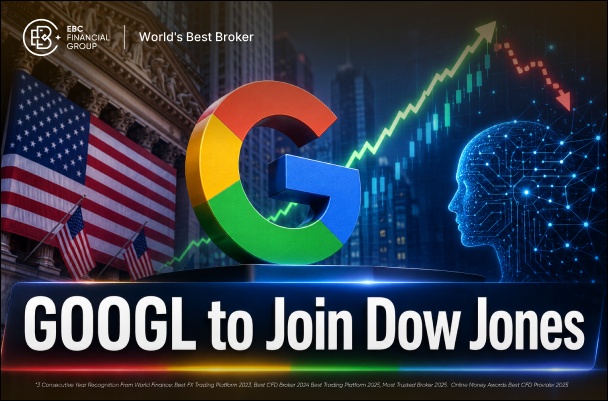
Class A shares (GOOGL) are set to replace Verizon in the Dow before market open on 29 June 2026.
Verizon’s weight had fallen to roughly 0.5% because the price-weighted Dow discounts low-priced constituents regardless of market value.
GOOGL near $345.29 against Verizon near $45.68 gives Alphabet far greater index influence at current prices.
Inclusion lifts Alphabet’s blue-chip profile but is unlikely to drive a standalone rerating, given how widely the stock is already held across broad indexes.
The active debate concerns AI: Search monetization, AI Overview economics, Cloud margins, capital intensity, talent retention, and antitrust exposure.
Full-year 2026 capex guidance has been raised to $180 billion to $190 billion, marking a structurally heavier investment phase. [3]
Alphabet (NASDAQ: GOOGL) is set to replace Verizon in the Dow Jones Industrial Average before the U.S. market opens on Monday, 29 June 2026, making the index shift a recognition event rather than a resolved investment thesis. The change retires a carrier whose low share price has left it a negligible factor in the price-weighted index. [1]
The inclusion confirms Alphabet’s standing among the defining companies in the U.S. economy, yet GOOGL stock continues to trade on a harder question: whether Google can convert AI into a durable growth engine without eroding the margin structure of Search.
The most recent quarter delivered $109.9 billion in revenue, up 22%, with Search and other revenue rising 19% and Google Cloud revenue rising 63% to $20.0 billion. [2] The shares were down about 11.5% over the past month, with weakness coinciding with investor scrutiny of AI spending, competition, and Search monetization risk.
The change will realign the index with the modern corporate base, swapping legacy connectivity for a constituent spanning digital advertising, cloud infrastructure, artificial intelligence, hardware, autonomous mobility, healthcare technology, and media distribution. S&P Dow Jones cited that breadth, together with Alphabet’s higher share price, in selecting it as the stronger Communication Services representative. [1]
Because the Dow weights by price rather than market capitalization, a constituent’s influence tracks its nominal share price. Verizon's low price has held it to roughly half a percentage point of the index despite a market value above $190 billion, whereas Alphabet near $345 will carry materially greater daily influence.
The promotion will raise Alphabet’s visibility and seat it alongside Microsoft, Apple, Amazon, Nvidia, JPMorgan, and Goldman Sachs without altering its underlying earnings power.
Index reconstitution generates short-term volume as Dow-linked funds rebalance and traders position around the effective date, but the structural demand is limited.
Alphabet already sits in the S&P 500, the Nasdaq 100, communication-services ETFs, and most growth and AI mandates. The S&P 500 had about $20.16 trillion indexed or benchmarked to it at year-end 2024, compared with about $115.3 billion tied to the Dow Jones Industrial Average, which limits the mechanical demand created by a Dow-only inclusion. [4]
Dow additions often confirm prior market leadership rather than create a new earnings catalyst, and historical studies of Dow changes show mixed post-addition performance. The stronger investment case still needs to come from Alphabet’s fundamentals rather than index mechanics.
The more durable effect is on positioning: inclusion will reframe Alphabet as infrastructure underpinning advertising, enterprise computing, mobile operating systems, video distribution, and AI, supporting sentiment while leaving intact the valuation risk embedded in a 26x earnings multiple.
| Metric | Latest Data | Investor Interpretation |
|---|---|---|
| GOOGL share price | $345.29 | Higher nominal price gives Alphabet meaningful Dow influence |
| Alphabet market cap | $4.18 trillion | Far larger than Verizon, though market cap does not drive Dow weight |
| Verizon share price | $45.68 | Low nominal price limited Verizon’s Dow impact |
| Verizon market cap | $192.3 billion | Still large, but no longer representative enough for the index role |
| Alphabet P/E | 26.3x | Valuation depends on AI growth and Search margin durability |
| Alphabet Q1 2026 revenue | $109.9 billion | Revenue rose 22% year over year |
| Google Cloud Q1 revenue | $20.0 billion | Cloud revenue rose 63%, strengthening the AI platform case |
| Q1 free cash flow | $10.1 billion | Capex is absorbing more operating cash flow |
At current prices Alphabet’s Class A shares trade at roughly 7.6 times Verizon’s, the differential that translates directly into index weight under price weighting.
The central question for GOOGL is not whether Search survives but whether it remains as cheap to operate and as profitable to monetize as AI-generated answers proliferate. AI Overviews, AI Mode, Gemini, and agentic experiences can deepen engagement while simultaneously altering click behavior, publisher referral economics, ad placement, and per-query compute costs.
Independent research illustrates the sensitivity: one study found AI Overviews generated for 51.5% of representative real-user queries, while another measured 13.7% overall activation across queries and 64.7% on question-form queries. These findings do not establish revenue erosion, but they document a rapidly shifting search interface.
Alphabet’s disclosures cut the other way. Search queries hit an all-time high in Q1 2026 alongside 19% revenue growth, and management reported that the cost of core AI responses fell more than 30% after migrating AI Overviews and AI Mode to Gemini 3. Rising usage paired with falling inference costs would render AI accretive to Search, whereas persistent click loss or compute intensity outrunning monetization would compress the segment’s margins. [3]
Cloud offers a cleaner growth narrative than Search because it expands a new profit pool rather than defending an existing one. Q1 revenue rose 63% to $20.0 billion, operating income reached $6.6 billion, and operating margin expanded to 32.9% from 17.8% a year earlier. Backlog of roughly $462 billion, comprising contracted commitments rather than pipeline, reflects enterprise AI demand and TPU-related agreements and lends visibility to forward revenue. [2]
The segment broadens Alphabet’s AI surface beyond advertising to infrastructure, enterprise software, Workspace features, security through Wiz, and TPU capacity. The rerating case hinges on whether that growth proves profitable after depreciation, energy, chip procurement, and data-center expansion, rather than merely capital-intensive.
The economics of the AI buildout are now visible in the cash statement. Q1 capex reached $35.7 billion, concentrated in technical infrastructure, while free cash flow was $10.1 billion for the quarter and $64.4 billion on a trailing-twelve-month basis. Compared with Q1 2025 implied free cash flow of about $19.0 billion, quarterly free cash flow fell roughly 47% as capex more than doubled. [2][3]
Reported net income rose 81% to $62.6 billion, but that figure was boosted by a $36.9 billion net gain on equity securities, which increased net income by $28.7 billion after tax, leaving free cash flow the cleaner gauge of cash generation. [2]
Guidance of $180 billion to $190 billion for 2026, raised from $175 billion to $185 billion and accompanied by a signal that 2027 capex will rise significantly, marks a departure from the asset-light Search model that historically underwrote Alphabet’s premium cash conversion.
The June equity raise reinforced the shift: an upsized $84.75 billion package spanning common stock, mandatory convertible preferred securities, a $40 billion at-the-market program, and a $10 billion private placement by Berkshire Hathaway. Tapping external equity at one of the most cash-generative companies in the market signals both the scale of AI infrastructure demand and the tightening constraint on internally funded growth. [3][5]
Regulatory exposure is unchanged by the Dow entry. The 2025 remedies in the U.S. search case bar Google from exclusive distribution contracts covering Search, Chrome, Google Assistant, and the Gemini app, and compel it to share certain search-index and user-interaction data with rivals. [6]
The framework avoided a forced Chrome divestiture, but appeals remain live, and the contested terrain of default placement, browser access, Android leverage, and Gemini distribution intersects directly with the AI strategy. Weaker default distribution would force greater reliance on product quality, user habit, and ad relevance to defend Search volume.
Alphabet’s Dow inclusion will strengthen the index’s exposure to the digital and AI economy and add another layer of blue-chip legitimacy without repricing the equity. The next durable move in GOOGL depends on Search resilience, AI monetization, Cloud margin expansion, and capital discipline, with antitrust shaping the durability of the distribution moat as Gemini and AI Mode move to the center of Google’s strategy.
The index change underscores Alphabet’s economic importance; whether AI proves additive to Search economics rather than dilutive will determine whether that recognition converts into sustained upside.