Published on: 2026-01-09
Updated on: 2026-01-09
In current financial market of 2026, the barrier to entry for investing has never been lower. Whether you are using a mobile app to buy a fraction of a share or allocating capital into a specialized AI-driven fund, the fundamental question remains the same: Should you invest in an ETF or a single stock?
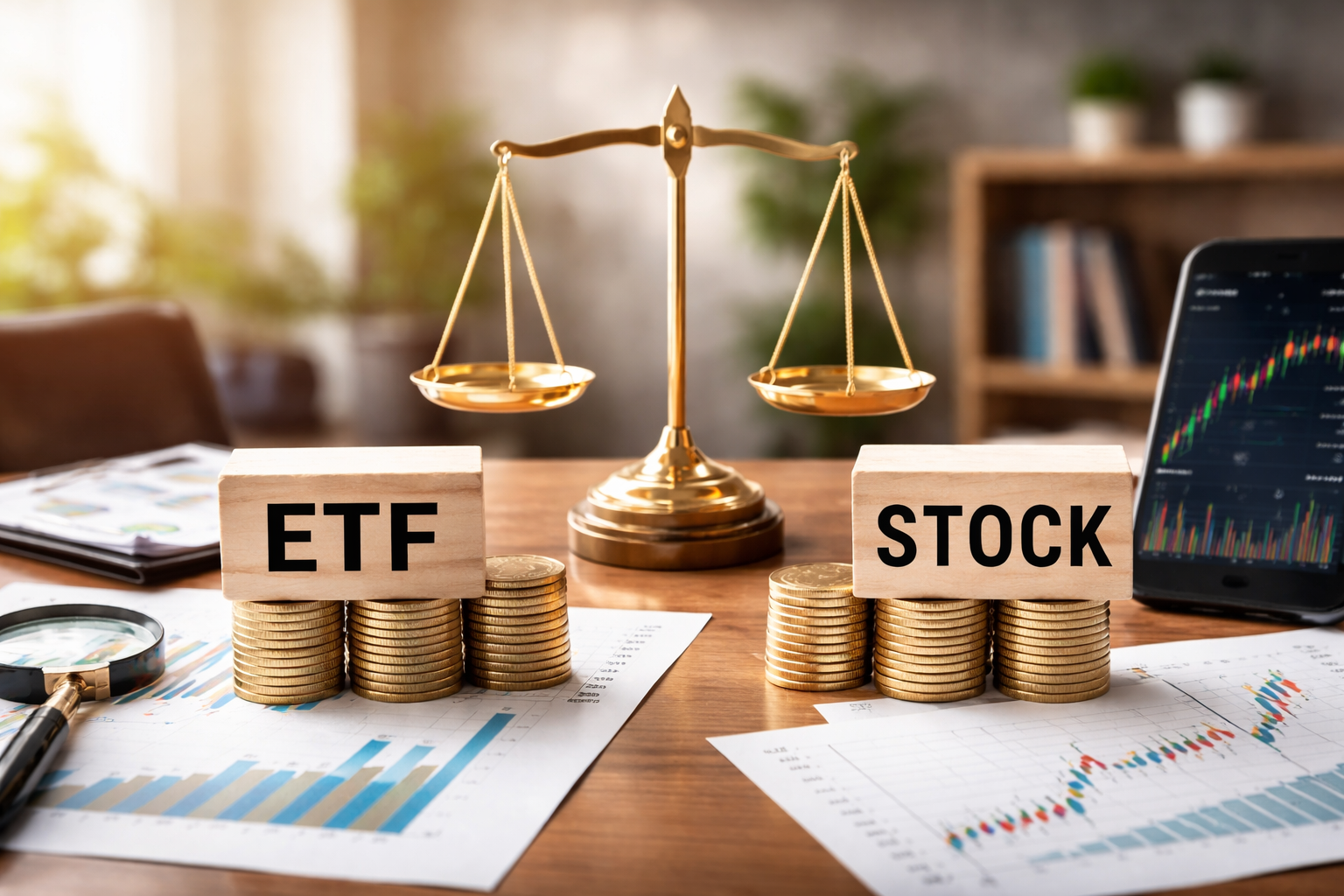
Choosing between an Exchange-Traded Fund (ETF) and an individual stock isn't just about which one "performs better." It’s about which vehicle aligns with your risk tolerance, your time commitment, and your ultimate financial destination.
This guide provides a deep dive into the ETF vs stock debate, exploring everything from basic meanings to advanced trading instruments like stock CFDs and leverage.
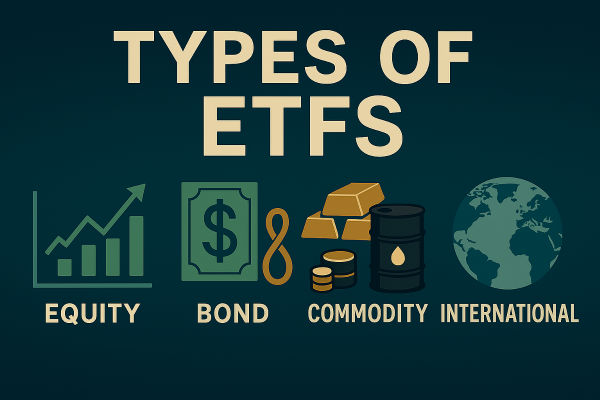
The ETF, or Exchange-Traded Fund, is a pooled investment vehicle that holds a basket of assets such as stocks, bonds, commodities, or a mix, and trades on an exchange like a single share. By buying one ETF, investors gain exposure to dozens, hundreds, or even thousands of underlying securities.
 ETFs are designed for efficiency. They emphasize diversification, low operating costs, and transparency. Most ETFs track an index, sector, or theme rather than attempting to outperform through stock selection.
A stock represents direct ownership in a single company. Its price reflects the market’s assessment of that firm’s earnings, growth prospects, balance sheet strength, and competitive position. When investors buy a stock, they are making a concentrated bet on one business and its management.
Stocks offer precision and potential upside, but also concentration risk. Success or failure hinges on company-specific outcomes rather than broader market trends.
| Cost / Feature | ETF | Individual Stock |
|---|---|---|
| Management Fee | Expense Ratio: Annual fee deducted from fund assets (typically ~0.05%–0.50%) | None: You directly manage the investment |
| Transaction Fees | Often $0 at modern brokers | Often $0 at modern brokers |
| Implicit Costs | Bid-Ask Spread: Usually narrow due to high liquidity | Bid-Ask Spread: Can be wide, especially for small-cap or thinly traded stocks |
| Tax Efficiency | High, due to in-kind creation/redemption mechanism | Variable, depends on how often and when you sell |
| Dividends | Distributions: Aggregated from all holdings and paid to you (usually quarterly) | Direct Payout: Paid directly by the company to your brokerage account |
The most important distinction in any ETF vs stock comparison is diversification.
ETFs spread risk across multiple holdings. A single company’s failure has a limited impact.
Stocks concentrate risk in one issuer. Strong performance can generate outsized gains, but negative events can severely damage capital.
For long-term investors focused on consistency and risk control, diversification is not optional; it is structural protection.
Costs quietly compound and often determine whether an investment strategy succeeds.
ETFs charge an annual expense ratio, typically ranging from 0.03% to 0.50%. These fees cover fund management, administration, and operational costs and are deducted automatically. Many ETFs also distribute dividends collected from underlying holdings, offering a steady income stream with lower volatility.
Stocks do not charge management fees, but active trading introduces transaction costs, bid–ask spreads, and potential tax inefficiencies. Dividend-paying stocks can provide attractive income, but maintaining diversification across multiple dividend stocks requires higher capital and ongoing oversight.
For long-term investors seeking cost efficiency and consistent dividend exposure, ETFs often provide a more scalable solution.
Leverage introduces a different dimension to the ETF vs stock debate.
Some traders use stock CFDs (Contracts for Difference) to speculate on price movements without owning the underlying asset. CFDs allow leverage, meaning a small amount of capital controls a larger position. Gains are magnified, but so are losses.

ETFs can be traded unleveraged or through leveraged ETF products designed to amplify daily returns.
Stocks can be traded directly or via CFDs, where leverage significantly increases risk.
Leverage is a tactical tool, not a long-term solution. It is best suited for experienced traders with strict risk controls, not investors building durable portfolios.
ETFs are primarily exposed to market risk. Their performance reflects broader economic conditions, interest rate trends, and sector dynamics. While they decline during market downturns, losses are usually more gradual due to diversification.
Stocks combine market risk with company-specific risk, including earnings volatility, regulatory changes, competitive disruption, and dividend cuts. In volatile environments, individual stocks may experience sharp repricing, while diversified ETFs tend to absorb shocks more smoothly.
Both ETFs and stocks trade on major exchanges and offer high liquidity in normal conditions. However, their transparency differs:
ETFs disclose holdings daily, allowing investors to see exactly what they own.
Stocks provide transparency through financial reporting, but future performance depends on forecasts rather than visible asset composition.
This distinction matters for investors who prioritize predictability and structural clarity.
The ETF vs stock decision should follow purpose, not preference.
| Objective | ETFs Fit Better | Stocks Fit Better |
|---|---|---|
| Investment Approach | Long-term wealth building through broad market exposure | Targeted bets driven by high conviction in specific companies |
| Management Style | Passive or semi-passive strategies | Active, hands-on portfolio management |
| Risk Tolerance | Emphasis on diversification and overall portfolio stability | Acceptance of higher volatility and idiosyncratic risk |
| Income Strategy | Aggregated, smoother dividend distributions | Company-specific dividend growth and payout policies |
| Portfolio Role | Core or foundational holdings | Satellite, tactical, or opportunistic positions |
Remember: Investors can combine ETFs and individual stocks within the same portfolio to balance diversification and targeted exposure. For beginners, however, understanding personal objectives, risk tolerance, and time horizon is essential before selecting either instrument.
These ETFs are widely used, highly liquid, and structurally aligned with long-term investing goals rather than short-term speculation:
SPDR S&P 500 ETF (SPY) – Broad exposure to U.S. large-cap equities
Vanguard Total Stock Market ETF (VTI) – Entire U.S. equity market in one fund
Invesco QQQ Trust (QQQ) – Growth-heavy exposure to technology and innovation
iShares MSCI ACWI ETF (ACWI) – Global equity diversification across developed and emerging markets
Vanguard FTSE All-World ETF (VT) – Single-fund global allocation with geographic balance
These ETFs are best suited for core portfolio construction, retirement strategies, and investors prioritizing consistency over prediction.
These stocks remain central to global economic and technological trends. They are not “safe,” but they are structurally important:
Apple (AAPL) – Ecosystem dominance, pricing power, and capital return strength
Microsoft (MSFT) – Enterprise software leadership and AI infrastructure exposure
NVIDIA (NVDA) – Core supplier to AI, data center, and high-performance computing demand
Alphabet (GOOGL) – Search dominance paired with long-term AI optionality
Amazon (AMZN) – Logistics scale, cloud computing, and margin expansion potential
These stocks suit investors willing to tolerate volatility in exchange for concentrated exposure to long-term growth engines.
An ETF generally carries less company-specific risk because it spreads exposure across multiple holdings. A single corporate failure has a limited impact on a diversified fund. However, ETFs are still fully exposed to market risk. When equity markets decline, broad-based ETFs decline as well. Safety, in this context, refers to reduced concentration risk rather than protection from losses.
Stocks are riskier in the sense that outcomes depend entirely on a single company. This increases volatility and the likelihood of permanent capital loss if the business underperforms. ETFs dilute that risk by design, which makes returns more predictable but limits the impact of exceptional winners.
Beginners can invest in stocks, but the learning curve is steeper. Stock investing requires evaluating financial statements, competitive dynamics, valuation, and risk management. ETFs allow new investors to gain market exposure while reducing the impact of early mistakes, which makes them more suitable as a starting point.
Stocks do not charge management fees, while ETFs charge an annual expense ratio. In practice, ETFs are often cheaper for diversified exposure because replicating the same breadth with individual stocks requires frequent trading, rebalancing, and higher transaction costs.
Leverage amplifies both gains and losses regardless of the instrument. Leveraged ETFs and stock CFDs are structured for short-term trading and can experience significant performance decay over time due to volatility and financing costs. They are generally unsuitable for long-term investing.
The ETF vs stock decision ultimately depends on investment needs and objectives. ETFs provide efficient market access, diversification, aggregated dividend income, and controlled risk exposure, making them well-suited for long-term portfolio construction.
Stocks offer concentrated exposure, dividend growth potential, and the possibility of outperformance, but demand deeper analysis, active oversight, and greater emotional discipline.
Neither instrument is inherently superior. Each serves a distinct role within a disciplined investment framework. When structure matches purpose, markets become a strategic allocation tool rather than a source of unnecessary risk.
Disclaimer: This material is for general information purposes only and is not intended as (and should not be considered to be) financial, investment, or other advice on which reliance should be placed. No opinion given in the material constitutes a recommendation by EBC or the author that any particular investment, security, transaction, or investment strategy is suitable for any specific person.