Published on: 2026-02-04
Eli Lilly is scheduled to release its fourth-quarter 2025 results on February 4, 2026, followed by a conference call at 10:00 a.m. Eastern Time (E.T.). Analyst consensus estimates center on revenue of approximately $17.9 billion and earnings per share (EPS) of about $6.99. However, the range of estimates has widened among data providers, reflecting uncertainty about product mix and an increased emphasis on forward guidance over single-quarter results.
The Q4 2025 earnings report for Eli Lilly arrives at a particularly sensitive period for large-cap pharmaceutical companies. Eli Lilly (LLY) now serves as a proxy for the global obesity and metabolic care sector, prompting the market to evaluate not only quarterly performance but also the sustainability of demand, the pace of supply expansion, and the credibility of 2026 guidance.
Macroeconomic sensitivity is increasing as the GLP-1 weight-loss segment is being repriced in real time, intensifying market reactions to guidance language and 2026 demand projections.
Consensus estimates focus on approximately $17.9 billion in revenue and $6.99 in EPS. A clear outperformance will likely require incremental gains from incretin volumes and product mix resilience, rather than reliance on one-time items.
Forward guidance is more significant than quarterly results, as investors are expected to prioritize 2026 sales and margin commentary due to ongoing capacity expansions and evolving payer dynamics.
Lilly will report Q4 2025 results on February 4, 2026, followed by a 10:00 a.m. Eastern investor call. Although the reporting schedule is standard, the context is unique. The current valuation assumes that Lilly will leverage its leadership in obesity and diabetes to achieve sustained revenue growth and maintain gross margins through operational scale and manufacturing efficiency.
 As a result, market reactions have become less predictable. A modest Q4 outperformance, combined with conservative 2026 guidance, may be received less favorably than a slight miss accompanied by confident commentary on supply and demand. Thus, while headline figures are important, the narrative regarding volumes, fulfilment, and forward pricingis even more critical.
Analyst expectations for the quarter are generally aligned with revenue but show greater variability for EPS. This divergence is primarily due to efforts to correlate incremental obesity-drug volumes with incremental profit during a period of significant manufacturing investment.
| Metric | Actual | Estimate | Key drivers / what to watch |
|---|---|---|---|
| Revenue | $17.87B | ~$17.85B | Incretin growth, mix, and international scaling |
| EPS (reported/adjusted varies by source) | $6.99 | ~$7.48 | Margin cadence, expense trajectory, and quality of beat |
| EPS (reported/adjusted varies by source) | $6.99 | ~$7.48 | Margin cadence, expense trajectory, and quality of beat |
Expectations of $17.87 billion in revenue and $6.99 in EPS are widely cited. Another frequently referenced dataset estimates EPS at approximately $7.48 with revenue near $17.85 billion. For investors, this dispersion reflects meaningful differences in underlying assumptions.
This variation indicates that small differences in assumptions regarding product mix, manufacturing costs, and R&D timing can significantly impact earnings, even when revenue projections are relatively stable.
Given Lilly’s current market sensitivity, the quarter will likely be evaluated based on three primary criteria:
Top-line durability: Does revenue land cleanly in the high-$17B range without “pull-forward” concerns?
Profit conversion: Does EPS track the top line, or do costs swallow the incremental sales?
2026 line-of-sight: Does guidance validate a path to continued obesity franchise scaling without margin erosion?
Meeting the first two criteria without providing clear 2026 guidance may still result in investor disappointment.

1) Obesity and diabetes franchise signals: demand is not the only variable
LLY’s core earnings debate has shifted from “Is demand strong?” to “How fast can supply and access convert demand into fulfilled prescriptions?” In Q4, investors will parse management’s wording on:
manufacturing output and capacity additions,
order fill rates and channel inventory normalisation,
International launch pacing and reimbursement progress.
Indications that supply is increasing more rapidly than anticipated can support positive forward volume assumptions. Conversely, signs that demand is stabilising more quickly than supply is expanding may prompt a negative market response, particularly given recent volatility among peers in the obesity-drug space.
The next leg of the obesity market is not only about units. It is about net price, breadth of coverage, and patient persistence. The market will look for:
commentary on gross-to-net trends,
employer and insurer coverage momentum,
early signals on Medicare-related policy direction and timing.
Even in the absence of definitive policy changes, management’s tone can influence expectations regarding the expansion of the addressable market.
Lilly’s growth strategy requires high spending, but the market will want evidence that the spending is strategic and scalable, not structurally dilutive. Key watch items include:
whether operating expense growth is moderating versus revenue growth,
whether manufacturing investments are translating into measurable throughput,
whether pipeline progress supports continued multiple expansion.
A quarter may exceed EPS expectations yet experience a decline in share price if investors perceive the cost base as inflexible.
Given how closely LLY trades to obesity-market sentiment, 2026 guidance will likely dominate the post-earnings tape. Investors will interpret guidance through three lenses:
Demand realism: Is the guidance built on conservative uptake or aggressive penetration assumptions?
Supply credibility: Does the company describe a feasible manufacturing plan with clear milestones?
Margin narrative: Do scale benefits appear in the outlook, or does the company suggest pricing pressure and cost drag?
Peer developments are also significant. Novo Nordisk’s substantial decline following its 2026 outlook has heightened market sensitivity to any indications of future deceleration.
Ahead of the announcement, the stock is no longer exhibiting unidirectional momentum. Recent performance reflects a notable pullback over the past month, despite significant gains over the longer term.
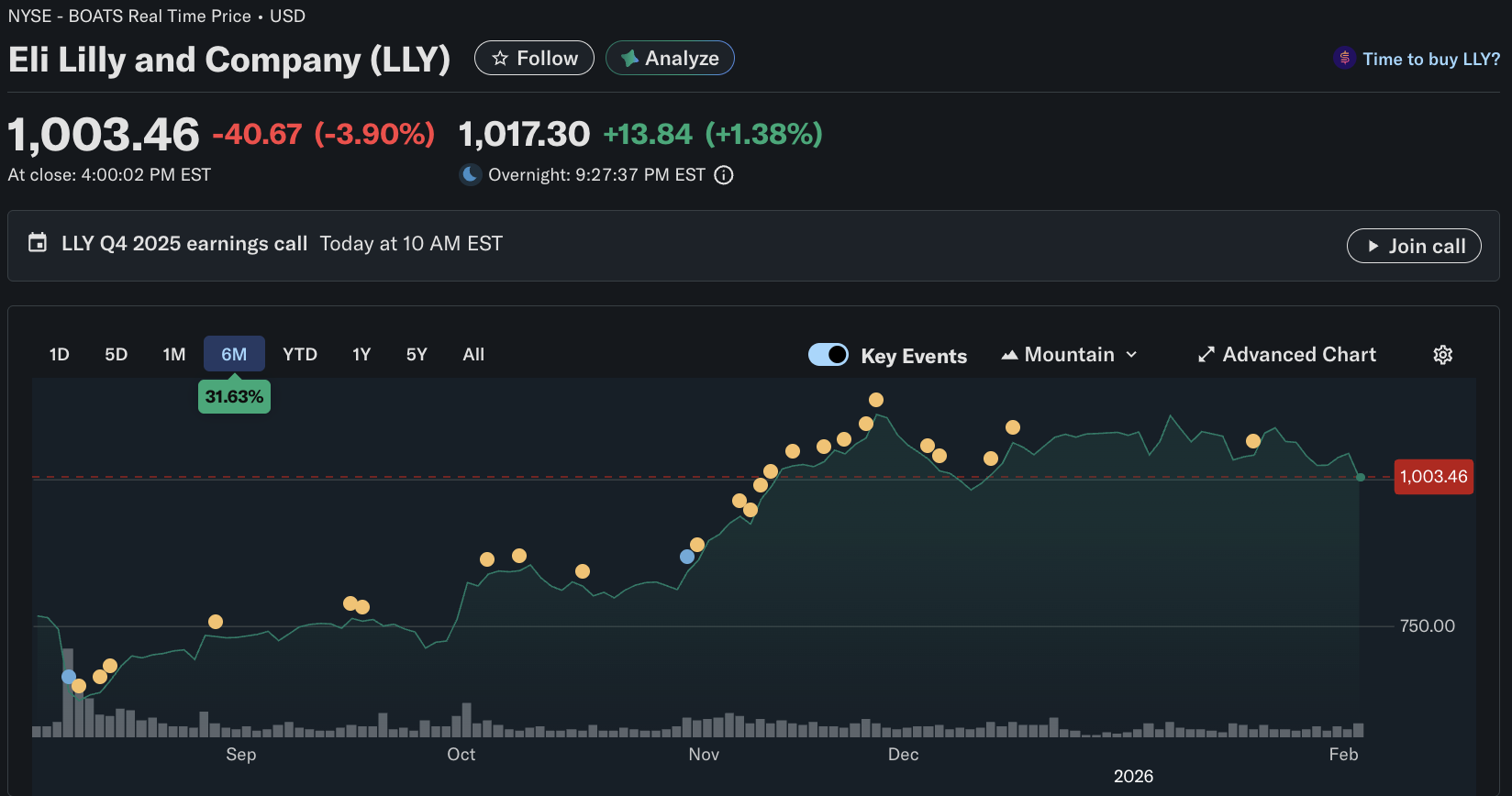
LLY performance (as of Feb 3, 2026, close):
| Window | Performance |
|---|---|
| 1 day | -3.90% |
| 1 week | -3.47% |
| 1 month | -7.12% |
| 6 months | +30.49% |
Two implications arise. First, investor positioning may be less concentrated than during the late-2025 rally, potentially reducing the risk of sharp declines following positive results.
Second, the threshold for a relief rally is higher, as investors will require clear guidance rather than solely an EPS beat.
Commonly monitored technical indicators suggest that the stock has moderated from previous highs but continues to maintain a strong long-term trend.
| Scenario | Revenue | EPS | What would justify it |
|---|---|---|---|
| Bear case | $17.3B to $17.6B | $6.4 to $6.8 | Softer-than-expected mix, higher spend, cautious 2026 tone |
| Base case | $17.8B to $18.0B | $6.9 to $7.2 | Steady obesity and diabetes execution, no margin surprise, balanced guidance |
| Bull case | $18.1B to $18.4B | $7.3 to $7.7 | Upside volumes and mix, reassuring capacity commentary, confident 2026 outlook |
The quarter may meet base-case expectations yet experience a decline in share price if 2026 guidance suggests slower volume conversion or greater price compression than investors anticipate.
Lilly is set to announce Q4 2025 financial results on February 4, 2026, followed by a 10:00 a.m. Eastern Time (E.T.) conference call.
Consensus centres on revenue of around $17.9 billion and EPS of around $7.0, though EPS varies by provider due to differing adjustments and modelling assumptions.
LLY’s valuation is tied to multi-year growth in obesity and metabolic care. The market is primarily pricing 2026 demand conversion, supply expansion, and the margin trajectory, which are more clearly reflected in guidance and management commentary than in a single-quarter EPS print.
As of the Feb 3, 2026, close, LLY is down 3.90% on the day, 3.47% over one week, and 7.12% over one month, but up 30.49% over six months.
The most significant swing factor is the credibility of 2026 guidance, especially any detail on obesity-drug supply, access, and net pricing. In the current tape, even substantial Q4 numbers can be overshadowed if forward assumptions look conservative.
The Q4 2025 Eli Lilly earnings report should be viewed primarily as a guidance event rather than a standard quarterly release. While consensus estimates indicate approximately $17.9 billion in revenue and $7.0 in EPS, the primary market focus will be on Lilly’s ability to reinforce confidence in 2026 volume conversion, supply expansion, and margin progression.
Given the recent short-term decline in the stock alongside robust six-month performance, the current setup is conducive to significant price movement if management’s forward-looking commentary substantially alters investor expectations.
Disclaimer: This material is for general information purposes only and is not intended as (and should not be considered to be) financial, investment or other advice on which reliance should be placed. No opinion given in the material constitutes a recommendation by EBC or the author that any particular investment, security, transaction or investment strategy is suitable for any specific person.
1) Lilly confirms date and conference call for fourth-quarter 2025