Published on: 2026-03-24
Updated on: 2026-03-24
The Coppock Curve indicator is a long‑term momentum tool used by traders and investors to identify major trend reversals in financial markets. It is designed to highlight potential buying and selling opportunities in stocks and stock indexes by analysing changes in momentum over extended periods.
The Coppock Curve indicator is a momentum oscillator developed to identify long‑term trend reversals in financial markets.
It is calculated using a weighted moving average of rate‑of‑change (ROC) values over specific time frames.
A key signal occurs when the indicator crosses above or below the zero line, indicating potential bullish or bearish phases.
The Coppock Curve is most effective over longer timeframes and is best used in conjunction with other technical tools.
Investors should combine the Coppock indicator with fundamental analysis and broader market context to make more reliable decisions.
The Coppock Curve indicator is a technical analysis tool that measures momentum in financial markets to help identify significant trend changes, particularly long‑term buying and selling opportunities. It was originally developed by economist Edwin S. Coppock in the early 1960s and first published as a tool for analysing major stock indexes, such as the S&P 500.
At its core, the Coppock Curve is a smoothed momentum oscillator that interprets market momentum by analysing past price changes. It combines the rate of change of prices over specified periods and applies a weighted moving average to smooth out short‑term noise. This smoothing highlights broader shifts in trend direction, making it valuable to investors focused on medium- to long-term market cycles.
To understand the Coppock Curve, it is helpful to know how it is constructed. The formula typically uses rate‑of‑change calculations over two different periods, which are then smoothed with a weighted moving average.
Coppock Curve = WMA10 of (ROC14 + ROC11)
Here, the ROC measures the percentage change in price over the specified period, and WMA assigns greater weight to the most recent data points. The result is a single line that oscillates above and below a zero line, which traders use to interpret momentum shifts.
The Coppock Curve indicator is interpreted by watching how it moves relative to the zero line and the direction of the curve itself.
Zero Line Cross Above: When the Coppock Curve rises and crosses above zero, this is often interpreted as the end of a bearish phase and the start of a bullish trend. Investors see this as a potential long‑term buying opportunity.
Upward Momentum: Sustained upward movement above zero indicates strengthening momentum in price direction.
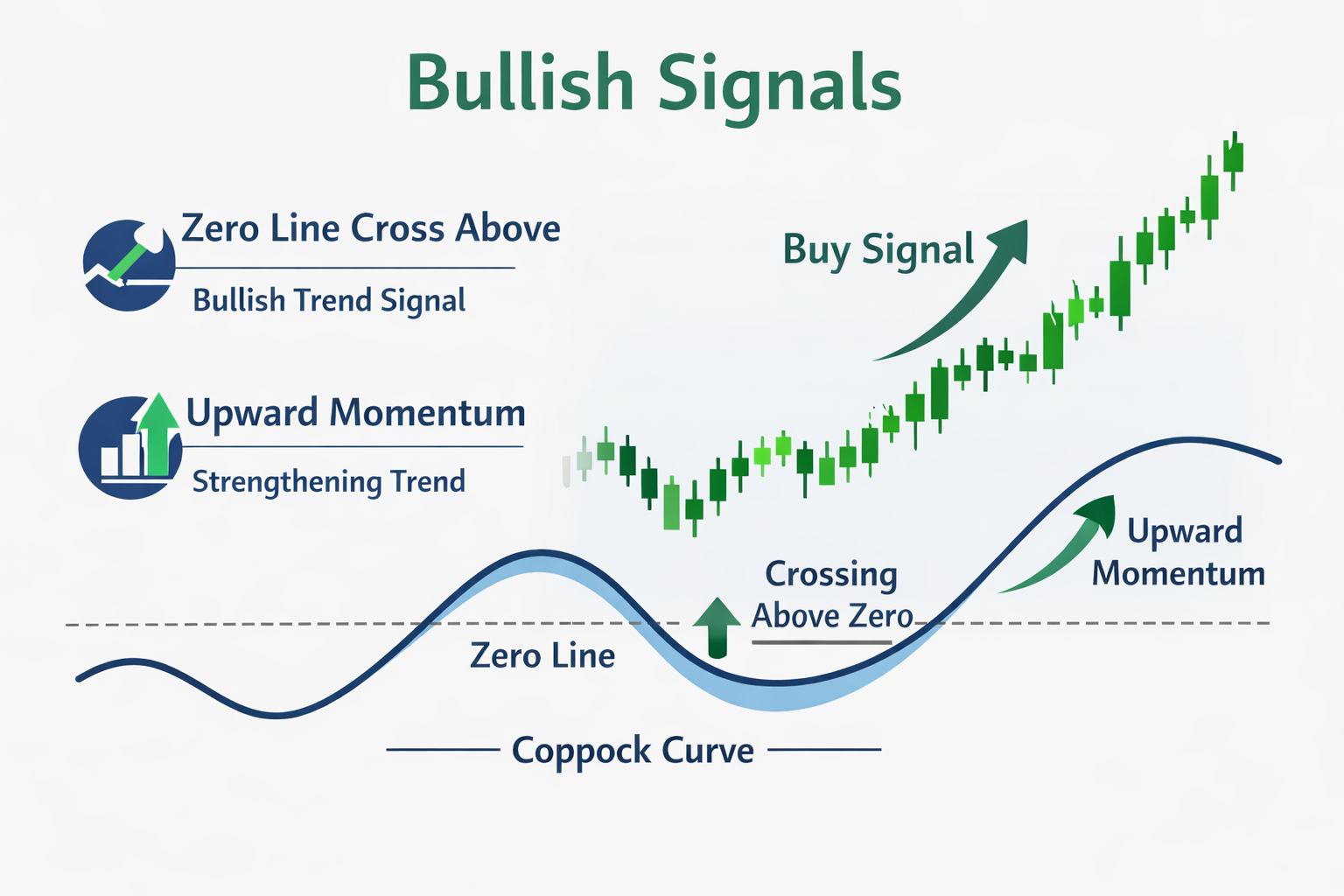
Zero Line Cross Below: A downward cross below zero may signal a weakening trend or a potential exit point for long positions. Although the original model focused on buy signals, many technical analysts also apply a bearish interpretation.
Negative Momentum: Extended negative readings suggest bearish conditions.
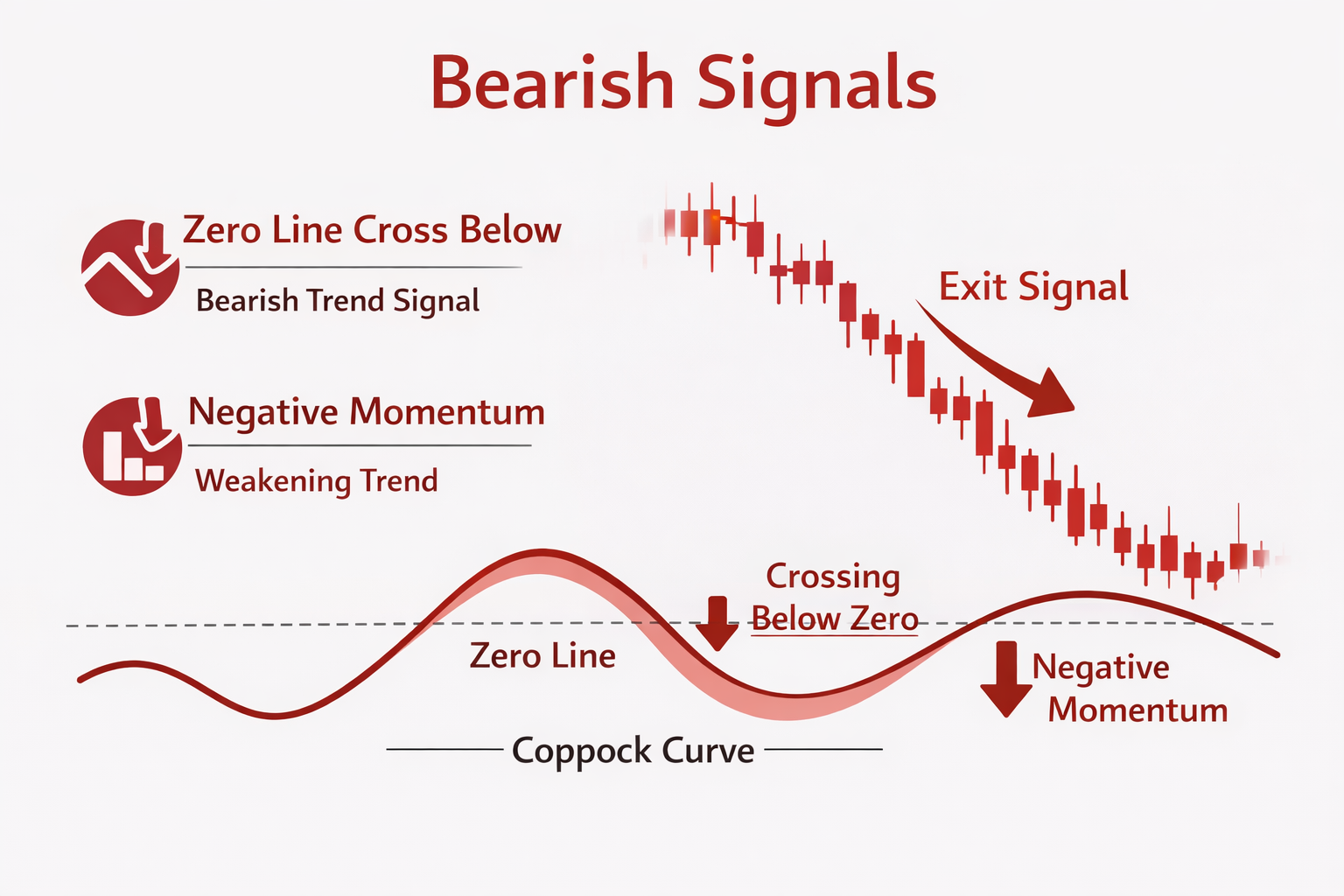
Traders often confirm Coppock Curve signals with additional indicators such as moving averages or trendlines to reduce the risk of false signals and improve accuracy.
The Coppock Curve has several strengths that make it useful for certain types of trading and investing:
The Coppock Curve was specifically designed for monthly charts and longer timeframes, making it particularly effective at identifying significant market bottoms and trend changes over months or years.
By smoothing out price data with a weighted moving average, the indicator filters out short‑term volatility and focuses on more meaningful shifts in momentum.
When applied to major market indices, the Coppock Curve has historically highlighted major trend reversals, offering insight for long‑term position traders.
While the Coppock Curve is a respected tool, it has limitations that all traders should understand:
Because it relies on moving averages and long‑term price changes, the Coppock Curve can lag in signalling reversals, especially during rapid market movements.
Like many oscillators, the indicator can generate false signals, particularly in range‑bound markets where the curve oscillates above and below zero without meaningful trend confirmation.
The traditional Coppock settings were designed for monthly data and long cycles. It may not be as effective for day traders or short‑term swing traders without customised parameters.
To use the Coppock Curve effectively, many investors apply it along with other technical and fundamental analysis tools.
Complementary Indicators
Moving Averages: Confirm trend direction and filter noise.
Relative Strength Index (RSI): Helps validate changes in momentum.
Volume Analysis: Confirms whether momentum shifts coincide with strong participation.
This combined approach improves the reliability of signals by reducing reliance on a single indicator and helping to verify underlying price behaviour.
While originally designed for monthly charts, the Coppock Curve can be tailored to weekly or daily timeframes by adjusting the ROC and WMA periods to produce more frequent signals. Investors should backtest adjustments to ensure robust performance.
While the Coppock Curve is primarily discussed in the context of broad markets and stock indices, momentum indicators, including the Coppock Curve, can assist in evaluating individual stocks, including defence sector equities. Some prominent defence companies often monitored by investors include:
These companies are subject to broader market cycles and investor sentiment. Momentum indicators, such as the Coppock Curve, combined with fundamental analysis, including earnings, contract awards, and geopolitical developments, help investors assess the timing of entry and exit points within long‑term trends.
The Coppock Curve measures long-term market momentum by smoothing the sum of rate-of-change values over time. It oscillates above and below zero, signalling potential price trend reversals.
Originally designed for long-term analysis on monthly charts, the Coppock Curve may not suit short-term trading unless its calculation period is adjusted to shorter timeframes.
Investors often combine the Coppock Curve with other indicators, such as moving averages or the relative strength index, to confirm momentum changes and reduce the risk of false or misleading signals.
Traditionally, a crossing above zero generates a buy signal, while some analysts also interpret crossings below zero as potential sell signals, depending on broader market trends and confirmation tools.
False signals happen when the Coppock Curve crosses zero without a strong trend, often in sideways or choppy markets where momentum is weak, making confirmation from other indicators important.
The Coppock Curve indicator remains a valuable tool for investors and traders seeking to identify long‑term trends and potential market reversals. When momentum is analysed over extended periods and smoothed with weighted averages, the indicator helps filter out market noise and reveal broader shifts in sentiment.
While it is most effective on longer timeframes, thoughtful application in conjunction with complementary technical tools and fundamental analysis can enhance investment decision‑making across diverse market conditions. Whether evaluating major indices or specific sectors, such as defence stocks, mastering the Coppock Curve contributes to a holistic, disciplined approach to market analysis.
Disclaimer: This material is for general information purposes only and is not intended as (and should not be considered to be) financial, investment or other advice on which reliance should be placed. No opinion given in the material constitutes a recommendation by EBC or the author that any particular investment, security, transaction or investment strategy is suitable for any specific person.