Published on: 2026-05-07
Updated on: 2026-05-07
An investment portfolio is a structured allocation of capital across assets such as stocks, bonds, funds, ETFs, cash, real estate, commodities, and alternatives. Its purpose is not to own more investments. Its purpose is to make each dollar serve a defined role: growth, income, liquidity, protection, or opportunity.
The question has gained urgency because the return map has changed. Cash no longer carries a near-zero yield penalty, bonds again provide meaningful income, and equity markets carry heavier valuation and concentration risks.
The US 3-month Treasury bill yielded 3.61% on 5 May 2026, while the 10-year Treasury yielded 4.43%. At the same time, US CPI rose 3.3% over the 12 months to March 2026, keeping inflation risk relevant for any long-term portfolio.
An investment portfolio is an allocation framework, not just a collection of financial products.
Asset allocation across stocks, bonds, cash, and alternatives usually shapes long-term outcomes more than individual security selection.
Cash, bonds, and equities now compete more directly for capital, with short-term Treasury bills yielding 3.61% and 10-year Treasuries yielding 4.43% in early May 2026.
Diversification must be measured beneath the label, since broad funds can still carry heavy sector or company concentration.
Rebalancing brings the portfolio back to its target risk profile after market gains or losses change the asset mix.
A strong portfolio manages market risk, liquidity risk, inflation risk, fees, taxes, and behavioral errors.

An investment portfolio is the full set of investments owned by an individual, institution, company, trust, or fund. It can include stocks, bonds, cash, real estate, and other assets.
That definition is accurate, but incomplete for practical decision-making. A portfolio is better understood as a structure for organizing capital around objectives and constraints. It answers four questions: what the money is for, when it may be needed, how much loss can be tolerated, and which assets can deliver the required return without taking unnecessary risk.
A retirement portfolio should not be built like a house-deposit portfolio. A portfolio for monthly income should not carry the same risk profile as one designed for long-term capital growth. A young professional, a retiree, and a business owner may all own stocks and bonds, but the role of each asset will differ.
Before choosing investments, investors should first decide what job the portfolio needs to perform. The main portfolio types reflect different combinations of growth, income, liquidity, and capital protection.
The classic beginner explanation says a portfolio should balance risk and return. That remains true, but the inputs have shifted.
| Market Variable | Latest Reading | Portfolio Signal |
|---|---|---|
| US 3-month Treasury bill | 3.61% | Cash and short-duration assets provide usable income |
| US 2-year Treasury yield | 3.93% | Front-end bonds still reflect restrictive policy expectations |
| US 10-year Treasury yield | 4.43% | Duration risk and income potential both matter |
| US CPI inflation | 3.3% YoY | Cash stability must be weighed against purchasing-power erosion |
| S&P 500 forward P/E | 20.9x | Equity valuations sit above 5-year and 10-year averages |
| Money market fund assets | $7.63 trillion | Defensive capital remains large and liquid |
| SPY technology weight | 35.2% | Index exposure carries meaningful sector concentration |
The data point to a more competitive capital-allocation regime. Cash offers income, bonds carry both yield and duration risk, and equity exposure requires closer scrutiny because index concentration has increased.
The S&P 500 forward 12-month P/E ratio was 20.9, above its 5-year average of 19.9 and 10-year average of 18.9, while total money market fund assets stood at $7.63 trillion for the week ended 29 April 2026.
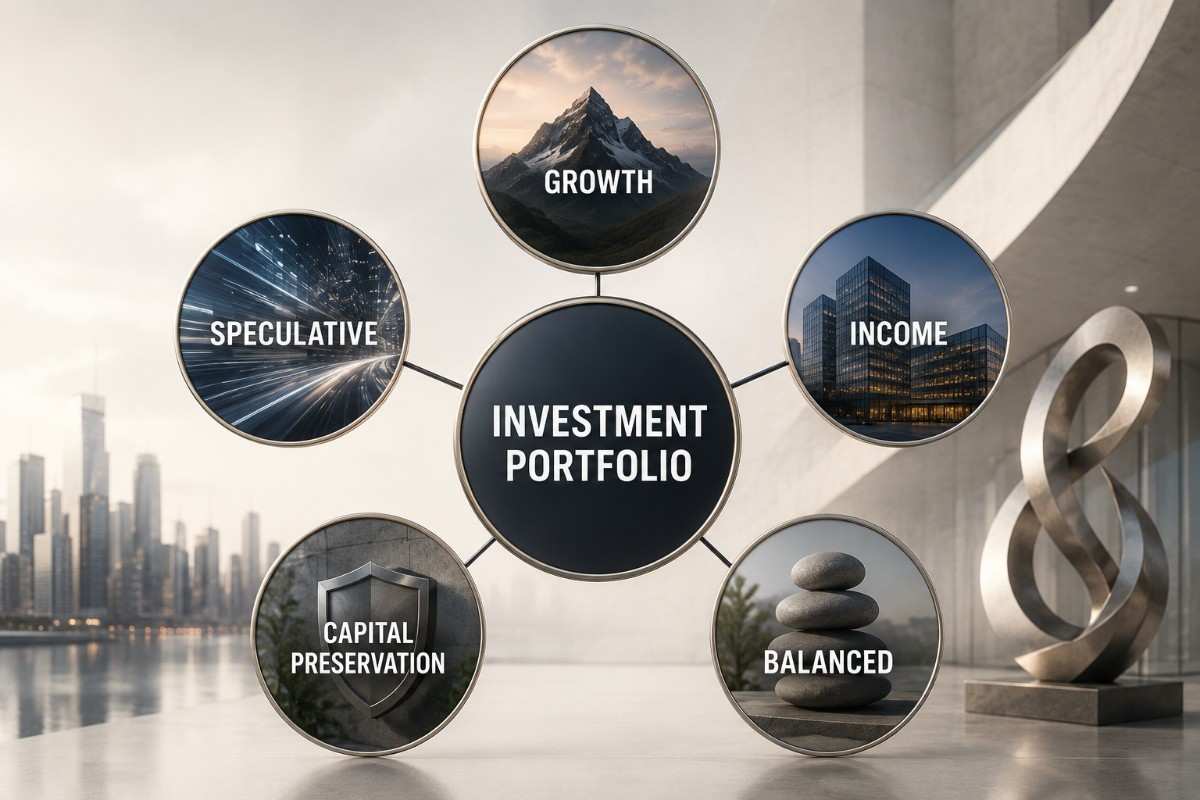
A growth portfolio focuses on capital appreciation. It usually allocates heavily to stocks, equity ETFs, and growth funds, and sometimes to thematic assets such as technology or emerging markets. The main drivers of returns are earnings growth and valuation expansion.
Growth portfolios typically suit investors with long time horizons, stable income, and the capacity to withstand multi-year drawdowns. They can compound strongly over long periods, but they can also suffer deep losses when rates rise, valuations compress, or earnings expectations weaken.
An income portfolio seeks regular cash flow. It may include government bonds, corporate bonds, dividend stocks, preferred shares, REITs, and income funds.
Income portfolios often suit retirees, conservative investors, or investors who want assets to support regular withdrawals. Income is not the same as safety. High-yield bonds, leveraged income funds, and unusually high dividend stocks often carry credit, duration, or payout risk. The quality of income matters more than the headline yield.
A balanced portfolio combines growth assets with defensive assets. A common structure may allocate 60% to equities and 40% to bonds, though the right mix depends on the investor’s age, income, liabilities, and spending horizon.
Balanced portfolios typically suit investors who want long-term growth while reducing full exposure to equity drawdowns. Bonds and cash may soften market declines, while stocks help offset inflation and support capital appreciation.
A preservation portfolio prioritizes stability, liquidity, and low drawdown risk. It may hold cash, money market funds, Treasury bills, short-duration bonds, or high-quality fixed income.
Capital preservation portfolios often suit investors with near-term spending needs, low risk capacity, or funds earmarked for a specific purpose. The main vulnerability is inflation. A portfolio can look stable in account value while losing real purchasing power.
A speculative portfolio accepts high levels of uncertainty for the potential of outsized gains. It may include single stocks, options, crypto assets, commodities, private companies, or leveraged products.
Speculative portfolios suit only capital that an investor can afford to lose without damaging essential goals. Position sizing should follow loss tolerance, not optimism. Capital that supports retirement, housing, education, or emergency needs should not depend on binary outcomes.
| Investor Objective | Stocks | Bonds | Cash | Alternatives | Portfolio Logic |
|---|---|---|---|---|---|
| Capital preservation | 20% | 55% | 20% | 5% | Reduces drawdown risk and protects liquidity |
| Income generation | 35% | 45% | 10% | 10% | Balances yield, stability, and inflation exposure |
| Balanced growth | 60% | 30% | 5% | 5% | Seeks long-term growth with risk control |
| Long-term growth | 80% | 10% | 5% | 5% | Accepts higher volatility for capital appreciation |
| Aggressive growth | 90% | 0% | 5% | 5% | Maximizes equity exposure and return potential |
These are illustrative models, not recommendations. The correct allocation depends on time horizon, income stability, required withdrawals, tax position, currency exposure, and capacity to withstand losses.
Every portfolio should start with a purpose. Retirement growth, emergency liquidity, education funding, home purchase savings, and income generation require different risk profiles.
A clear objective includes a target amount, a time horizon, a currency, a liquidity need, and an acceptable drawdown. Without those inputs, portfolio construction becomes product selection rather than capital planning.
Liquidity protects investors from forced selling. A cash reserve allows long-term assets to remain invested during market stress.
Cash should be treated as a stabilizer, not as a failed investment. Its role is to meet near-term obligations and preserve optionality. The trade-off is inflation risk, which rises as cash becomes a larger share of long-term capital.
Asset allocation divides capital among stocks, bonds, cash, and other assets. The right mix changes with time horizon, liquidity needs, risk tolerance, income stability, and required withdrawals.
Stocks usually provide growth. Bonds provide income and risk control. Cash provides liquidity. Alternatives may offer diversification, inflation sensitivity, or return streams that differ from traditional assets.
Investors can build portfolios with individual securities, ETFs, mutual funds, managed accounts, or model portfolios.
Broad ETFs and mutual funds can provide instant diversification. Individual stocks offer control but require research depth, position sizing, and risk discipline. The vehicle should match the investor’s time, skill, tax position, and need for simplicity.
Fees reduce compounding. Expense ratios, advisory charges, fund turnover, trading spreads, and taxes all affect net returns.
Taxes also influence where assets belong. Interest-heavy assets may be more suitable for tax-advantaged accounts, while broad equity ETFs may be more tax-efficient in taxable accounts. Net capital gains may be taxed at lower rates than ordinary income, which makes holding period and account location part of portfolio design.
Rebalancing restores the target allocation after market movement changes the portfolio’s risk level.
A rules-based process may use a calendar review, such as semiannual or annual rebalancing, or tolerance bands, such as adjusting when an asset class moves more than 5 percentage points from target. The aim is not frequent trading. The aim is disciplined risk control.
A useful portfolio review should answer these questions:
| Question | What It Reveals |
|---|---|
| What percentage is in stocks, bonds, cash, and alternatives? | Real asset allocation |
| What is the largest single holding? | Company concentration risk |
| What is the largest sector exposure? | Sector concentration risk |
| How much can be accessed within one week? | Liquidity strength |
| How much could fall in an equity selloff? | Drawdown exposure |
| Do several funds own the same companies? | Hidden overlap |
| What are the total fees? | Return leakage |
| Which assets create taxable income? | Tax efficiency |
Performance alone is an incomplete report card. A portfolio can rise sharply while becoming less diversified, more expensive, and more dependent on a narrow market theme.
An investment portfolio can include stocks, bonds, ETFs, mutual funds, cash, real estate, commodities, private assets, and alternatives. The mix should reflect the investor’s goal, time horizon, liquidity needs, risk capacity, tax position, and currency exposure.
A good beginner portfolio usually prioritizes broad diversification, low fees, adequate cash reserves, and a clear allocation rule. Many beginners use equity ETFs, bond funds, and cash rather than building portfolios around several individual securities.
Yes. Cash supports liquidity, emergency needs, and short-term spending. It can also prevent forced selling during market declines. For long-term goals, excessive cash can reduce real returns when inflation outpaces the cash yield.
Many investors review portfolios every six or 12 months. Others use tolerance bands that trigger action when allocations drift too far from target. Rebalancing should control risk rather than encourage constant trading.
An investment portfolio is not a storage box for financial products. It is a structure built to manage trade-offs between return, risk, liquidity, inflation, taxes, and investor behavior.
The strongest portfolios begin with purpose, diversify beneath the surface, control fees, respect taxes, and rebalance with rules. A well-built portfolio does not need perfect forecasts. It needs clear objectives, disciplined allocation, and enough resilience to keep capital working through different market cycles.