Published on: 2026-04-14
Updated on: 2026-04-14
The Bullish Percent Index (BPI) measures the percentage of stocks within an index on point-and-figure buy signals, helping investors gauge overall market strength or weakness. Unlike price-based indicators, BPI assesses participation, aiding in timing and risk assessment.

The Bullish Percent Index measures market breadth, not price direction.
Readings above 70% often indicate overbought conditions, while readings below 30% may signal oversold conditions.
It is most effective when used alongside other indicators such as moving averages and volume trends.
BPI helps investors identify risk-on or risk-off market environments.
It is widely used for sector rotation and index-level analysis.
The Bullish Percent Index tracks the percentage of stocks in an index that show buy signals on point-and-figure charts.
For example, if 70 out of 100 stocks in the S&P 500 are on buy signals, the BPI would read 70%. This gives a snapshot of internal market strength rather than relying solely on index price movements.
Unlike traditional indicators that focus on price trends, BPI is a breadth indicator that evaluates participation across the market.
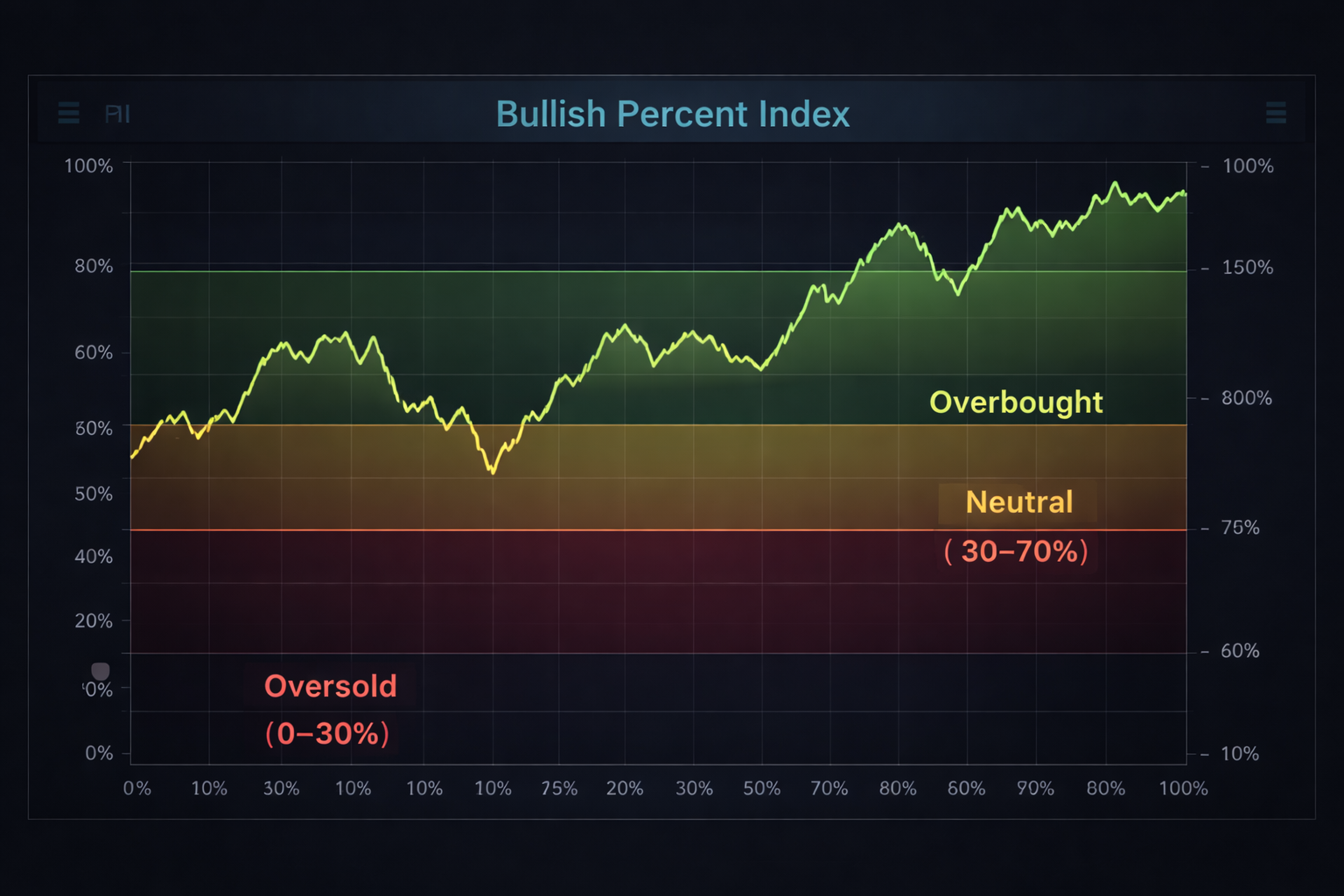
The BPI is calculated using point-and-figure charts, which filter out minor price fluctuations and focus on significant trend reversals.
A rising BPI suggests increasing market participation in the rally, while a declining BPI signals weakening breadth even as index prices are still rising.
One of the most important insights in market analysis is that not all rallies are healthy. Markets can rise while only a small number of stocks drive gains. BPI helps identify this imbalance.
Market Breadth Insight: Shows whether gains are broad-based or concentrated.
Risk Management Tool: Helps investors reduce exposure when participation weakens.
Trend Confirmation: Confirms whether an index uptrend is supported internally.
Early Warning Signal: Divergence between price and BPI can signal upcoming reversals.
In modern markets such as the 2026 environment, where megacap technology and AI-related stocks often dominate indices, BPI becomes especially useful for identifying whether broader market participation is improving or deteriorating.
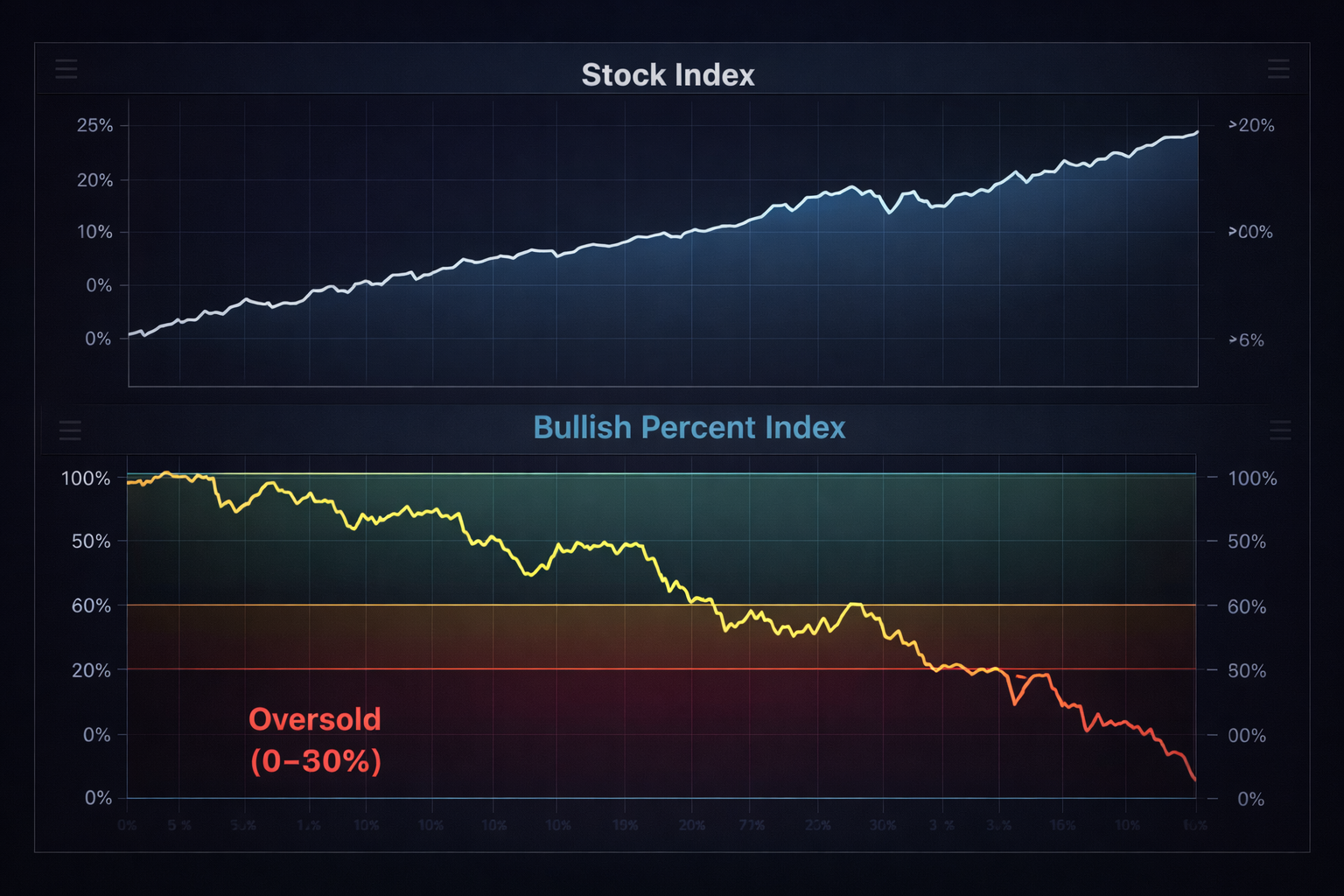
It is important to understand that the BPI does not move in the same way as price indices like the S&P 500 or Nasdaq 100.
A common scenario occurs when the S&P 500 continues to rise while BPI declines. This divergence often signals weakening market participation and increased vulnerability to corrections.
Consider a scenario in early 2026 where AI-driven stocks continue to push major indices higher. The Nasdaq 100 may reach new highs, but if the Bullish Percent Index for technology stocks begins to decline from 65% to 45%, it suggests fewer tech stocks are participating in the rally.
This could indicate:
Narrow leadership (few stocks driving gains)
Rising market fragility
Increased correction risk despite strong index performance
Conversely, if BPI rises alongside index gains, it signals a healthier and more sustainable trend.
Investors typically use BPI in combination with other tools rather than in isolation.
Trend Confirmation: Confirming bullish or bearish market phases.
Sector Rotation Analysis: Identifying strong or weakening sectors.
Timing Entry and Exit Points: Entering when BPI rises from oversold zones.
Risk Reduction: Reducing exposure when BPI reaches overbought levels.
Professional traders often integrate BPI with momentum indicators, volume analysis, and macroeconomic signals to gain a more comprehensive market view.
While useful, BPI is not perfect and has limitations:
It can lag during fast-moving markets.
It depends on point-and-figure methodology, which may differ across data providers.
It does not predict the exact timing of reversals.
It should not be used as a standalone trading signal.
Therefore, it is best used as a contextual indicator rather than a direct buy or sell trigger.
The BPI measures the percentage of stocks in a specific group that are on Point and Figure "buy" signals. Unlike standard price indices, it tracks participation, showing whether a rally is supported by the majority of stocks or just a few heavyweights.
Traditionally, a BPI above 70% is considered overbought, while a reading below 30% is considered oversold. A reading above 50% suggests the "bulls" are in control of the internal market.
BPI is generally considered a lagging to coincident indicator because it requires a Point and Figure reversal to change. However, it can "lead" a market top by showing a decline in breadth before the actual price index starts to fall.
Yes. While the Point and Figure charting behind it is technical, the BPI percentage itself is very intuitive. It is best used as a "market filter" to decide whether to be aggressive or defensive in your portfolio.
While the BPI is updated daily, it is most effective when viewed on weekly charts. Because it filters out minor price fluctuations (noise), it is designed to highlight mid- to long-term trend shifts rather than day-trading signals.
The Bullish Percent Index is a powerful market breadth indicator that helps investors gauge a market's underlying strength beyond price movements. Tracking the percentage of stocks on buy signals provides valuable insight into market participation, risk conditions, and trend sustainability.
When combined with other technical and macro indicators, BPI becomes an essential component of a disciplined investment strategy.
Disclaimer: This material is for general information purposes only and is not intended as (and should not be considered to be) financial, investment or other advice on which reliance should be placed. No opinion given in the material constitutes a recommendation by EBC or the author that any particular investment, security, transaction or investment strategy is suitable for any specific person.