Published on: 2026-09-17
Arabica coffee has fallen towards its lowest level in roughly 10 weeks even as ICE-certified inventories shrink to 217,646 bags, their lowest since 1999. Brazil has simultaneously begun releasing significantly more coffee into global supply channels following months of tighter availability. Futures are increasingly responding to the supply approaching the market rather than the depleted exchange stocks already sitting in warehouses.
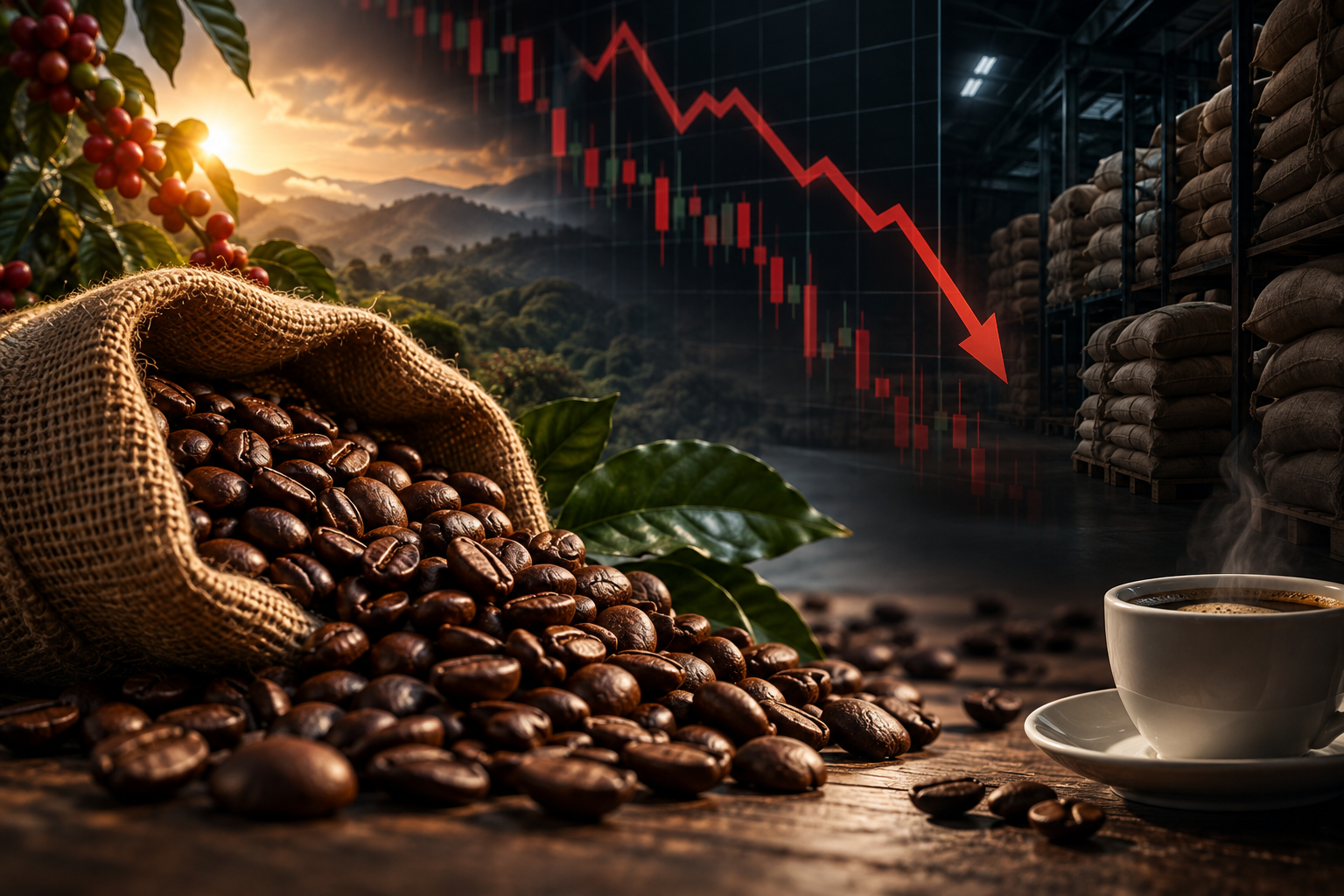
Arabica traded around $2.8170 per pound on 16 September after touching $2.8120 earlier in the week, its lowest level in roughly 10 weeks.
ICE-certified Arabica stocks have fallen to 217,646 bags, the lowest level in 27 years.
Brazil’s Arabica exports reached 2.866 million bags in August, up 25.7% year on year, while total Brazilian coffee exports hit a record August 4.155 million bags, up 31%.
Brazilian coffee shipments to Belgium jumped 245.3% in August, while nearly 64,000 Brazilian bags were awaiting ICE grading by 14 September.
A sustained increase in certified stocks would provide the clearest evidence that Brazil’s stronger supply is finally reaching the ICE warehouse system.
Arabica futures fell 0.7% to $2.8170 per pound at 11:47 GMT on 16 September, according to Reuters, after touching $2.8120 on Monday. That marked the lowest level in about 10 weeks. Prices had traded above $3.50 per pound in July.
ICE inventories have continued moving in the opposite direction. Certified Arabica stocks are now down to 217,646 bags, their lowest level since 1999. These stocks cover exchange-approved coffee available for delivery against Coffee C futures, not all coffee held globally.
The exchange’s immediately deliverable supply has therefore become scarcer while Arabica has fallen sharply from its July high. The shift driving prices is coming from further upstream, where much more Brazilian coffee has started moving into export channels.
Brazil shipped 2.866 million 60kg bags of Arabica coffee in August, up 25.7% from August 2025. Total Brazilian coffee exports reached 4.155 million bags, up 31% year on year and the strongest August in Cecafé’s records.
That acceleration carried into September. Brazilian green-coffee exports averaged roughly 13,500 metric tonnes per working day during the first two weeks of the month, 51.5% above the comparable pace a year earlier, according to government data cited by Reuters.
Those coffee exports in January and August reached 25.073 million bags, still 1.2% below the same period in 2025. Cecafé said August benefited from greater availability of new-crop Arabica after rainfall delayed harvesting and beans arrived in the market earlier in the season.
By late August, Brazil’s 2026/27 harvest was almost complete. Brazil did not spend the year flooding the market. Supply flowed more heavily once the new crop became available. The destination of those exports now provides the link between Brazil’s harvest and depleted ICE inventories.
Brazilian coffee exports to Belgium surged 245.3% year on year in August to 31,500 metric tonnes, equivalent to more than 525,000 60kg bags, according to Brazilian government data analysed by Terra Investimentos and reported by Reuters.
Belgium deserves attention because around 70% of existing ICE-certified Arabica stocks are held in Antwerp. Large Brazilian shipments into Belgium do not automatically become exchange inventory, and the 31,500-tonne total is not itself a measure of ICE-certifiable Arabica. The figure does not show how much of the coffee was Arabica, how much met ICE specifications or how much was intended for exchange delivery. Reuters noted that unusually large Belgian shipments are used as a gauge of excess availability, rather than a one-for-one prediction of future certification.
A more direct route to certification already exists. As of 14 September, 63,955 Brazilian bags were awaiting ICE grading, alongside 960 Kenyan bags. Coffee presented for grading must pass exchange quality requirements before it can become certified inventory.
Reuters also reported that Olam was seeking to certify 150,000 to 200,000 bags for potential delivery against December futures, while Louis Dreyfus was pursuing a similar programme, according to sources familiar with the plans. Both companies declined to comment. Around 300,000 bags of eventual deliveries would more than double current certified inventories, although they would still leave stocks below the roughly one-million-bag level market sources cite as comfortable.
Futures can react before inventories recover when incoming deliveries alter expectations for available supply. Brazil’s crop estimates suggest that August’s export surge also has substantial production behind it.
The USDA forecasts Brazil’s 2026/27 coffee crop at 71.9 million bags, 14% above its estimate for the previous season. Arabica production alone is projected at 47.5 million bags, up 25%.
StoneX is even higher. The consultancy raised its Brazilian crop estimate on 2 September from 75.3 million to 77.2 million bags after fieldwork and yield analysis found better-than-expected performance across producing regions.
The broader global balance has also improved. The International Coffee Organisation now estimates 2025/26 production at 183.6 million bags against consumption of 180.6 million, creating a roughly 3 million-bag surplus after four consecutive deficit seasons. Those earlier deficits help explain why ICE stocks remain exceptionally low even as current production prospects strengthen.
Weather has recently reinforced the improved supply outlook. Rabobank’s 15 September update said the first flowering for Brazil’s 2027/28 crop had appeared across several regions, while above-average rainfall and higher soil moisture had reduced immediate weather concerns.
A major uncertainty remains. NOAA’s 10 September outlook assigns a greater than 90% probability of a very strong El Niño during the Northern Hemisphere autumn and winter of 2026–27. The event raises the probability of characteristic regional weather effects without guaranteeing crop damage in Brazil.
Stronger exports, a larger Brazilian crop, and coffee moving toward exchange warehouses have shifted supply expectations. The physical confirmation is still missing.
ICE-certified inventories remain at 217,646 bags. Brazilian beans awaiting grading must satisfy exchange standards before they enter that total, while future shipments can still move into ordinary commercial channels instead of being delivered against futures.
The 2027/28 crop is also only beginning its development cycle. Recent rainfall has improved early conditions, although flowering still needs suitable follow-up weather before production estimates become reliable.
The next decisive evidence will therefore come from the warehouse data rather than another crop forecast. If Brazilian coffee clears grading and certified stocks begin rising sustainably, the supply recovery will finally show up in ICE. If inventories remain near their 27-year low, the price decline will have moved further ahead of the physical rebuild it anticipates.
No. ICE-certified stocks cover exchange-approved Arabica available for futures delivery, not total global inventories. They can remain extremely tight even while production and exports increase in major producing countries.
Reuters sources indicated roughly 300,000 bags could eventually be delivered, enough to more than double current certified stocks. Even then, inventories would remain below the roughly one-million-bag level cited as comfortable.
Failed ICE grading, slower Brazilian exports, or worsening conditions for Brazil’s 2027/28 crop could weaken expectations for a supply recovery while certified stocks remain near their lowest level since 1999.
Brazilian coffee has now reached the stage where the supply story can be tested against physical inventory data. Successful grading and a sustained increase in certified stocks would show that stronger origin supply is finally rebuilding the exchange buffer. Continued inventory declines would leave a much tighter physical market than the recent price move suggests.
Until certified stocks turn higher, the price decline is running ahead of the inventory recovery it anticipates.