Published on: 2026-09-07
Updated on: 2026-09-07
Most 3x leveraged ETFs target roughly three times their benchmark’s return in a single trading day. Because that leverage resets daily, returns over several days, months, or years are shaped by compounding, volatility, the market's path, and fund costs. The final return can finish above or below three times the benchmark’s cumulative move.
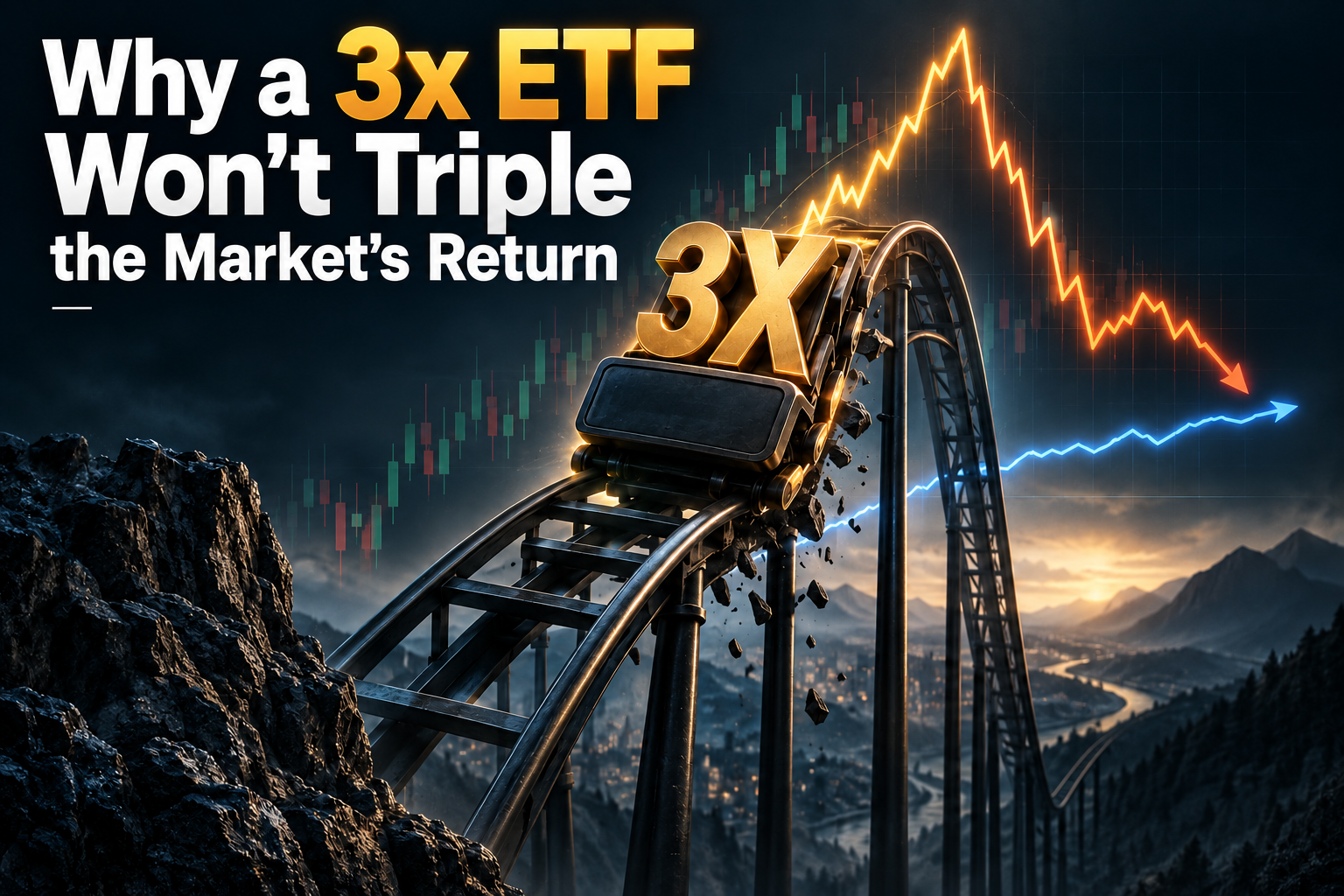
A 3x leveraged ETF usually targets about three times its benchmark’s daily return.
Each daily reset changes the value from which the next gain or loss is calculated.
Persistent trends can make compounding favourable, while repeated reversals can create significant volatility drag.
Fees, financing costs and tracking differences can widen the gap between an ETF’s return and a simple 3x calculation.
The 3x label usually describes a daily investment objective. If the benchmark rises 1% during one trading session, an idealised 3x long ETF aims to gain about 3% before fees and expenses. If the benchmark falls 1%, the fund aims to lose about 3%.
One-Day Move |
Benchmark |
3x ETF Target |
Rises |
+1% |
About +3% |
Falls |
-1% |
About -3% |
ProShares TQQQ is a familiar example. The fund seeks three times the daily performance of the Nasdaq-100 before fees and expenses.
The 3x target then resets for the next trading day. It does not promise that a 10% Nasdaq-100 gain over a month will automatically translate into a 30% TQQQ gain over the same period.
Consider a benchmark starting at 100 and an idealised 3x ETF also starting at 100. If the benchmark rises 10% in one session, it reaches 110. The 3x ETF targets roughly a 30% gain, taking its value to 130.
The next session begins from those new values. A further percentage gain or loss in the ETF is calculated from 130 rather than the original 100.
The fund also resets its exposure so that it can again target about three times the benchmark’s next daily move. Leveraged ETFs commonly use instruments such as swaps and futures to maintain this exposure.
Once that process repeats across multiple sessions, the returns compound. The result depends on the daily moves that occurred along the way.
Two benchmark paths can start at the same value, and both finish 10% higher, yet produce very different results for a daily-reset 3x ETF.
Smoother Path |
Volatile Path |
|
Day 1 benchmark |
+5.00% |
+20.00% |
Day 2 benchmark |
+4.76% |
-8.33% |
Benchmark total |
+10.00% |
+10.00% |
Idealised 3x ETF |
+31.43% |
+20.00% |
In the smoother path, the benchmark gains 5% and then about 4.76%. An idealised 3x ETF gains 15% on the first day and about 14.29% on the second, producing a cumulative return of roughly 31.43%.
In the more volatile path, the benchmark jumps 20% and then falls about 8.33%. It still finishes 10% higher. The 3x ETF gains 60% on the first day but then loses 25%, leaving it only 20% higher.
The benchmark’s cumulative return is identical in both cases. The leveraged outcome is not.
A monthly or yearly benchmark return alone cannot tell you what a daily-reset 3x ETF earned during the same period.
The effect of daily compounding changes with the market environment. Persistent moves in one direction can produce a very different result from repeated gains and reversals.
Assume a benchmark rises 2% on three consecutive days. After three sessions, its cumulative gain is about 6.12%. Multiplying that figure by three gives 18.36%.
An idealised 3x ETF gains 6% each day. Compounding those daily gains produces a return of about 19.10%. The ETF finishes above three times the benchmark’s cumulative return because each gain is applied to an increasingly larger fund value.
Time alone does not create decay. When a benchmark moves consistently in the same direction, daily compounding can work in the leveraged fund’s favour.
Now consider a benchmark that rises 10% and then falls about 9.09%. A starting value of 100 rises to 110 and then returns to roughly 100. The benchmark finishes almost exactly where it began.
An idealised 3x ETF rises 30%, moving from 100 to 130. The next day, it loses about 27.27%, leaving it near 94.55.
The benchmark is flat, while the leveraged ETF is down roughly 5.45%. This effect is commonly called volatility drag. Repeated gains and losses are applied to changing fund values, so choppy markets can steadily push a leveraged ETF away from a simple multiple of the benchmark’s cumulative return.
Daily compounding explains much of the difference, but real funds also have expenses and trading frictions.
Management fees reduce returns over time. Maintaining leveraged exposure can involve financing, derivative and transaction costs, while the fund may not track its daily target perfectly every session.
Volatility drag comes from the mathematics of compounding leveraged daily returns. Fees and financing are actual costs the fund charges or incurs. Both can affect the final result, but grouping them all under the word “decay” can hide what is really happening.
Real 3x ETF returns can therefore differ further from the simplified examples above.
The leverage multiple is only one part of the product. For a position lasting longer than a single session, several other features can affect the outcome:
Daily objective: Check the leverage multiple and how often the exposure resets.
Benchmark: Know the exact index, sector or asset being leveraged.
Volatility: Larger day-to-day swings can increase the difference between the ETF and a simple multiple of the benchmark’s cumulative return.
Market path: Persistent trends and frequent reversals create very different compounding effects.
Holding period: More trading sessions mean more daily resets and more opportunities for compounding and costs to accumulate.
Costs: Expense ratios, financing and tracking differences can further affect performance.
A longer holding period does not automatically produce a worse result. A strong, persistent trend may create favourable compounding, while a much shorter period of sharp back-and-forth moves can produce significant drag.
The key question is how the benchmark behaved during the holding period, not simply how far it moved from start to finish.
No universal maximum holding period is built into a 3x ETF. However, most 3x leveraged ETFs state a daily investment objective, so returns over longer periods can diverge substantially from three times the benchmark’s cumulative move. Volatility, daily resets and costs become increasingly important as more sessions are included.
You can hold a 3x ETF longer than one trading day, but its stated 3x target generally applies to daily performance rather than the full holding period. Long-term results may be above or below three times the benchmark’s cumulative return, depending heavily on the market path and volatility.
“Decay” is often used loosely to describe the loss of value that can arise from unfavourable daily compounding in volatile or reversing markets. Management fees, financing costs and tracking differences can also reduce returns, but these are separate from the compounding effect itself.
Yes. A benchmark can rise and fall before eventually returning to its starting level, while the leveraged gains and losses compound into a negative ETF return. The earlier +10% followed by -9.09% example leaves the benchmark flat, but the idealised 3x ETF is down about 5.45%.
For a multi-day position, the benchmark’s total return is only part of the picture; the pattern of daily gains and losses, volatility and fund costs also shape the outcome. Instead of assuming that a 10% benchmark gain should produce 30%, look at how the benchmark reached that 10%. That path can determine whether a daily-reset 3x ETF finishes near 30%, well above it or far below it.