Published on: 2026-09-09
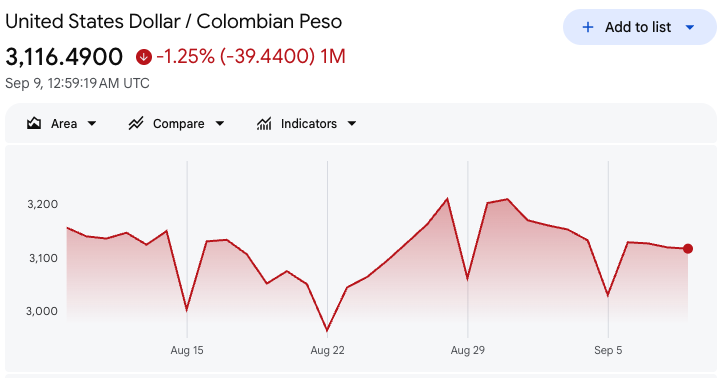
USD/COP is holding near 3,100 because flows supporting the Colombian peso have exceeded the dollars Banco de la República has removed from the market. The central bank bought $399.9 million through reserve accumulation put options during August, close to the full amount on offer, and the pair still trades below where it stood when the programme began.

The official TRM for 9 September was set at COP3,116.47, roughly 17% below where the pair started 2026 and about 18% under its May peak near 3,805.
A 12% policy rate, an export basket dominated by fuels and gold, and a softer global dollar have done more to set the exchange rate this year than anything the central bank has bought.
The year opened with a TRM of 3,757.08 on 1 January, with spot changing hands close to 3,770. The pair rebounded toward 3,805 in May, then turned lower from mid-June in a run of progressively lower highs and lows.
August also showed how volatile the move has been. The official TRM fell to 3,048.12 for 24 August before rebounding to 3,202.79 for 29 to 31 August, a rise of about 5.1%. It reached 3,213.97 on 1 September before falling back toward 3,100. The current level therefore follows a sharp round trip rather than a straight-line peso appreciation.
On 31 July, the board announced a programme to accumulate up to $4 billion in international reserves, its first reserve-accumulation programme since the previous programme ended in October 2024. The first session carried a ceiling of $400 million, with the options exercisable between 4 and 31 August.
The auction design keeps the central bank out of the market unless the peso is already firm. Accumulation runs through put options that can only be exercised when the TRM sits below its average over the previous 20 business days.
Bids in the first auction totalled $877.5 million against the $399.9 million awarded, at a cut-off premium of $13,000 per $1,000. Auctions are monthly, but the amount is announced in each individual call, so nothing commits the bank to another $400 million in September.
BanRep has been explicit that the programme is precautionary and compatible with its monetary policy stance, with purchases spread out rather than concentrated in order to limit any effect on the exchange rate. Neither the instrument nor the stated intent supports treating it as an effort to weaken the peso.
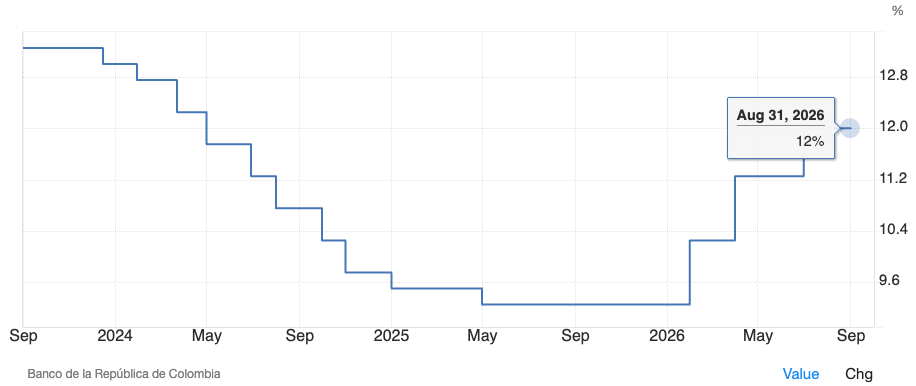
The first support is the rate differential. The board raised the benchmark by 75 basis points to 12% at its June meeting and held it there on 31 July. A double-digit nominal policy rate gives Colombian assets a substantial yield advantage and makes COP carry positions more attractive, although high rates alone do not prove portfolio capital has been flowing into the country.
The second is the export mix. Fuels and extractive products made up 40.0% of July’s shipments and grew 8.3%, while the mining and energy basket reached $17.52 billion between January and July, a gain of roughly 28.4% and 53.9% of total exports. Non-monetary gold did much of the heavy lifting, at $4.57 billion and up 90.9%. Elevated crude and bullion prices convert directly into dollar receipts.
The third support has come from capital inflows associated with fiscal financing. Villar noted in August that international government bond issuance and foreign purchases of Colombian public debt can increase the supply of foreign currency, paradoxically allowing a large fiscal deficit to contribute to peso appreciation in the short run. Direct investment has added to it, with FDI reaching $8.138 billion in the first half, up 31.1% from a year earlier.
Against flows of that size, $399.9 million spread across a month of eligible sessions carries limited weight in a market where the 25 August session alone turned over $1,744 million.
Annual inflation accelerated to 6.24% in August from 6.03% in July, with a monthly print of 0.39% and a year-to-date figure of 5.35%. The monthly reading came in above the 0.27% consensus in BanRep’s own analyst survey, leaving headline inflation more than double the 3% target.
For households, and for the credibility of the target, that is an unwelcome result. For the currency, the inflation surprise works differently because it reduces the scope for near-term easing. If markets expect the 12% rate to remain in place for longer, Colombia’s yield advantage can continue supporting COP. The cost is that the same restrictiveness weighs on credit and activity.
Aggregate export figures do not show collapse. July shipments were $4,690.7 million FOB, up 5.9% year on year, and the January to July total reached $32,489.2 million, a rise of 12.7%.
The strain is concentrated in the non-commodity basket. Between January and July, unroasted coffee fell 9.9%, and flowers dropped 7.9%, while bananas rose 22.5% and crude palm oil gained 32.2%. Manufacturing exports declined 2.5% over the same period.
Exporters bill in dollars but pay wages, freight and inputs in pesos, so a stronger currency compresses margins even when volumes hold.
For importers, a stronger peso lowers the local-currency cost of foreign goods and inputs and can moderate imported inflation. Separately, Colombia’s imports rose 27.0% year on year to $6,775.8 million CIF in June, contributing to a wider merchandise trade deficit of $2,161 million FOB. The increase cannot be attributed to the exchange rate alone.
Several counterweights have been building through the second half. A retreat in oil or gold would remove the export leg quickly, given how much of 2026’s growth came from those two lines. A firmer US dollar would do the same from the other direction. Any eventual easing cycle from 12% narrows the carry appeal.
Fiscal policy carries the clearest risk. The updated Financial Plan points to a 2027 central government deficit of 9.4% of GDP and net debt of 66.2%, against 4.5% and 58.9% in the 2026 medium-term framework. BanRep has stressed that these are a diagnosis of risk rather than government targets, and that the numbers should be read as a starting point until spending rationalisation materialises.
The external accounts have moved with them. The second-quarter current account deficit reached $4,702 million, or 3.5% of quarterly GDP, and the first-half shortfall was $5,981 million, equal to 2.3% of semester GDP. None of this guarantees a weaker peso, though it does weaken the case for extrapolating the 2026 move indefinitely.
The next rate decision lands on 30 September, with August’s inflation surprise making a hold easier to defend than a cut. Beyond that, the monthly reserve auction calls will show whether BanRep sizes future operations near the first ceiling or below it.
Subsequent CPI prints, the fiscal adjustment bill attached to the 2027 budget, oil and gold pricing, and Federal Reserve policy round out the list. Year-end forecasts remain widely dispersed, and there is little value in anchoring to a single number.
What stands out in 2026 is the durability of the peso through a stretch in which the central bank began rebuilding reserves, inflation climbed further above target and the 2027 fiscal outlook deteriorated. The reserve programme fits that picture. BanRep is using a period of currency strength to restore an external buffer, not defending a particular level on the screen.