Published on: 2026-09-08
A U.S.-listed ETF can keep trading after the markets for some of its overseas holdings have closed. New information can move the ETF while those securities have no opportunity to trade again until their local exchanges reopen. The resulting premium or discount may reflect different pricing times rather than clear evidence that the ETF is mispriced.
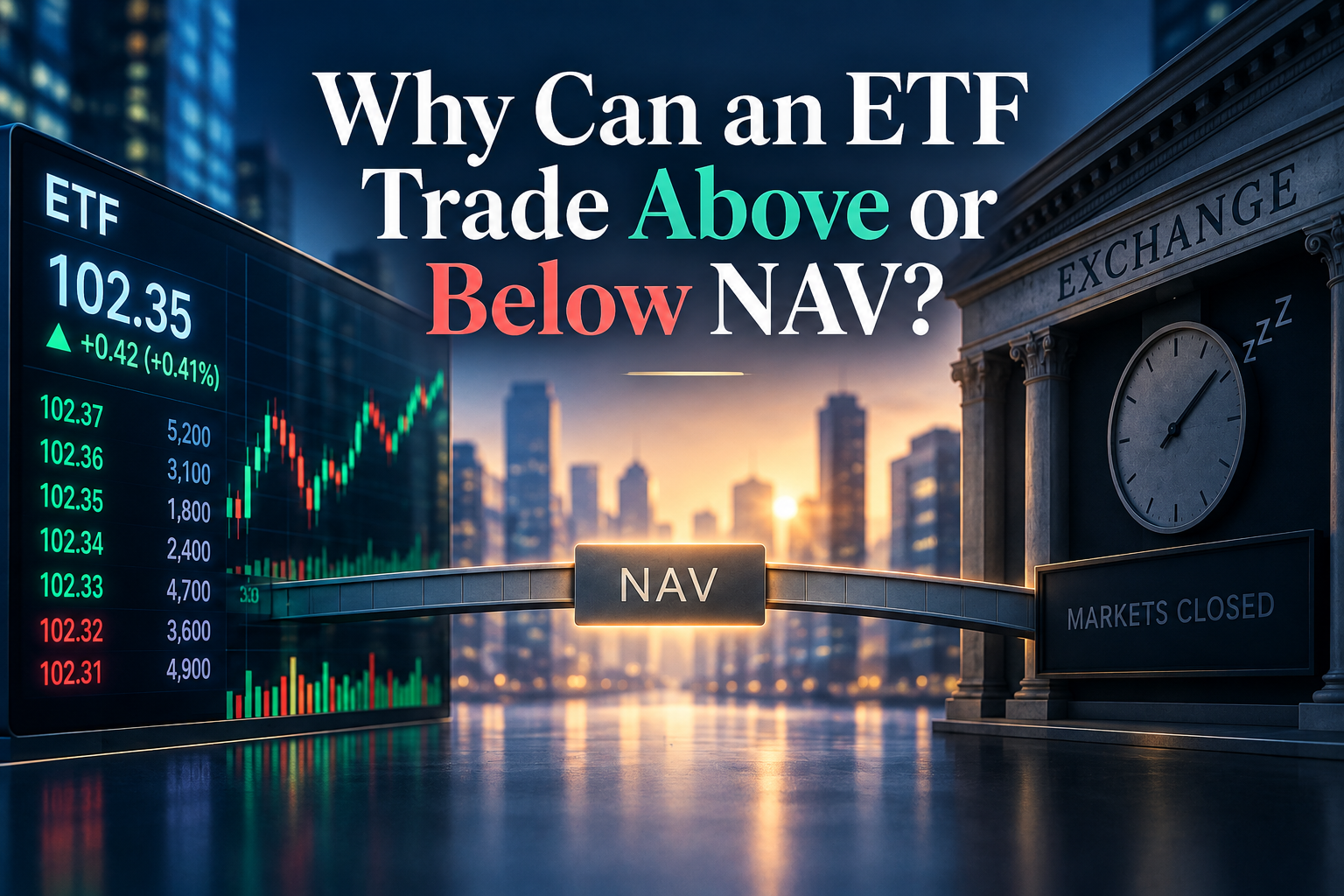
An ETF can continue trading even when some of its underlying markets have already closed.
Its market price and NAV may reflect information from different points in time.
A premium or discount does not automatically mean an ETF is overpriced or underpriced, especially when foreign holdings are not currently trading.
Arbitrage still helps keep ETF prices aligned with portfolio value, but it becomes less precise when the underlying securities cannot be traded at the same time.
An ETF has a market price and a net asset value, or NAV. The market price changes throughout the trading session as buyers and sellers place orders, while NAV represents the per-share value of the ETF’s portfolio after accounting for its assets and liabilities.
Measure |
What it tells you |
ETF market price |
The price buyers and sellers agree on while the ETF is trading |
NAV |
The per-share value of the underlying portfolio |
Premium |
The ETF market price is above NAV |
Discount |
The ETF market price is below NAV |
The size of the premium or discount can be expressed as:
Premium or discount = (market price − NAV) ÷ NAV × 100
ETF issuers generally calculate official NAV once each business day under their valuation procedures. The comparison gets harder when the ETF and its holdings don't trade at the same time because their prices may reflect different sets of information.
Consider a U.S.-listed ETF that owns Japanese shares. Tokyo closes many hours before the U.S. stock market, so the Japanese securities stop trading while the ETF remains active in New York.
Fresh information can arrive after Tokyo closes, including:
economic data or central-bank decisions;
moves in global stock or sector markets;
company-specific news; and
changes in foreign-exchange rates.
The Japanese stocks still have valid last-traded prices, but those prices may no longer reflect everything the market has learned since Tokyo closed.
This timing mismatch can be particularly noticeable with Asian markets because they have little or no overlap with normal U.S. trading hours. European markets usually overlap with the U.S. session for part of the day, but their exchanges also close several hours before U.S. trading ends.
The ETF can keep responding to new information during that period, even though its foreign holdings cannot record another trade. Schwab describes this as an important price-discovery function of international ETFs.
A closed underlying market does not leave the ETF without pricing information. Market makers can look at other active markets to estimate where the underlying securities might trade if their exchanges were open.
They may use:
index futures;
American depositary receipts, where available;
related ETFs and global equity markets;
currency movements; and
fresh economic or company news.
These signals help estimate the portfolio’s current value, even though some holdings cannot be traded directly.
Consider a simple example:
Example |
Value |
Last portfolio value |
$100 |
Estimated current value |
$102 |
ETF market price |
$102 |
Assume the portfolio was valued at $100 per ETF share when its local market closed. Positive news then arrives, and market participants estimate that those holdings could now be worth closer to $102. The ETF may begin trading near $102 before the underlying securities have another opportunity to move.
Compared with the earlier $100 valuation, the ETF appears to trade at a 2% premium. Whether that represents genuine mispricing depends on how current the underlying valuation is.
Currencies can also affect the calculation. If a U.S.-listed ETF owns yen-denominated shares, a move in USD/JPY can change the portfolio’s dollar value even while Japanese stock prices remain unchanged.
Not always. What matters is when each price was formed.
Return to the earlier example. The portfolio was last valued at $100, while the ETF now trades at $102. If current market information also suggests that the underlying securities are worth around $102, the apparent 2% premium may largely reflect the age of the earlier valuation.
BlackRock notes that some premiums and discounts in international ETFs can arise because ETF prices and underlying asset prices are measured at different times. The comparison can make the ETF appear farther from current portfolio value than it actually is.
Fund providers may also adjust foreign closing prices when later market moves make those prices less representative of current value. These fair-value adjustments can reduce part of the apparent premium or discount.
The SEC has long recognised that a foreign market’s closing price may no longer be reliable when significant events occur before a U.S. fund calculates its NAV. In those circumstances, funds may use fair-value procedures instead of relying entirely on the earlier local close.
Fair-value estimates cannot remove all uncertainty. A large premium or discount can still reflect genuine market stress, poor liquidity or another disruption. A gap alone does not establish that the ETF is wrongly priced.
The ETF creation and redemption process normally helps keep market prices close to portfolio value.
If an ETF trades above the value of its holdings, an authorised participant may buy the underlying basket, exchange it for newly created ETF shares and sell those shares into the market. A similar process can work in reverse when the ETF trades at a discount.
The process is more difficult when the underlying market is closed. The authorised participant cannot necessarily buy or sell all of the required foreign securities at the same time as the ETF trade.
Market makers can hedge some of that exposure using futures, ADRs, related ETFs or currencies. These hedges help, though they rarely match the underlying basket exactly.
That uncertainty can widen bid-ask spreads and allow larger temporary differences between ETF market price and NAV. Arbitrage still operates, but it is harder to execute precisely while part of the portfolio is unavailable.
This is one reason a modest premium or discount in an international ETF during non-overlapping market hours may need a different interpretation from the same gap in a highly liquid domestic ETF whose holdings are actively trading.
A premium or discount is easier to interpret once you know whether the underlying market is open. If the holdings stopped trading several hours earlier, part of the difference may come from the timing of the prices being compared.
When a premium or discount appears, check:
Market hours: Is the underlying market currently open?
Last trade: How long ago did the holdings stop trading?
New information: Has important economic, company or market news arrived since the local close?
Market disruption: Is there a holiday, trading halt or unusually volatile session?
Bid-ask spread: Has the ETF’s spread become noticeably wider?
Persistence: Does the gap remain after the underlying market reopens?
The last point is particularly useful. Once the foreign exchange reopens, its securities can react to information released while they were closed. If the ETF had already reflected much of that change, the underlying prices may move closer to the value implied during U.S. ETF trading.
The ETF should not be treated as a precise forecast of the next local-market opening. Expectations can change, and market makers can misestimate fair value.
A brief difference during normal time-zone gaps differs from a large, persistent divergence during stressed markets. Trading halts, impaired liquidity, extreme volatility or disruptions to the creation and redemption process deserve closer attention.
Yes. An ETF follows the trading hours of the exchange where it is listed. Foreign holdings may trade on different schedules, allowing the ETF to remain active for several hours after their local markets close.
Not necessarily. If the underlying securities stopped trading earlier, the ETF may already reflect newer information. The apparent premium can partly result from comparing a current ETF price with earlier prices for its foreign holdings.
Authorised participants may be unable to trade the full underlying basket while its market is closed. Futures and other hedges can reduce their exposure, but they rarely match the basket perfectly, making arbitrage less precise.
The underlying securities can respond to information released while the ETF was closed. Their prices may move closer to the value already reflected in ETF trading, reducing a gap that was mainly caused by different trading hours.
An ETF premium or discount is most useful when its market price and portfolio valuation reflect comparable information. When the holdings market is closed, the ETF can react while the underlying securities wait for their next session. The gap makes more sense when investors consider when each price was formed rather than treating it automatically as evidence of mispricing.