Published on: 2026-01-13
Updated on: 2026-01-13
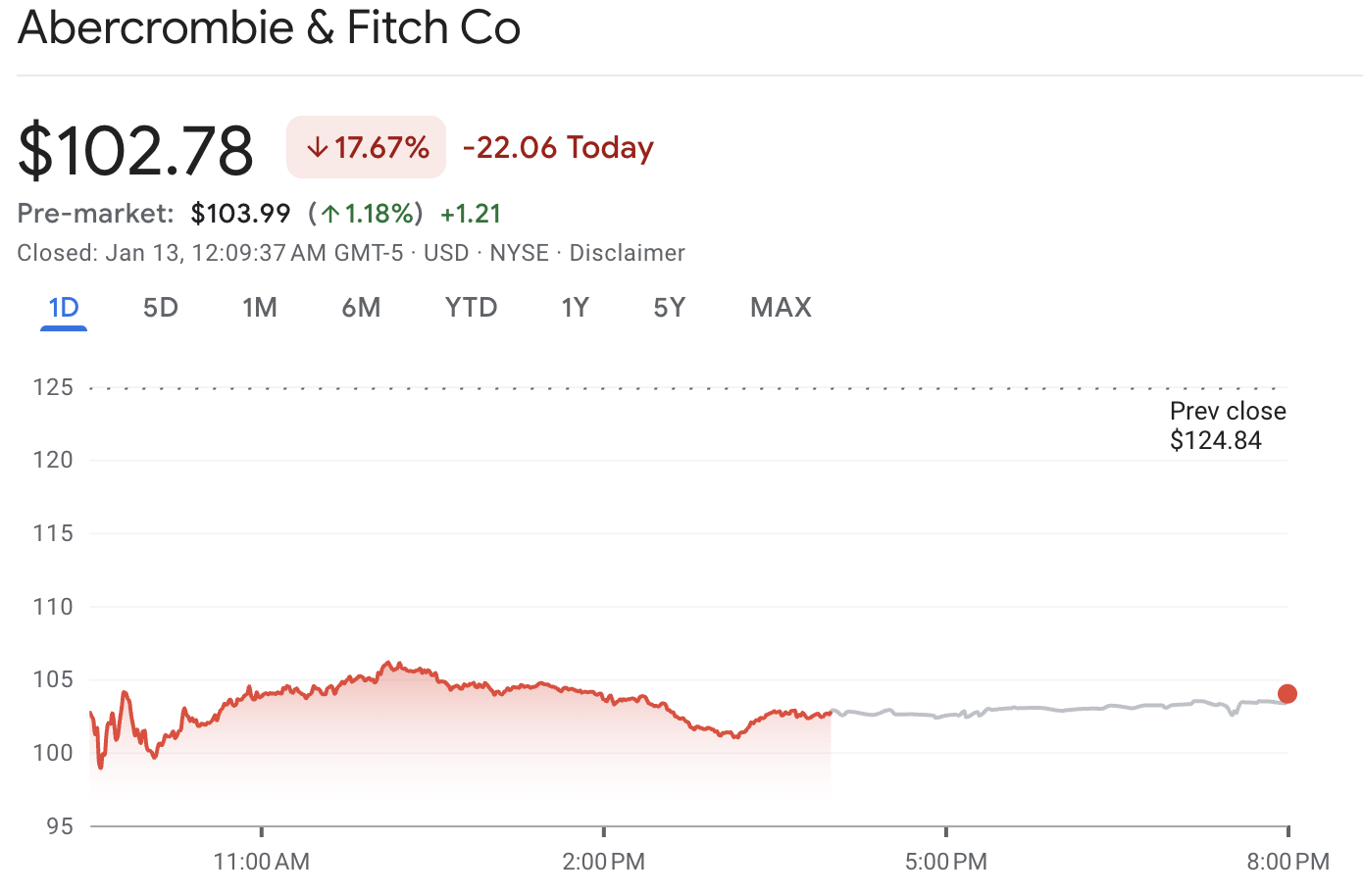
Abercrombie & Fitch (ANF) is sliding sharply after the company published a holiday-quarter business update that fell short of the market's robust expectations. ANF stock last traded around $102.78, down around $22.06, which is roughly -17.67% from the prior close.
What made the move feel like a "shock" is that the guidance change was not huge on paper. But ANF stock had been priced for strong upside after a powerful rally late in 2025.
When management reduced the annual sales forecast and highlighted significant tariff expenses, investors responded quickly.
The core reasons behind ANF's stock decline are straightforward:
The full-year sales growth forecast has been revised to "at least 6%," a decrease from the previous range of 6% to 7%.
Tariff costs have become a more significant issue, with the company projecting approximately $90 million in tariff costs (after mitigation).
Investors were positioned for a stronger update after a big run in November and December 2025.
The apparel group sold off together, which amplified the downside.
| Item | Value |
|---|---|
| Last price | $102.78 |
| Day change | -$22.06 (about -17.67%) |
| Day range | $98.80 to $106.20 |
| Previous close | $124.87 |
| 52-week range | $65.40 to $147.91 |
ANF's drop was broad and fast, with sellers in control from early trading and little relief into the close.
A move of this size tells traders one thing clearly: this was not just normal profit-taking. The market repriced expectations.
The sell-off began after Abercrombie issued a business update (filed as an 8-K with the SEC) that included revised targets for the fourth quarter and the complete fiscal 2025.
Here is what the company updated versus what it had previously guided.
| Metric | New outlook | Previous outlook |
|---|---|---|
| Full-year net sales | Growth of at least 6% | Growth 6% to 7% |
| Full-year operating margin | Around 13% | 13.0% to 13.5% |
| Full-year EPS | $10.30 to $10.40 | $10.20 to $10.50 |
| Full-year capex | About $245M | About $225M |
| Q4 net sales | Growth around 5% | Growth 4% to 6% |
| Q4 EPS | $3.50 to $3.60 | $3.40 to $3.70 |
In short, the market did not focus on the parts that stayed steady. It focused on what was a ceiling on growth and margin.
When ANF stock falls 15% to 20% on a guidance update, it usually means the market was already leaning one way.
It is the central reason ANF stocks fell in premarket trading.
Investors tend to treat ranges as a sign of confidence. Moving from 6% to 7% to "at least 6%" removes the upper band that traders were anchoring to.
Even if actual results end up strong, the market often reprices the stock immediately when guidance becomes less ambitious.
The company stated its outlook includes tariff impacts "in accordance with trade policies as of January 9, 2026.
Additionally, that net of mitigation efforts, the full-year outlook assumes approximately $90 million of tariff expense, or about 170 basis points of net sales.
That is a real number with real margin implications. It also introduces uncertainty, because trade policy can shift again.
Furthermore, multiple apparel and footwear retailers issued more muted updates ahead of the ICR conference, pointing to cautious discretionary spending and value-seeking behavior.
That matters because even strong operators can trade down when the whole group is de-risking.
This is the part traders feel, even when they do not write it down.
When a stock is loved, the market demands upside surprises. A guidance update that is still solid can still be treated as a disappointment if it suggests:
Growth is normalizing
Costs are rising
The next beat will be harder
That is why "guidance shock" can happen without a true fundamental shock.
| Indicator | Value | Signal |
|---|---|---|
| RSI (14) | 24.574 | Oversold |
| MACD (12,26) | -6.62 | Sell |
| ADX (14) | 43.241 | Sell |
| Stoch (9,6) | 15.739 | Oversold |
| Williams %R | -88.16 | Oversold |
| ATR (14) | 4.0914 | High volatility |
| ROC | -20.786 | Sell |
From a technical analysis perspective, ANF stock is experiencing a short-term decline following a significant gap down, and momentum indicators indicate that the stock is oversold.
The daily technical dashboard indicates a "Strong Sell" overall view, with the 14-day RSI at 24.574, which is firmly in oversold territory.
Oversold does not mean the stock must bounce immediately. It suggests the sell-off has been intense enough that a pause, or a sharp snapback, becomes more likely than it was a week ago.
| Moving average | Simple | Signal |
|---|---|---|
| MA5 | 103.44 | Sell |
| MA10 | 109.72 | Sell |
| MA20 | 119.47 | Sell |
| MA50 | 123.48 | Sell |
| MA100 | 124.82 | Sell |
| MA200 | 115.99 | Sell |
ANF stock is trading below key moving averages on the same daily read, which is typical after a gap-down session.
Using classic pivot points from the same technical source:
Support (S1 / S2 / S3): 100.59 / 99.73 / 98.07
Pivot: 102.26
Resistance (R1 / R2 / R3): 103.12 / 104.79 / 105.65
Today's low near the high-$90s area aligns with those lower support bands, which is why that zone now matters for short-term direction.
A hold above the $98 to $100 support zone, followed by a move back above the pivot near $102.
A reclaim of the 5-day moving average area near $103 to $105 as volatility cools.
A clean break below the $98 area, which would suggest the gap-down move is still unfolding.
Weak rebounds that quickly falter near resistance typically indicate that sellers remain engaged.
A sharp one-day sell-off often creates a two-part story: the headline move, and then the follow-through.
Here are the upcoming signals that matter most:
Any added color from management at investor meetings
Tariff updates and mitigation progress
Full earnings in early March 2026 (estimated)
Whether the stock stabilizes near support
ANF is falling after a business update that softened full-year sales growth guidance to "at least 6%" and highlighted tariff-related cost pressure, which disappointed investors who positioned for a stronger upgrade.
Yes. The guidance wording changed, the sales growth outlook became less ambitious, and the company explicitly called out tariff expenses.
ANF said its full-year outlook assumes about $90 million of tariff expense, net of mitigation efforts, equal to about 170 basis points of net sales.
Several indicators indicate oversold conditions, including a 14-day RSI of 24.574, which is below the typical 30 level many traders use for oversold signals.
In conclusion, ANF stock is falling because the market repriced the story after a guidance update. The company still expects growth and strong margins, but it trimmed the sales outlook, raised planned investment, and attached a clear tariff cost assumption to the forecast.
At the same time, retail sentiment has become more cautious, and the chart experienced a significant technical breakdown, pushing indicators into oversold conditions.
For traders, this is now a levels-and-risk-management market. Bounces are possible, but follow-through matters more than headlines.
Disclaimer: This material is for general information purposes only and is not intended as (and should not be considered to be) financial, investment or other advice on which reliance should be placed. No opinion given in the material constitutes a recommendation by EBC or the author that any particular investment, security, transaction or investment strategy is suitable for any specific person.