Published on: 2026-06-09
Updated on: 2026-06-09
Volatility measures how much and how fast prices change in a market. If prices fluctuate rapidly, volatility is high. If prices move slowly and stay within a small range, volatility is low.
It does not predict whether prices will go up or down. It only shows how active or unstable the price movements are. For example, if a stock goes from $100 to $101 in one day, that’s low volatility. If it drops from $100 to $90 and then climbs back to $98 in the same day, that’s high volatility.
Traders often check volatility before making a trade. It affects risk, where to set stop-losses, how big a position to take, profit goals, and trading discipline.
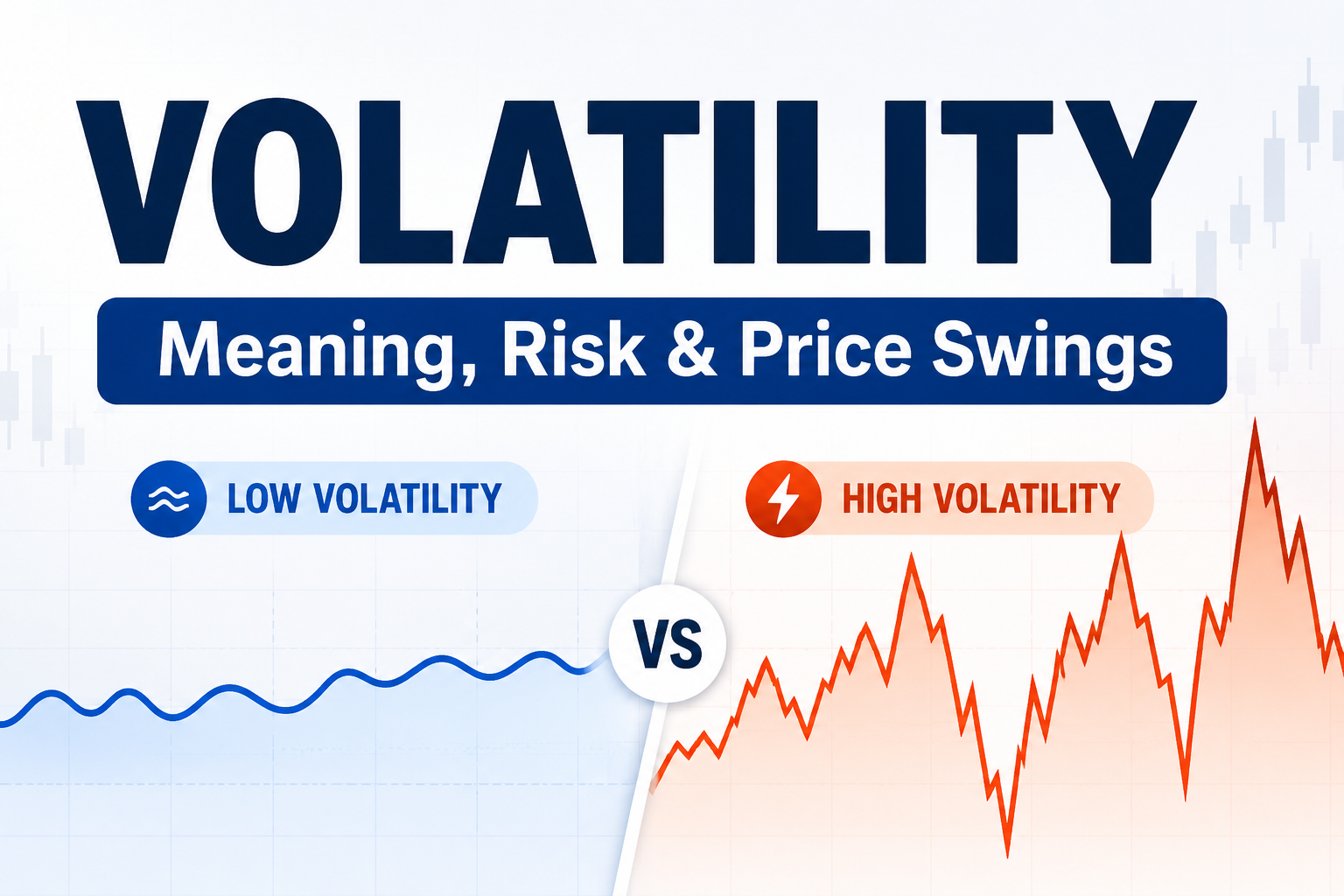
Volatility affects how trades work. In a calm market, prices usually stay within a narrow range. Traders might use smaller profit targets and tighter stop-losses.
In a volatile market, prices can move quickly and by large amounts. This can mean more chances to trade, but also faster losses if you are not ready. The problem comes from using a slow-market plan in a fast-moving market.
For example, a stop-loss that works in a calm market might be too close in a volatile one. The price could hit the stop just because the normal range is now wider. That’s why traders often change their trade size, stop-loss distance, and profit targets when volatility goes up or down.
Volatility usually increases when there is greater uncertainty. Traders react to new information, and prices can move sharply as buyers and sellers change their positions. Common causes of volatility include:
earnings reports;
interest rate decisions;
inflation or jobs data;
political or geopolitical events;
unexpected company news;
low market liquidity;
panic selling or aggressive buying.
For example, a stock can become volatile after earnings if the company’s results are much better or worse than expected. A currency pair might move sharply if a central bank surprises the market with a rate change.
Volatility can catch beginners off guard because prices may move faster than they expect. A trade that seems safe can quickly become stressful if the market starts moving in bigger swings.
A common mistake is using the same trade size and stop-loss for every market. In a calm market, a small stop-loss might work. In a volatile market, normal price moves could hit that stop.
Another mistake is chasing quick price moves. When the market jumps or drops fast, traders might enter late because they don’t want to miss out. If the move reverses, losses can come just as quickly.
Being prepared pays off in volatile markets. Traders should know how much the market is moving before deciding how much risk to take.
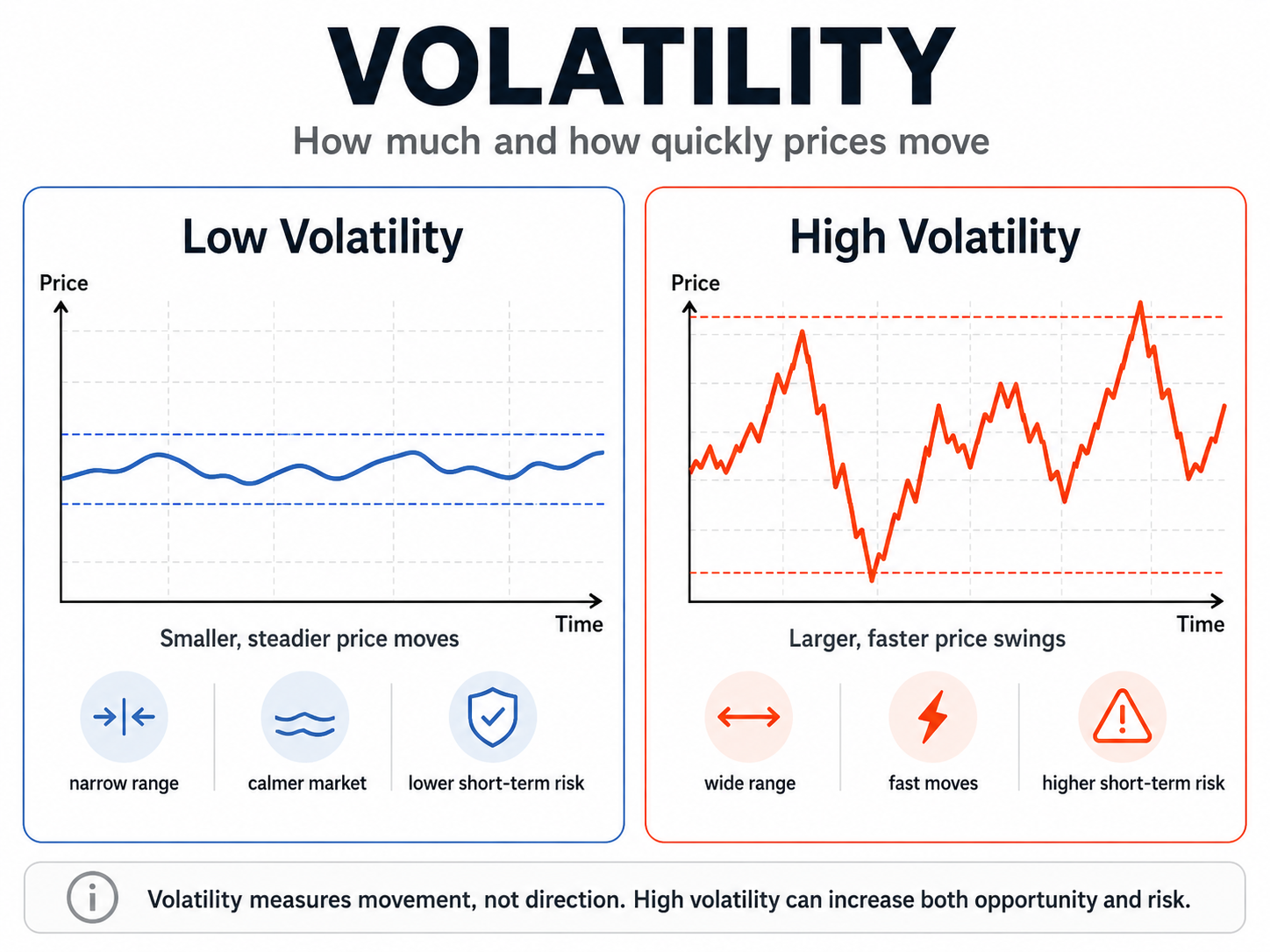
High volatility can benefit short-term traders by creating greater price movement. But it also means you need to control risk more carefully. Low volatility might seem safer since prices move slowly. But it can also mean weak trade setups, slow progress, or false breakouts if traders expect more movement than the market gives.
Traders may hear terms such as historical volatility, implied volatility, and realised volatility. Historical volatility measures how much an asset’s price has moved in the past. Implied volatility reflects what traders expect for future price movements, especially in options. Realised volatility is what actually happened over a certain time.
For most beginners, the key idea is simple: volatility helps you see if a market is calm, active, or unstable.
Before trading a volatile market, traders may ask these questions to help them avoid making a regular-sized trade in a market that’s acting differently than usual:
Is my position size too large?
Is my stop-loss too tight for the current price range?
Is there major news driving the move?
Is the market liquid enough to enter and exit easily?
Am I chasing the move because of emotion?
Average True Range (ATR): An indicator that shows the average size of price movement over a chosen period.
Implied Volatility: Expected future price movement, often used in options trading.
Liquidity: The ease of buying or selling an asset without causing a large price move.
Stop-Loss Order: An order used to close a trade if the price moves against the trader.
Risk Management: The process of controlling potential losses in trading.
VIX: A market index often called the fear gauge because it tracks expected U.S. stock market volatility.
Volatility isn’t good or bad on its own. It creates chances because prices move more, but it also brings more risk. Traders should adjust their position size, stop-loss levels, and expectations as volatility changes.
No. High volatility just means prices are moving a lot, either up or down. A stock that jumps 10% in one day is volatile, and so is a stock that drops 10% in a day.
Traders measure volatility with tools such as Average True Range, Bollinger Bands, and implied volatility in options. Many beginners use ATR because it shows the average price range in an easy way.
Volatility often goes up during news events because traders react to new information all at once. Earnings reports, inflation numbers, and central bank decisions can quickly change what people expect, making prices move faster than normal.
Volatility shows how much and how fast prices move. High volatility can bring more opportunities, but it also means you need to manage risk more carefully.
For beginners, the main lesson is simple: check how fast the market is moving before you trade. Even a good setup can turn risky if your position size, stop-loss, or leverage doesn’t fit the volatility.