Published on: 2026-09-08
Updated on: 2026-09-08
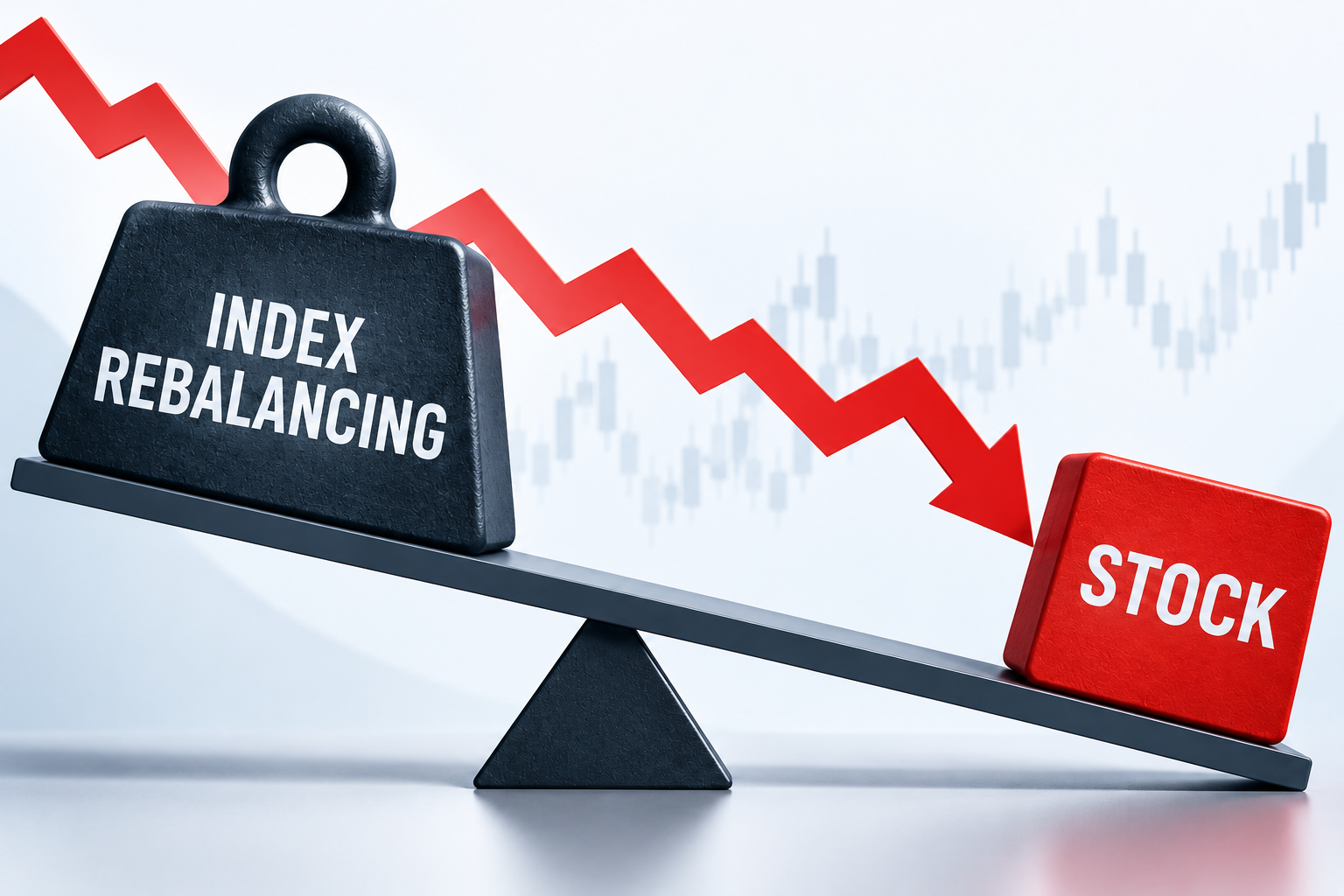
A stock can fall sharply even when there is no earnings warning, analyst downgrade or fresh deterioration in the underlying business. One possible explanation is index rebalancing, where a benchmark change alters how much exposure index-tracking funds are required to hold. Because those portfolios are designed to follow an index rather than make a fresh judgment on every constituent, the resulting trades can affect a share price even when the company itself has released no new information.
Index rebalancing can create mechanical buying and selling without a new company-specific catalyst.
The most predictable flows come from funds that actually track an index, not from all assets merely benchmarked against it.
Research on Hang Seng Index weight-cap reductions found that mandatory passive selling was associated with about a 0.6% decline in abnormal returns.
Large rebalance flows do not guarantee large price moves because liquidity, arbitrage and advance positioning can absorb part of the adjustment.
An index is not a static list of companies. Its constituents and weights can change because of market-cap movements, free-float adjustments, eligibility rules, corporate actions or scheduled reviews. When those weights change, funds designed to replicate the benchmark need to adjust their portfolios so their holdings continue to resemble the updated index.
Consider a simplified example. If $500 billion actually tracks an index and Stock A has a 1% weight, that implies about $5 billion of index-linked exposure. If the stock’s weight falls to 0.8%, the equivalent exposure drops toward $4 billion. Index trackers would need to reduce roughly $1 billion of exposure in aggregate, before allowing for derivatives, different implementation methods and other offsets.
The word “tracks” matters. Assets that merely use an index as a benchmark are not necessarily subject to the same portfolio constraint. An active manager benchmarked against an index can choose to remain overweight, underweight or even avoid a constituent entirely. The most mechanically predictable flow comes from assets that actually replicate or closely track the index.
FTSE Russell illustrates the distinction. It reported approximately $10.6 trillion in assets benchmarked to the Russell U.S. Indexes as of the end of December 2023, but only about $2 trillion was passive. Treating the entire benchmarked amount as automatic rebalance flow would substantially overstate the likely mandate-driven trade.
A 2025 working paper by Hongcheng Xu of Oxford’s Saïd Business School provides unusually clean evidence. The study examined Hang Seng Index constituents whose weights had to be reduced because they exceeded the index’s weight cap. The index methodology, rather than a new earnings release or corporate event, required their weights to come down.
That created a quasi-experiment in which passive funds tracking the Hang Seng Index had to rebalance around what the study describes as information-free flows. The paper estimates that mandatory weight reductions induced about a 0.6% decline in abnormal returns for the affected stocks.
The finding does not imply that every rebalance produces the same effect. It does provide direct evidence that required passive selling can move prices even when the index adjustment itself contains no new information about the company.
The amount of required trading depends on how far a stock’s target weight changes. A reduction from 1% to 0.8% calls for a proportional trim. A deletion can take the target weight all the way to zero, meaning an index tracker may need to remove the position associated with that benchmark entirely.
| Index change | Typical response by an index tracker |
|---|---|
| Weight reduced | Position is trimmed |
| Stock deleted | Benchmark-linked position may be sold |
| Weight increased | Additional exposure may be required |
The price response is not determined by the index decision alone. A deletion from a lightly tracked benchmark may create limited trading, while a change in a widely tracked index can produce a much larger adjustment. Liquidity is equally important. A large-cap stock trading billions of dollars a day can absorb a flow that might be disruptive in a thinner security.
The size of the mandate-driven adjustment matters, but so does the market’s capacity to absorb it.
Index changes are usually announced before they become effective. That gives hedge funds, arbitrage desks and other market participants time to estimate which securities index trackers will eventually need to buy or sell.
A stock scheduled for a weight reduction or deletion can weaken after the announcement rather than waiting for the formal rebalance. Traders expecting future passive selling may reduce exposure or sell ahead of the required index flow. Additions can experience the opposite dynamic as participants position for expected demand.
This advance positioning is why the effective date should not be treated as the starting point of the price response. By the time passive funds complete their adjustments, part of the expected flow may already have been reflected in the market price.
The effective date can still produce exceptional volume because index trackers eventually need to align their holdings with the revised benchmark. Many changes are implemented around the market close, where closing auctions allow large numbers of orders to transact at a common closing price. For a fund measured against a closing benchmark level, executing near that price can help reduce tracking differences.
The scale can be substantial. FTSE Russell reported that $219.6 billion traded at the close across Nasdaq and NYSE during the June 2024 Russell U.S. reconstitution.
Yet unusually large volume should not be confused with an equally large price distortion. Predictable flow can be absorbed by liquidity providers, arbitrageurs and other investors willing to take the opposite side of the trade.
S&P Dow Jones Indices examined S&P 500 additions and deletions from 1995 through June 2021 and found that the traditional “index effect” had been in structural decline. The research identified improved stock liquidity as one possible explanation for the weaker effect over time.
Large mandate-driven flows can affect prices, but their magnitude depends on how much of the trade was anticipated and how easily the market can absorb it.
Not necessarily. A stock can lose index weight because another constituent became larger, its free float changed, an index methodology rule was triggered or it fell below an eligibility threshold. None of those events automatically means earnings, cash flow or competitive conditions deteriorated on the rebalance date.
Fundamentals can still matter indirectly. A company whose market value has fallen for months because of weaker operating results may eventually become too small for a particular index. In that case, the deletion creates a new mandate-driven flow, but the circumstances that led to the deletion were not information-free.
The useful distinction is between the reason the company reached an index threshold and the trading generated once the benchmark changes.
There is no automatic rebound. If selling pressure came partly from a temporary imbalance between index trackers and available buyers, that pressure can fade once required portfolio adjustments are completed. Other investors may then step in if they consider the resulting valuation attractive.
However, the stock’s next move depends on more than the disappearance of passive selling. Liquidity, remaining fundamental concerns, the amount of advance positioning and longer-term changes in institutional ownership can all matter. Removal from a widely tracked benchmark can also reduce a persistent source of passive ownership beyond the one-day rebalance.
Completion of the index trade removes one source of supply, but it does not determine fair value or recreate the previous price.
No single signal proves that index flows caused a decline, so the better approach is to look for several pieces of evidence at the same time.
Start with the index calendar. Check whether the company has recently been added, deleted or reweighted, then compare the announcement and effective dates with the share-price move. Next, examine volume. An unusual surge around the rebalance, particularly near the close, can support the case for index-related execution.
It is also useful to compare other stocks affected by the same review. If several deletions weaken while additions strengthen during the same window, the common index event becomes a more credible explanation. The amount of assets actually tracking the benchmark and the size of the expected flow relative to normal daily trading volume provide further context.
Company news, sector moves and broader market conditions still need to be checked separately. The closer the index change, timing and trading activity align, the stronger the case that benchmark-related flows contributed to the move.
Index rebalancing is a reminder that a falling share price does not always carry new information about the underlying business. Portfolio mandates can create predictable demand or supply, and empirical evidence shows that those flows can affect returns even when the index change itself is information-free.
At the same time, the effect is neither uniform nor unlimited. Liquidity, advance positioning and arbitrage can absorb part of the adjustment, while genuine fundamentals may still matter in the background. When a stock moves sharply without an obvious catalyst, index announcements, effective dates and trading volume can help determine whether benchmark-related flows are part of the explanation.