Published on: 2026-09-08
Updated on: 2026-09-08
Peter Tuchman’s trading strategy is a risk framework rather than a forecasting one. The loss is defined before entry, every position carries a stop, gains are banked on the way up, and the session ends once a profit target or loss limit is reached.
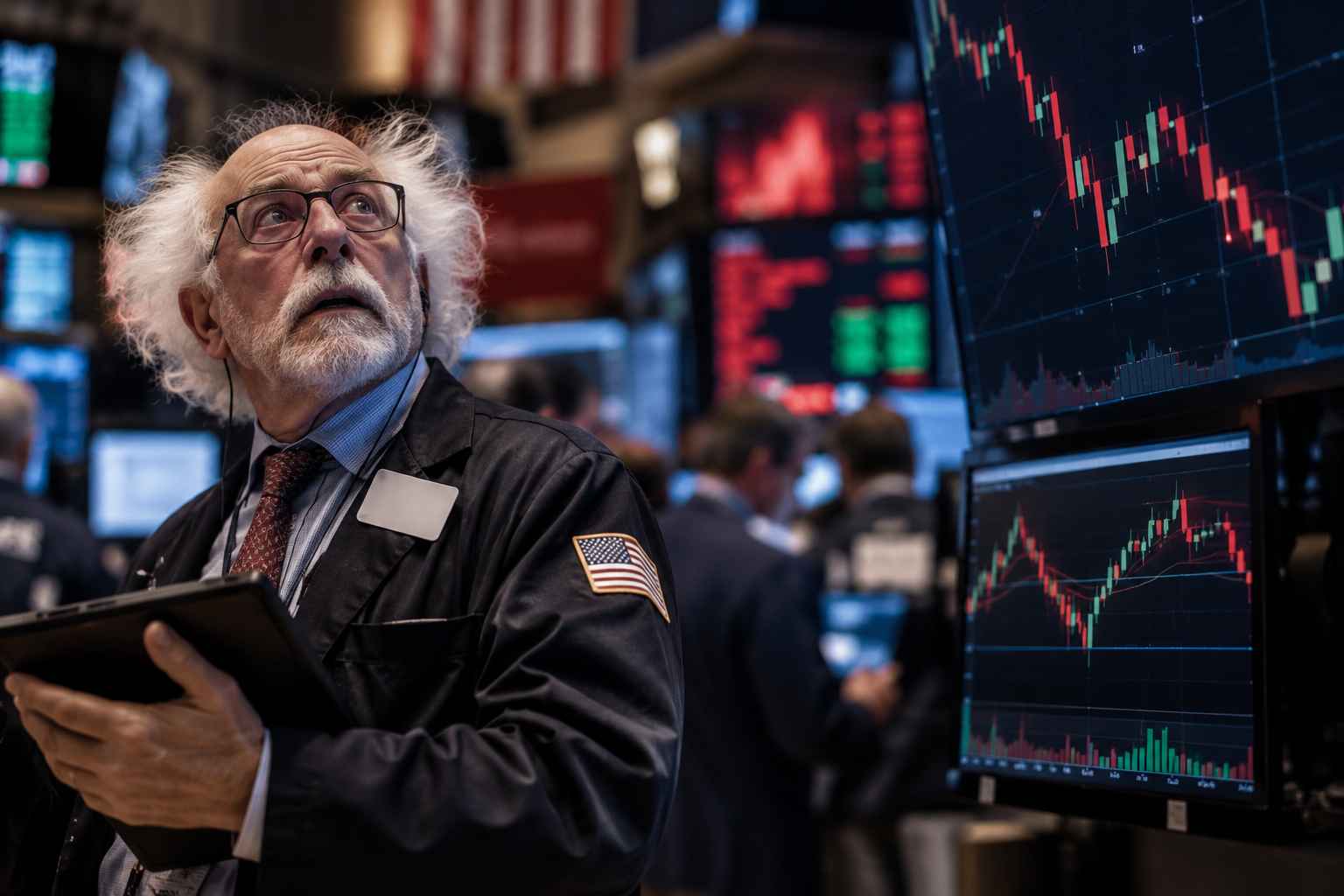
He has said he built an S&P 500 method of his own over four decades on the New York Stock Exchange floor, though he doesn't walk through its mechanics in public. The rules he gives individual traders govern exposure rather than entries.
The emphasis falls on two variables a trader can set in advance: how much a position is permitted to cost, and how long a losing day is allowed to run.
The stop comes before the position: Downside is defined first, and the target is judged against it.
Risk $50 to make $200: His illustration of payoff asymmetry, not a ratio every trade must meet.
Stop distance sets the share count: On $100 of risk, a 50-cent stop allows 200 shares; a $2 stop allows 50.
Never widen a stop: Trailing it in the trade’s favour reduces risk; moving it to avoid a loss increases it.
Three maximum-loss trades close the session: So does reaching the daily profit target.
A 3:1 payoff can still lose: At a 20% win rate, ten trades leave the account down $200.
Stops define risk, not guarantee it: A triggered stop becomes a market order and can fill lower.
Tuchman has worked on the New York Stock Exchange floor since 1985, a tenure that passed 41 years in March 2026 and spans Black Monday, the dot-com collapse, 2008 and every correction since.
He has spoken about building an S&P 500 strategy from the order flow he saw on the floor, though that method is not what he sets out in interviews. The advice he repeats for individual traders is not built around an indicator. It is a sequence of decisions about exposure, taken in a fixed order.
| Decision | Tuchman’s Approach | Risk Being Controlled |
|---|---|---|
| Before entry | Define downside and place a stop | Unbounded losses |
| Reward versus risk | Risk $50 to pursue $200, in his example | Poor payoff asymmetry |
| Winning position | Take profits and trail the stop | A winner becoming a loser |
| Profitable day | Stop once the daily goal is reached | Overtrading |
| Losing day | Stop after three maximum-loss trades | Revenge trading |
None of those concerns direction, as each limits the size of a mistake or how long a trader may keep making it.
The example Tuchman returns to is deliberately unsophisticated: he would rather risk $50 for a shot at $200 than risk $200 for a shot at $50.
Read as a ratio it is easy to dismiss, since no market supplies four-to-one opportunities on demand. Read as an order of operations, it is the foundation the rest of the framework rests on, because the acceptable loss is settled first and the target judged against a figure that already exists.
Most traders work the other way round, establishing the appeal of a position first and fitting the risk around it afterwards. Reversing that changes the opening question from how far a stock might travel, which cannot be known in advance, to how much the position may cost, which the trader sets.
Where the stop goes and how many shares to buy are normally treated as separate choices, but fixing the risk leaves only one free. Suppose the maximum loss on any trade is $100. A stop 50 cents below entry supports 200 shares, while a stop $2 below entry supports 50. The dollar risk is identical, the exposure is four times larger, and the difference is set by where the invalidation level falls rather than by how attractive the setup looks.
Reversing that order produces the error that quietly drains accounts. A trader settles on a share count, places the stop wherever the chart suggests, and inherits whatever risk that combination creates, which on a wide stop can be several times the intended loss.
Sizing from the stop outward keeps planned risk consistent across trades before slippage or gaps, and a position size calculator does the conversion in seconds.
A common failure comes not from skipping the stop but from revising it. A trader without one at least knows the loss is undefined within the plan. The more damaging sequence is that the stop exists, the position moves against it, the level starts to look pessimistic rather than protective, and it gets pushed lower.
The trade then has no defined loss at all, since the exit is wherever the trader can next bear to accept it.
Tuchman is specific about direction. A stock bought at $50 gets a stop at $49.50, and that level is not moved to accommodate a losing position. Trailing it in the trade’s favour is the opposite action, since it reduces exposure rather than extending it. Moving a stop to cut risk follows the plan. Widening it because the trade is losing raises the risk after entry, when the decision is hardest to make well.
Favourable reward-to-risk is often presented as though it settles the question of profitability. Consider a trader risking $100 to make $300 who wins two trades in ten. The winners return $600, the eight losers cost $800, and the account finishes down $200 before costs, with the payoff structure faultless throughout.
The outcome depends on the interaction of win rate, average win, average loss, and costs, and Tuchman’s rules focus mainly on the loss and trade-management side. That is a boundary rather than a flaw, since the loss is among the clearest variables a trader can define before entry.
The framework limits damage while a trader establishes whether the underlying strategy carries positive expectancy, which makes broader risk management the container rather than the contents.
Tuchman applies limits to the session as well as to the individual trade, both set in advance. After three maximum-loss trades he stops for the day. At $100 a trade the session is down $300, small enough to feel recoverable, which is precisely the problem.
The trader most likely to continue is the one least equipped to, since urgency and the wish to get even are both present and neither improves the next call. The point is to fix the limit before frustration starts shaping the next trade.
The same logic runs in reverse. He advises fixing a daily profit goal and closing the terminal once it is reached, on the reasoning that a strong session breeds confidence, confidence generates extra trades, and marginal trades hand the gain back.
In this framework, overtrading is better understood as a deterioration than a count, in the quality of available opportunities or of the trader’s own judgement. Twelve trades on a day full of setups need not qualify, while two forced trades after the target is met can.
Tuchman does not ask a trader to capture an entire move. The failure he guards against is specific: a position that was profitable and closed as a loss. His method is to sell portions into strength and raise the stop on what remains, so a stock bought at $50 and trading at $52 might have part of the position closed and the protective level lifted behind it.
The trade-off is unavoidable: scaling out surrenders some of the gain from a strong trend, while carrying the full position toward a distant target leaves more profit exposed to a reversal. His preference leans toward banking achievable gains rather than waiting on the rare large winner.
A stop defines intended risk rather than guaranteed risk, and the difference becomes most visible in volatile markets. A conventional stop becomes a market order once triggered, and FINRA warns that the execution price can differ materially from the stop price when markets move quickly. A sell stop at $49.50 may fill at $49.20 if that is where the next liquidity sits, and an overnight move can widen the shortfall.
A stop-limit order caps the acceptable price and creates the opposite exposure, since it may not execute at all if the market trades through the limit. Neither outcome undermines the framework. Both clarify what it does: predefine risk rather than remove it.
Speaking to Business Insider on 15 August 2026, Tuchman said he is not bracing for an AI-driven crash. He pointed to three differences from the dot-com peak. Nvidia was trading at 24.8 times forward earnings at the time of the interview, against Cisco above 100 times at its own peak.
AI companies are generating real profits, with S&P 500 earnings then on track for roughly 50% annual growth in the quarter. And the wealthiest 10% of households hold 87% of stocks and fund shares, which in his reading makes forced selling less likely. His conclusion was that the market is close to too big to fail.
That is his assessment rather than a settled view, and the advice attached travels better than the forecast. He warned against trying to pick the perfect entry or waiting for the next crash, and said holding out for the home run costs traders money. Record highs do not change the rules he advocates. The stop, the sizing and the session limits are the same in a rising market as in a falling one.
The risk framework Tuchman teaches answers a narrower question than most trading content attempts, and it does not tell a trader what to buy. What it specifies is the failure point of a trade, the exposure attached to it, and the conditions for protecting a gain and ending the day, none of which depend on the entry method a trader settles on.
The objective is unglamorous by design: be wrong on one trade, or on three in succession, without that outcome deciding anything beyond the trades themselves.