Published on: 2026-03-04
ROST stock surged after Ross Stores posted a decisive fourth-quarter earnings beat, delivering diluted EPS of $2.00 on revenue of $6.64 billion.
Comparable-store sales rose 9%, a demand signal that matters more than a margin-only beat because it reflects stronger traffic and conversion at scale.

The immediate market reaction is significant, as Ross Stores is often seen as a reliable indicator of cost-conscious consumer behavior and off-price inventory dynamics.
Ross Stores cleared a high bar on both earnings and revenue, then reinforced the quarter with upbeat early-season demand commentary that initially pushed shares higher.
| Metric | Q4 FY2025 (Actual) | Q4 FY2025 (Street) | FY2025 (Actual) | FY2025 (Street) |
|---|---|---|---|---|
| Revenue | $6.64B | $6.42B | $22.8B | $22.98B |
| EPS (Diluted / Reported) | $2.00 | $1.87 | $6.61 | $6.64 |
| Comparable Store Sales (Comps) | +9% | N/A | +5% | N/A |
| Operating Margin | 12.3% | N/A | N/A | N/A |
| Store Footprint (Ross / dd’s) | N/A | N/A | 1,909 / 364 | N/A |
Two key points warrant emphasis.
First, achieving a 9% increase in comparable-store sales at this scale indicates that Ross Stores is successfully attracting more customers and increasing their purchase activity simultaneously.
Second, full-year guidance is now critical for a stock that has already seen its valuation rise. While investors previously tolerated cautious guidance when ROST was less expensive, the current valuation requires confirmation that favorable demand trends and margin improvements are sustainable.
ROST stock surged because it delivered the retail combination that forces rapid recalibration: a clear earnings and revenue beat, a strong comps signal, and confident near-term guidance.
 1) Earnings Beat With Real Demand Behind It
Ross posted $2.00 EPS on $6.64 billion in revenue, both above expectations, and paired it with a 9% comparable-store sales gain that pointed to traffic and conversion strength rather than one-time levers.
Management guided Q1 comps up 7% to 8% and Q1 EPS of $1.60 to $1.67, reinforcing that momentum carried into the new quarter, which the market typically rewards more than backwards-looking beats.
Ross also approved a 10% dividend increase to $0.445 per share (payable March 31, 2026), which added a quality-and-confidence signal alongside the operating results.
Ongoing bargain-hunting behavior continues to favor off-price leaders, keeping incremental buyers engaged even after a gap-up move.
The honest analyst's answer is conditional. The stock can still work, but the path from here depends on whether you are investing, trading, or managing risk around a stretched chart.
Off-price retail typically performs well when consumers prioritize value and when branded inventory is available at compelling discounts.
Ross continues to benefit from value-oriented demand, and management’s spring commentary suggests traffic strength remained intact entering the new quarter.
Additionally, Ross Stores operates at a significant scale. Accelerating comparable-store sales typically allows for greater leverage of fixed costs, supporting earnings growth without requiring aggressive assumptions.
Following the earnings-driven increase, the primary risk is not tied to Ross Stores' underlying business strength. Rather, the risk lies in the stock being valued on the assumption that operational execution will remain exceptionally strong.
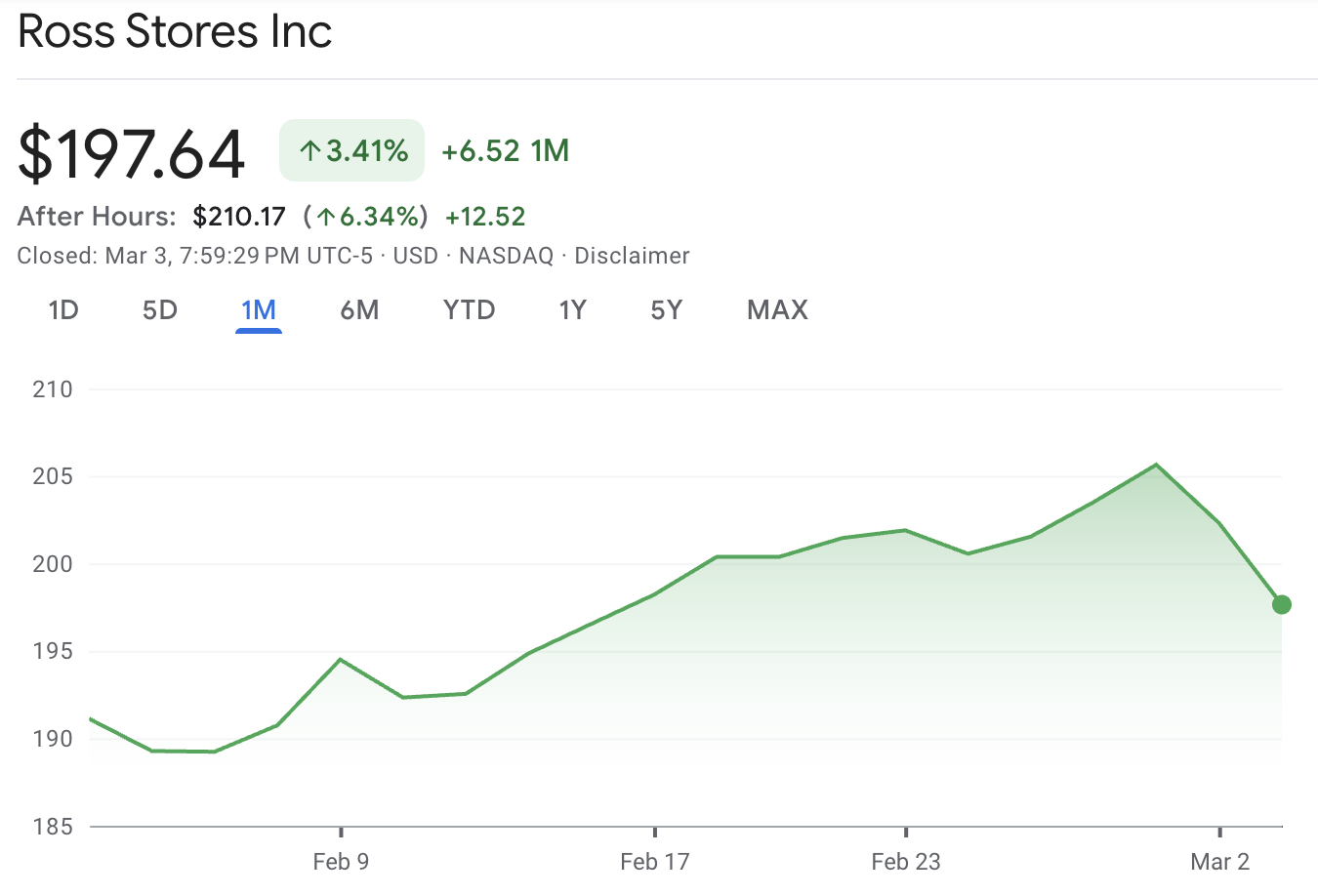
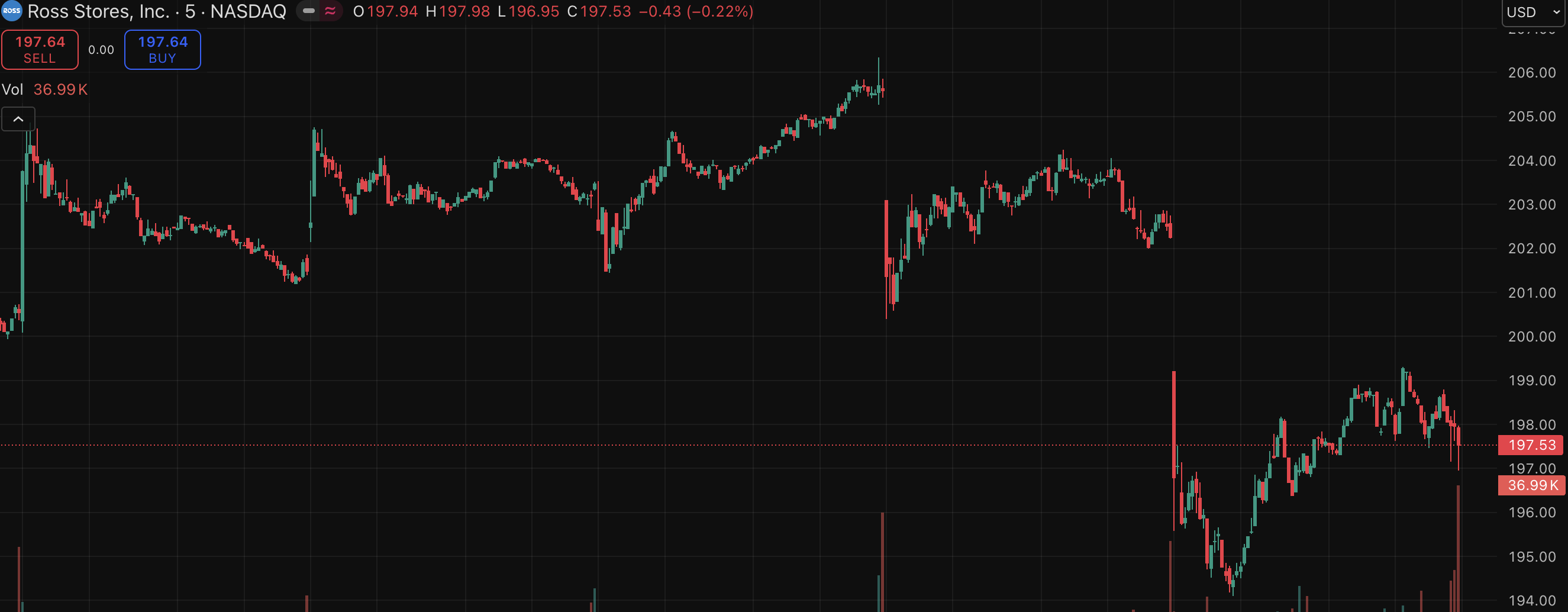
The shares are currently around $197.64, and intraday trading showed a wide range of roughly $194 to $211, consistent with a post-earnings repricing and fast profit-taking.
With a price-to-earnings ratio of approximately 24.7 based on trailing earnings, ROST is positioned as a premium quality retailer rather than a low-cost defensive stock.
If consumer demand weakens or cost pressures re-emerge, the valuation multiple could contract even if earnings remain positive.
| Action | Best if you… | Quick checklist |
|---|---|---|
| Buy now | Have a multi-quarter horizon and can tolerate volatility | You expect off-price to keep gaining share, believe comps can stay elevated without heavy promotions, and accept premium-priced returns. |
| Hold | Already own ROST stock and want confirmation after the surge | Your thesis still holds, you want proof spring momentum supports operating margin, and you prefer volatility to cool before resizing. |
| Sell / Trim | Are more trading-driven or want to reduce risk after a sharp run | You’ve captured the earnings move, you’re wary of multiple compression with stretched technicals, and you want less consumer and policy headline risk. |
Even after a clean earnings beat, the ROST stock reaction can reverse quickly when the market shifts from celebrating results to stress-testing durability. The key downside risks cluster around expectations, the consumer, costs, and post-earnings positioning.

After a gap-up, ROST stock is no longer judged by performance alone, but by whether it is exceptional. If management’s tone turns even modestly cautious on the next update, the market can reprice the multiple before fundamentals weaken.
If comparable-store sales normalize faster than investors expect, the narrative can flip from “demand strength” to “peak momentum.”
In off-price, small changes in traffic and conversion can produce outsized changes in quarterly sentiment because the market treats comps as the cleanest demand read-through.
Off-price models depend on disciplined expense control. A re-acceleration in freight and logistics costs, higher wage pressure, or sustained shrinkage can erode operating margin, particularly if Ross maintains sharp value pricing to protect traffic.
Policy-driven cost shocks remain an asymmetric risk. Even modest tariff-related pressure can force either higher retail prices, risking traffic, or lower gross margins, which hits profitability.
Because the off-price promise is price leadership, the market is especially sensitive to commentary on sourcing flexibility and cost pass-through.
Momentum indicators suggest the short-term move may be stretched, even as the longer-term trend remains constructive.
| Indicator | Latest Read | Interpretation |
|---|---|---|
| RSI (14) | 76.19 | Overbought momentum, pullback risk rises |
| MACD (12,26) | 4.22 | Positive trend, but extended |
| EMA 20 | 197.41 | Price above trend support, still bullish |
| EMA 50 | 189.97 | Medium-term uptrend intact |
| EMA 200 | 163.12 | Long-term trend strongly positive |
| Support | ~$195 to $200 | Near post-earnings lows and nearby pivots |
| Resistance | ~$205 to $211 | Recent trade zone and intraday high |
| Trend | Up | Moving averages aligned upward |
| Momentum | Hot | Elevated RSI suggests crowded short-term positioning |
A high RSI does not mean a stock must fall. It means the stock is more vulnerable to any incremental disappointment, including something as simple as “good news already priced in.”
The options market anticipated an average post-earnings price movement of approximately ±6.4% based on recent trends, although actual movements have typically been smaller. This dynamic often encourages short-term selling following a price increase, particularly if the stock encounters resistance levels.
After a sharp earnings-driven surge, the biggest risk in ROST stock is chasing strength without defined risk.
Focus on simple rules instead:
Set your invalidation level first (e.g., a break back below the post-gap support zone).
Size is smaller than usual because post-earnings volatility can stay elevated for days.
Let the open settle: watch spreads and liquidity in the first hour as price discovery plays out.
Trading carries risks, and losses can exceed deposits when using leverage. Ensure you fully understand these risks before engaging in trading.
ROST stock surged after Ross Stores reported an earnings and revenue beat, backed by a 9% comparable-sales increase, and delivered upbeat first-quarter guidance, signaling strong spring demand and reinforcing confidence in the off-price momentum.
“Overvalued” depends on your required return. ROST is trading at about 24.7 times trailing earnings, which implies the market expects continued clean execution. If comps normalize quickly or costs rise, the multiple could compress even if earnings growth remains positive.
Comparable-store sales, merchandise margin, and operating margin matter most because they reveal whether demand strength is traffic-driven and whether Ross can convert that strength into sustainable profit. Guidance reliability also matters more after a re-rating.
Key risks for Ross Stores in 2026 include softer demand from lower-income customers, renewed sourcing, tariff, wage, freight, or shrink cost pressures, and tougher comparable-sales comparisons.
Ross can behave defensively relative to many discretionary retailers because value formats often gain traffic in slower periods, but it is not immune. If inflation on essentials rises again or policy-driven cost pressures hit margins, the stock can still reprice.
Ross Stores earned the market’s attention with a quarter defined by a clear earnings beat and a strong demand signal. The 9% comparable-sales increase and confident first-quarter guidance strengthened the view that traffic momentum remains intact.
The decision for ROST Stock now is less about operational execution and more about price and positioning. With valuation elevated and technical signals stretched, the setup favors disciplined holders and selective buyers rather than aggressive chasing.
Disclaimer: This material is for general information purposes only and is not intended as (and should not be considered to be) financial, investment or other advice on which reliance should be placed. No opinion given in the material constitutes a recommendation by EBC or the author that any particular investment, security, transaction or investment strategy is suitable for any specific person.