Published on: 2026-03-25
Updated on: 2026-03-25
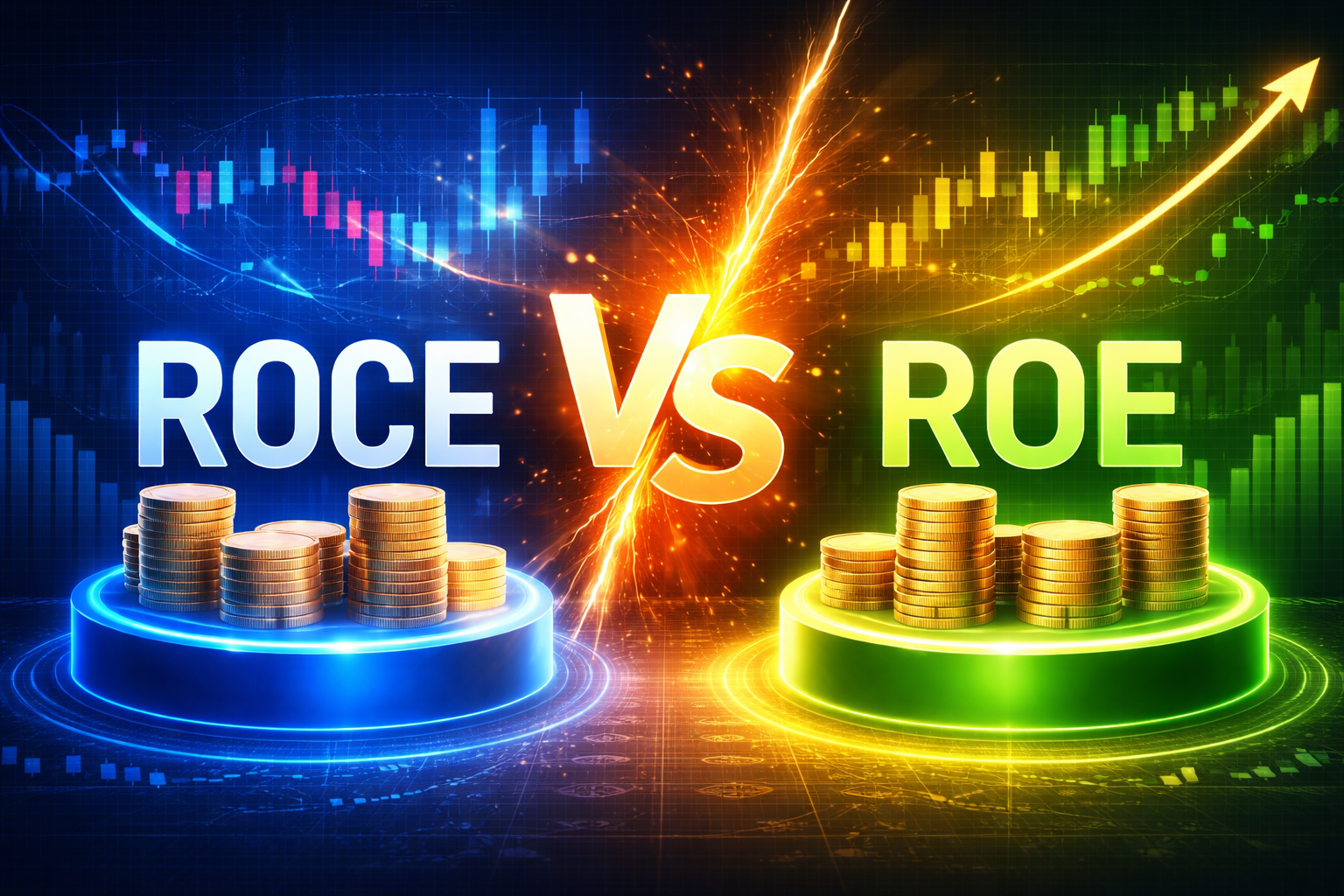
Return on Capital Employed and Return on Equity are two of the most important profitability ratios used by investors to evaluate how efficiently a company generates returns. While both metrics measure performance, they focus on different capital bases and can lead to very different conclusions about a company’s financial strength.
ROE (Return on Equity) measures how efficiently a company generates profit from shareholders’ equity.
ROCE (Return on Capital Employed) evaluates how effectively a company uses all available capital, including debt and equity.
ROE is more useful for assessing shareholder returns, while ROCE provides a broader view of operational efficiency.
Companies with high debt may show strong ROE but weaker ROCE, which can signal hidden risk.
Comparing the two metrics provides a clearer, more balanced investment perspective.
Return on Equity measures how much profit a company generates for each unit of shareholders’ equity. It shows how effectively management is using investors’ funds.
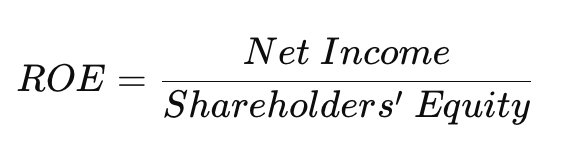
Investor-focused metric: It directly reflects returns generated for shareholders.
Profitability indicator: A higher ROE generally indicates stronger earnings performance.
Management efficiency: It highlights how well a company allocates equity capital.
Debt distortion: Companies with high debt can artificially inflate ROE.
Not comprehensive: It ignores total capital employed, which can mislead investors.
Return on Capital Employed measures how efficiently a company uses all its capital, including both debt and equity, to generate profits.

Capital employed = total assets minus current liabilities.
Holistic view: It includes both equity and debt financing.
Operational efficiency: It reflects how well a company uses its total resources.
Capital-intensive industries: Particularly useful for sectors like defence, energy, and manufacturing.
Complexity: It requires more detailed financial data.
Accounting variations: Differences in asset valuation can affect the accuracy of financial statements.
In today’s market environment, especially in capital-intensive sectors such as defence, infrastructure, and aerospace, relying on a single metric can lead to incomplete conclusions.
Defence companies often require large upfront investments in research and manufacturing, as well as long-term contracts. This means they typically operate with significant capital bases.
Consider major global defence players such as Lockheed Martin, Raytheon Technologies and BAE Systems.
These companies may show strong ROE due to efficient equity usage and more moderate ROCE due to large capital investments.
A high ROE alone might suggest strong profitability.
A lower ROCE could reveal heavy capital usage and potential inefficiencies.
This is why institutional investors and analysts often prioritise ROCE when evaluating companies in capital-heavy industries.
Understanding when to use ROE and ROCE can significantly improve the quality of your investment decisions. Each metric serves a different purpose, and applying them in the right context helps avoid misleading conclusions.
ROE is most useful when your primary goal is to understand how effectively a company generates profit from shareholders’ capital.
You should focus on ROE when:
Comparing companies within the same industry
Businesses in sectors like banking or technology often have similar capital structures. This makes ROE a reliable comparison tool.
Assessing management performance
A consistently high ROE indicates that management is using equity efficiently to generate profits.
Evaluating dividend-paying companies
Companies with strong ROE often have the capacity to sustain or grow dividends over time.
Analyzing asset-light businesses
Firms that do not require heavy infrastructure investment tend to show more meaningful ROE figures.
ROCE becomes critical when you want a complete view of how a company uses all its capital, not just equity.
You should rely on ROCE when:
Analyzing capital-intensive industries
Industries such as defence, energy, and manufacturing require large investments in assets and infrastructure.
Comparing companies with different debt levels
ROCE neutralises the impact of leverage by including both debt and equity.
Evaluating long-term sustainability
Companies that consistently generate strong ROCE are often better at allocating capital efficiently over time.
Assessing expansion-heavy businesses
Firms investing heavily in growth projects may have distorted ROE, but ROCE provides a more balanced view.
Instead of choosing one metric over the other, use them together with a clear framework:
Start with ROE: Understand how well the company rewards shareholders.
Validate with ROCE: Check whether those returns are supported by efficient capital use.
Analyse the gap between the two.: A large difference often signals high leverage or inefficiencies.
The most effective approach is to use both metrics together.
High ROE + Low ROCE
Indicates heavy reliance on debt
Potential financial risk
High ROE + High ROCE
Strong profitability and efficient capital usage
Ideal investment profile
Low ROE + High ROCE
Efficient operations but weak shareholder returns
Could signal underutilised equity
Relying only on ROE without considering debt levels
Ignoring industry context when comparing ratios
Comparing companies with vastly different capital structures
Overlooking trends over time rather than single-period values
ROE measures returns generated from shareholders’ equity, while ROCE evaluates returns from total capital, including debt. ROCE provides a broader perspective, whereas ROE focuses specifically on shareholder profitability and equity efficiency.
ROCE is preferred because it considers both equity and debt, which are heavily used in capital-intensive industries. It gives a clearer picture of how efficiently companies use large investments in assets and infrastructure to generate profits.
Yes, this often happens when a company relies heavily on debt financing. High leverage can boost ROE, but ROCE may remain low, indicating that total capital is not being used efficiently.
ROE alone is insufficient because it ignores debt and the overall capital structure. Investors should use ROCE alongside ROE to gain a more comprehensive understanding of a company’s financial performance and risk profile.
ROCE is generally more important for long-term investing because it reflects overall capital efficiency. However, combining it with ROE provides a more balanced view of profitability, risk, and management effectiveness.
ROCE and ROE are both powerful tools, but they serve different purposes. ROE highlights how well a company rewards its shareholders, while ROCE reveals how efficiently it uses all available capital.
For informed investment decisions, especially in sectors like defence and infrastructure, combining both metrics provides deeper insight into profitability, efficiency, and financial stability.
Disclaimer: This material is for general information purposes only and is not intended as (and should not be considered to be) financial, investment or other advice on which reliance should be placed. No opinion given in the material constitutes a recommendation by EBC or the author that any particular investment, security, transaction or investment strategy is suitable for any specific person.