Published on: 2025-12-12
Updated on: 2025-12-12
The Walmart stock split must be viewed within the broader context of market structure and investor behaviour. In an era where retail participation has grown significantly and fractional trading has normalised lower entry points, a split is no longer essential. Yet it remains a powerful signalling tool.
When a company with the scale and maturity of Walmart executes a split, it is often interpreted as a strategic expression of confidence in future earnings visibility and operational resilience.
Institutional managers frequently note that splits in mega cap firms tend to coincide with periods of internal optimisation, competitive re positioning and structural investment.
For Walmart, the timing aligns with multi year commitments to logistics modernisation, wage enhancements and integrated store fulfilment. This makes the split relevant not only from a trading standpoint but also from a corporate strategy perspective.
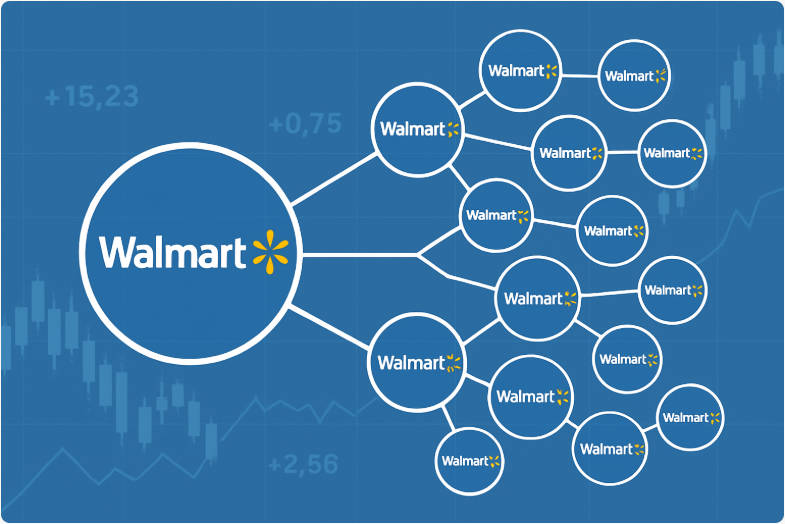
A 3 for 1 split may appear simple, but the internal considerations that precede such actions are complex. Walmart's leadership historically avoids unnecessary financial engineering.
Therefore, the decision suggests that management sought a share structure that better reflects the company's diversified shareholder base while supporting long term capital market engagement.
From a liquidity perspective, the reduced per share price broadens participation among international retail investors who may face platform or minimum purchase constraints. It also improves share availability for employee stock programmes and may subtly enhance Walmart's attractiveness within retail focused ETFs that prefer lower weighted share prices for allocation mechanics.
In practice, the split did not change earnings power or cash flow generation, but it made Walmart appear more approachable to new investors, particularly those who allocate small increments on a recurring basis.
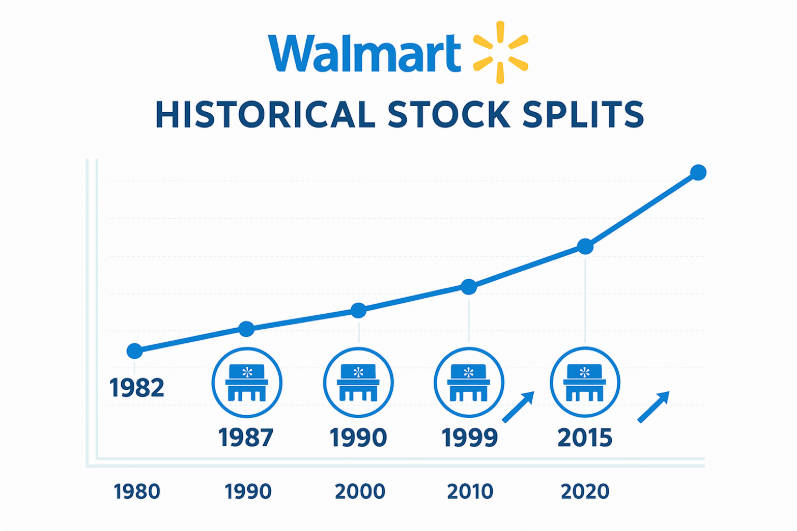
Walmart's split history mirrors its corporate evolution. During the 1980s and 1990s the firm executed multiple two for one splits as it expanded aggressively across the United States. Each of these events occurred during years of high store rollout, rapid comparable sales growth and robust earnings momentum.
The 2024 split stands out because it did not coincide with geographic expansion but rather with a fundamental reinvention of the business model.
Walmart is transitioning from a traditional retailer to a hybrid ecosystem that includes digital retail, subscription services, fintech solutions and last mile fulfilment capabilities. In this regard, the split symbolises a new growth cycle, albeit one driven by innovation rather than footprint growth.
This connection between corporate transformation and share structure adjustment provides a meaningful narrative for long term investors.

Although splits do not alter valuation, they influence perception. Analysts often view splits within mature companies as indicators that management believes the share price trajectory will remain strong enough to justify a materially lower base. This contrasts with distressed firms that reverse split to raise share prices artificially.
For Walmart, the split also assists with index dynamics. A lower share price reduces concentration risk in certain equal weighted indices and may increase inclusion in retail focused thematic baskets.
From a behavioural standpoint, the lower nominal price may attract momentum driven traders who often disregard proportional ownership logic. While this does not enhance intrinsic value, it can influence short term demand and price action.
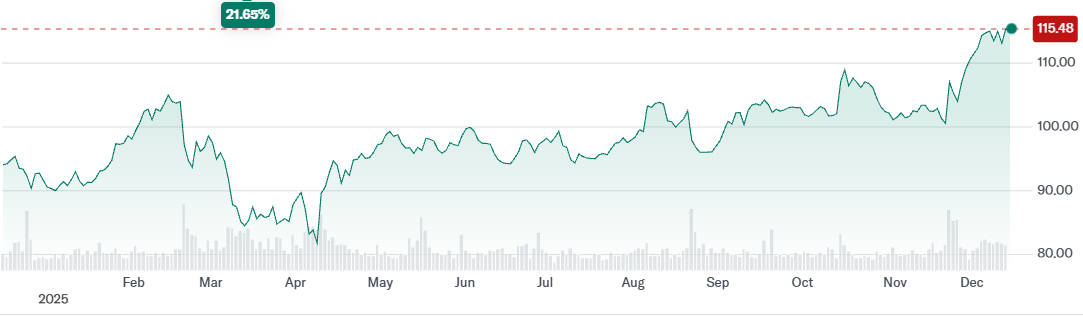
Post split behaviour in large scale consumer companies typically mirrors broader economic conditions. For Walmart, trading patterns since the split have shown a notable distinction between institutional and retail flows.
Institutions continued to focus on margin guidance, membership growth and supply chain efficiency, while retail investors responded more strongly to nominal price changes and short term movements.
In the months following the split, volume stabilised at a higher baseline, suggesting sustained interest. Walmart's resilience relative to consumer discretionary names reflects the firm's defensive profile and stable customer base.
A deeper look reveals that Walmart benefits from multiple counter cyclical characteristics. Higher traffic during inflationary periods, increased reliance on grocery sales and expansion of essential categories provide a stabilising effect. This contributes to smoother price performance compared with companies that rely more heavily on discretionary spending.
Sell side analysts evaluating Walmart in 2025 and 2026 increasingly reference three structural drivers:
Profit growth from automation: Walmart's investment in automated fulfilment centres and data driven inventory systems is expected to unlock margin expansion. Analysts anticipate multi year cost efficiencies that support upward earnings revisions.
E commerce scaling without margin erosion: Unlike many e commerce competitors, Walmart benefits from in store fulfilment, which reduces last mile delivery costs. This integrated approach preserves margins that pure online retailers struggle to maintain.
Membership monetisation: Walmart Plus is still early in its lifecycle. Analysts believe that as adoption increases, recurring revenue will strengthen the company's valuation framework and help diversify earnings.
Overall, consensus expectations lean moderately positive, with analysts forecasting stable revenue growth, measured earnings progress and a valuation supported by predictable cash flows.

Long term investors must treat the split as a gateway to reassessing Walmart's strategic positioning rather than as a catalyst in itself.
A strong long term thesis includes the following pillars:
Walmart has a decades long record of annual dividend increases. Its retail model naturally generates consistent free cash flow, which provides downside protection during economic stress.
Walmart captures a broad customer demographic and maintains pricing power in essential categories such as groceries. This limits cyclical swings and supports demand stability.
The company's advanced fulfilment network creates sustainable competitive advantages. Investors should consider this structural capability as a long term value driver rather than a short term operational feature.
Walmart avoids overly aggressive capital allocation. This conservative approach appeals to investors who prefer predictable return profiles over volatile growth strategies.
Several major firms have announced splits in recent years, particularly within technology. These splits typically followed explosive price appreciation. Walmart's split differs in both context and intention. It signals stability, accessibility and shareholder alignment rather than rapid speculative growth.
One distinctive strength is Walmart's multi channel ecosystem. Competitors either excel in physical retail or online commerce. Walmart is one of the few global companies achieving scale in both. This hybrid structure allows the company to defend market share across categories and minimise vulnerability when consumer preference shifts.
Walmart's operational consistency, robust vendor relationships and unrivalled purchasing power set it apart from other retailers that tend to be more sensitive to supply chain disruptions and commodity costs.

Walmart's medium term outlook contains a balanced mix of opportunity and risk, but the company's fundamentals support a favourable skew.
• Expansion of health services and pharmacy networks may create new recurring revenue streams.
• Enhanced digital advertising capability could lift high margin revenue, leveraging Walmart's enormous traffic data.
• Continued international growth in markets such as India and Mexico may reinforce long term earnings diversity.
• Labour cost increases may pressure operating margins and require pricing adjustments.
• Intensifying rivalry from low cost retailers, discount platforms and international entrants could challenge market share.
• Economic slowdowns typically reduce discretionary spending but Walmart may still benefit from trade down effects.
Sophisticated investors view Walmart as a company capable of weathering economic turbulence while gradually compounding earnings.
Walmart announced the stock split to improve share accessibility and market liquidity. Management framed the split as a move to make shares more readily available to retail investors while reflecting confidence in long term growth and earnings stability.
No. The stock split does not change total market capitalisation or underlying valuation. It increases outstanding shares and reduces price per share, leaving each investor with the same proportional ownership and the company with unchanged fundamentals.
A split can help long term investors by improving affordability and liquidity. It is not a guarantee of outperformance. Investors should prioritise Walmart's earnings, cash flow and competitive position when deciding to buy or hold shares.
Short term movements reflect market sentiment and macro conditions. Historically, Walmart showed stable post split behaviour and steady gains in 2025. Long term price action will depend on revenue growth, margin improvement and investor perception.
Walmart's split prioritises accessibility in a defensive retail profile. Unlike splits from high growth tech names, Walmart's move complements a value and income oriented investment case centred on steady sales, dividends and operational scale.
The Walmart stock split should encourage investors to revisit the fundamentals rather than treat the event as a catalyst. A measured, strategic approach would include evaluating valuation relative to stable consumer peers, assessing the sustainability of gross margin improvements and monitoring membership based revenue segments.
For disciplined investors, the split offers a practical opportunity to accumulate shares in a slow and consistent manner using dollar cost averaging. Walmart's role as a defensive anchor within portfolios remains strong and its continuous innovation suggests future resilience.
Disclaimer: This material is for general information purposes only and is not intended as (and should not be considered to be) financial, investment or other advice on which reliance should be placed. No opinion given in the material constitutes a recommendation by EBC or the author that any particular investment, security, transaction or investment strategy is suitable for any specific person.



World's Best Broker