Published on: 2026-07-16
Updated on: 2026-07-16
Stripe and private-equity firm Advent International have reportedly offered $60.50 per share for PayPal, a bid worth more than $53 billion. PYPL jumped 17.2% on the news to close at $55.52 on 15 July, yet it settled nearly 9% below the offer. The market’s reaction poses the real question for shareholders: not whether a deal is credible, but whether $60.50 is enough.
Stripe’s interest is not new. It first surfaced as exploratory takeover chatter earlier in 2026. What has changed is that a vague approach has hardened into a specific price, and a specific price can be judged.
PayPal stock closed at $55.52, up 17.2%, after trading as high as $55.88.
Stripe and Advent reportedly offered $60.50 per share, valuing PayPal above $53 billion.
The offer is a 27.8% premium to the unaffected close of $47.37, but it follows a 40%-plus decline over the prior year.
At $60.50, the proposal values PayPal at approximately 11.4 times trailing GAAP diluted EPS of $5.33.
PYPL trades about 9% below the offer, leaving a wide deal-risk spread rather than confidence in completion.
PayPal closed at $55.52 on 15 July, gaining $8.15 from the previous close of $47.37. The shares traded between $53.44 and $55.88 during the regular session on volume of about 90 million.
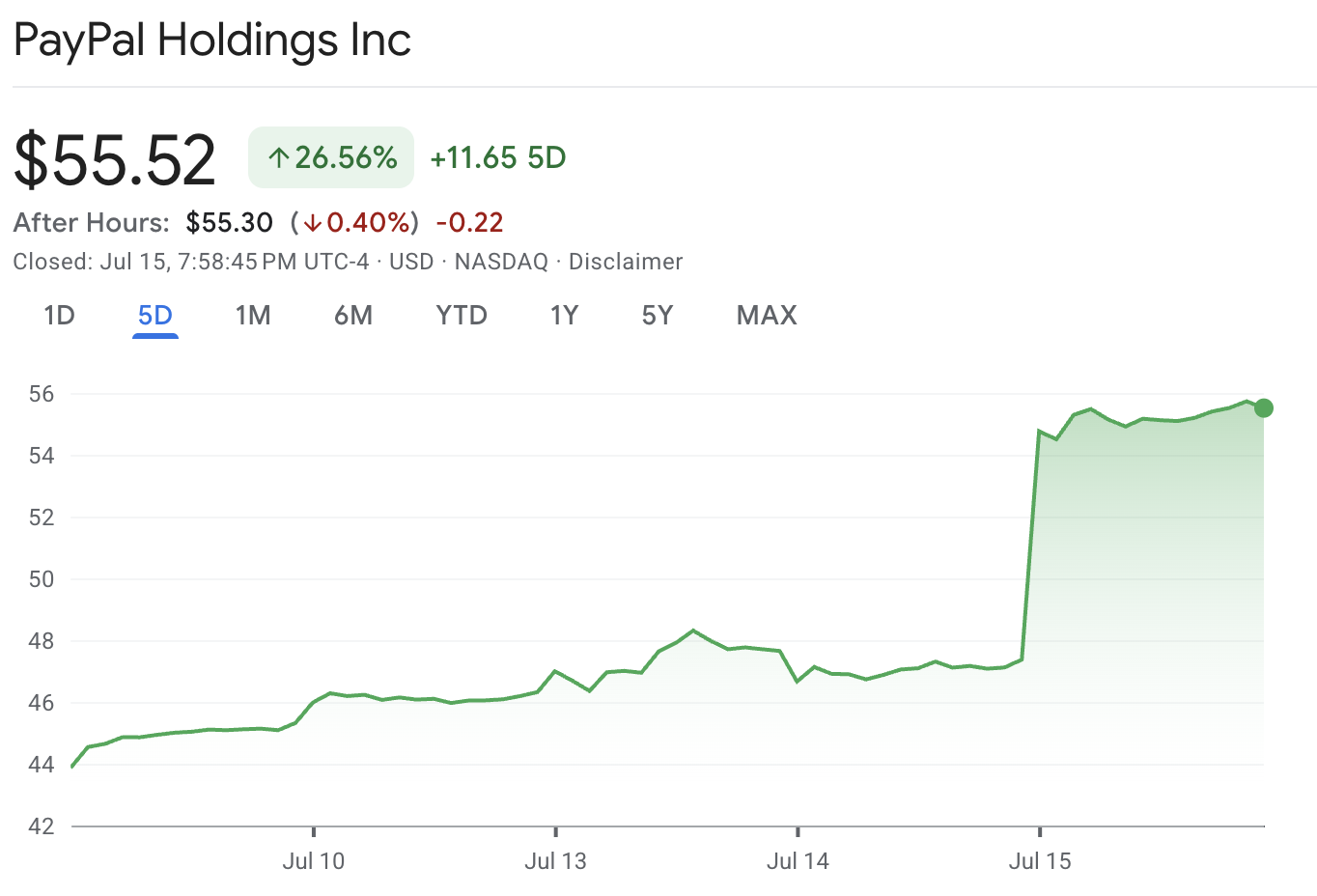
The rally followed reports that Stripe and Advent had jointly approached PayPal with a $60.50-per-share offer, first submitted in early July after an initial approach in April. The proposal would value PayPal above $53 billion, reportedly backed by around $50 billion of bank financing, with Stripe and Advent holding equal stakes and keeping the company intact.
| Deal detail | Reported figure |
|---|---|
| Offer price | $60.50 per share |
| Equity valuation | More than $53 billion |
| Premium to 14 July close | Approximately 27.8% |
| PayPal closing price | $55.52 |
| Remaining upside to reported offer | Approximately 9.0% |
| Reported financing | Around $50 billion |
| Proposed ownership | 50% Stripe, 50% Advent |
As of 16 July, PayPal had announced no response. Its public filings contained no definitive merger agreement or completion timetable, so the proposal remained an unconfirmed approach.
A reported offer does not guarantee shareholders will receive $60.50. PayPal’s board must decide whether to engage, and the buyers would still need to finish due diligence and clear financing and regulatory conditions.
The $4.98 gap reflects the financing, regulatory and execution risks associated with mergers and acquisitions, as well as the time shareholders may have to wait.
A simple two-outcome model illustrates the caution. Anchoring on the $47.37 unaffected price and a $60.50 deal value, the $55.52 close prices in roughly 62% of the gap between the two.
The estimate excludes the time value of money and any change in PayPal’s standalone worth, so it is directional rather than precise. If PayPal rejects the approach and no improved offer follows, part of the premium unwinds and the shares drift back toward pre-report levels.
The strategic fit is straightforward: Stripe is strongest in merchant infrastructure and developer tools, while PayPal contributes branded checkout, Venmo and 439 million active accounts across roughly 200 markets. A combination could push Stripe into digital wallets, consumer finance and stablecoin payments, and owning more of the infrastructure could improve unit economics.

That strategic logic has underpinned takeover speculation around PayPal for months. With a specific number now on the table, the more pressing issue is price.
There is a credible case that the opening bid undervalues PayPal. The 27.8% premium is applied after a sharp fall in PYPL, letting the buyers approach from a depressed base rather than a position of operating strength.
At $60.50, the proposal values PayPal at approximately 11.4 times trailing reported EPS of $5.33, a modest multiple for a profitable global payments company, even after accounting for competition, slow checkout growth and modernisation costs.
The balance sheet reinforces the point. PayPal held $13.5 billion in cash and investments at the end of March against $11.6 billion of debt, generated $1.72 billion of adjusted free cash flow in Q1 and repurchased $6 billion of stock over the trailing 12 months.
Not everyone thinks the price is final. Reuters reported that analyst Andrew Jeffrey viewed the proposal as potentially too low and suggested the buyers could have room to move toward $70.
PayPal’s own margin and earnings trajectory will shape the standalone valuation the board weighs against any bid. The offer looks inexpensive against PayPal’s history, but the execution concerns behind that cheapness are real.
PayPal’s Q1 headline figures were solid, but the composition explains why the standalone stock had been under pressure:
Revenue: $8.35 billion, up 7%
Total payment volume: $464.0 billion, up 11%
Transaction-margin dollars: $3.81 billion, up 3%
Non-GAAP EPS: $1.34, up 1%
Active accounts: 439 million, up 1%
Adjusted free cash flow: $1.72 billion, up 25%
The tension is between the top line and its quality. Branded checkout, the segment investors treat as the core engine, advanced only 2% on a currency-neutral basis, against 14% for Venmo.
Non-GAAP operating margin fell 229 basis points to 18.4%, and management guided to an approximately 9% year-over-year decline in non-GAAP EPS for Q2. That mix is the same one that drove the selloff after PayPal’s earlier earnings report and CEO change.
CEO Enrique Lores has reorganised PayPal into three divisions covering checkout, Venmo and payment services, and is targeting at least $1.5 billion in gross run-rate savings over two to three years, part of it earmarked for reinvestment.
Stripe and Advent would therefore be buying valuable assets alongside a difficult turnaround: any owner still has to modernise the technology, defend checkout share and lift lower-margin processing.
Once a stock trades on takeover mechanics, its price is anchored to the offer rather than to chart patterns. The levels below are reference points for the merger-arbitrage spread rather than a technical read.
| Price area | Significance |
|---|---|
| $60.50 | Reported offer price |
| $55.88 | Regular-session high |
| $55.00 to $55.50 | Post-report pricing area |
| $53.44 | Regular-session low |
| $47.37 | Unaffected closing price |
| Below $47 | Most of the takeover premium would be gone |
A confirmed agreement could compress the spread, though some discount may persist for timing and regulatory risk. A higher proposal could lift PYPL above $60.50, while a rejection, withdrawal or financing problem could push it toward the unaffected price.
The next catalyst is an official PayPal response. A press release or Form 8-K would reveal whether the board has rejected the approach, opened negotiations or signed an agreement, and would set the terms shareholders actually vote on.
Price will dominate any talks, because shareholders can argue that $60.50 hands the buyers too much of the turnaround upside. That also keeps the door open to a competing bidder: if another payments or technology group values PayPal’s consumer network more highly, a rival approach could raise the price, although none had been publicly confirmed as of 16 July.
Any signed transaction would then face antitrust review, since Stripe and PayPal overlap in merchant payments and checkout technology, and regulators could scrutinise the effect on merchants and payment data. Committed financing strengthens the buyers’ credibility but does not remove interest-rate, documentation or closing risk.
PayPal stock jumped 17.2% after reports that Stripe and Advent International had submitted a joint takeover offer. The rally reflects expectations of a possible acquisition rather than a sudden improvement in PayPal’s operating performance.
Stripe and Advent reportedly offered $60.50 per share, valuing PayPal at more than $53 billion. The proposal represented a premium of nearly 28% to PayPal’s closing price before the report.
PayPal remains below the reported offer because the transaction has not been agreed. The discount reflects the possibility that PayPal rejects the price, negotiations fail, financing changes or regulatory approval delays the deal.
No. PayPal had not publicly accepted the proposal or announced a definitive acquisition agreement as of 16 July 2026. The $60.50 offer remains a reported approach rather than a completed transaction.
The 17% jump repriced PayPal for a possible takeover; it did not confirm the offer is fair. The market treats the Stripe-Advent proposal as credible enough to hold most of the premium, but the discount to $60.50, and the “too low” commentary around it, show the price is contested as much as the deal itself.
Whether $60.50 undervalues PayPal comes down to how investors weigh its consumer network, Venmo and cash generation against slow checkout growth, margin pressure and reinvestment needs. Until the board responds, that valuation question, not the fact of the approach, is what PYPL is really trading on.