Published on: 2026-08-25
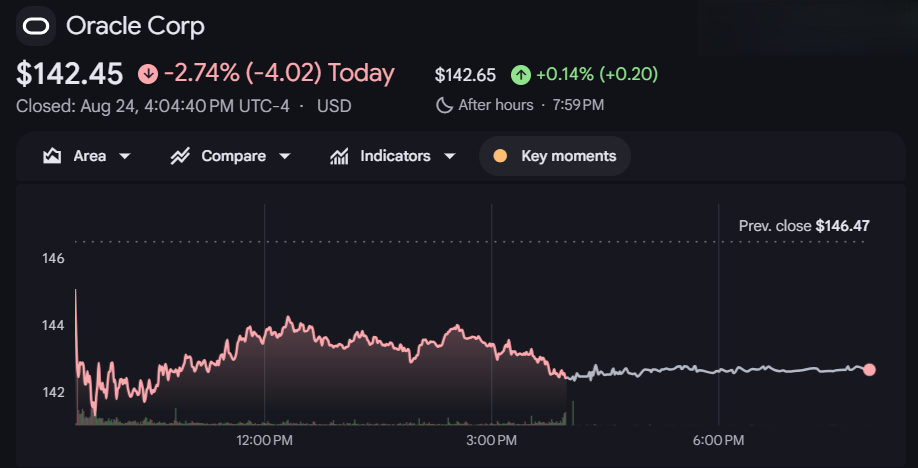
Wall Street loves a good comeback story, but sustaining one under the harsh light of macro scrutiny is a whole different ballgame. Oracle stock has found itself right at the center of this tension, trading down to around $142.45 after hitting record highs earlier in the year. The shift marks a distinct change in tone for a legacy giant that spent the last couple of years surprising critics with its aggressive pivot into cloud infrastructure and artificial intelligence.
For decades, Larry Ellison’s enterprise giant was viewed as a dependable, if somewhat dull, cash cow rooted in traditional databases. But its recent push to build massive, high-speed data centers for the AI era completely rewritten that narrative. Now, with the stock pulling back from its peaks, investors are trying to figure out if this breather is a natural cooling-off period or a warning sign about the true costs of running a modern cloud empire.
To understand why Oracle stock is moving the way it is, you have to look past the headlines and get straight to the balance sheet. Building out state-of-the-art AI infrastructure is a brutal, capital-intensive sport. Oracle hasn't shied away from the fight, sinking tens of billions into specialized data centers designed specifically to handle heavy, compute-hungry workloads.
That strategy paid off fast in terms of raw demand, but it has also brought fresh operational challenges to the surface:
The Backlog Paradox: Oracle’s Remaining Performance Obligations (RPO)—the measure of booked future revenue—has swelled past $80 billion. While that proves massive demand for its cloud compute power, it puts immense pressure on the company to actually build out data centers fast enough to fulfill those contracts.
Capital Intensity: Tens of billions in capital expenditures mean Oracle is taking on heavy debt and utilizing equity raises to fund its server purchases and facilities. That level of spending naturally makes shareholders nervous about near-term cash flow.
The Legacy Drag: As corporate clients shift toward cloud-based enterprise applications, traditional legacy software licensing continues to slow down, leaving cloud infrastructure to carry almost all the weight of the company’s growth metrics.
These factors explain why the broader market is suddenly taking a more measured approach to Oracle stock. The demand is clearly sitting there in plain sight, but the financial heavy lifting required to capture it isn't cheap.
The long-term case for Oracle stock ultimately hinges on Oracle Cloud Infrastructure (OCI). For years, Amazon Web Services, Microsoft Azure, and Google Cloud dominated the cloud hosting conversation. Oracle carved out a space for itself by redesigning its cloud architecture from scratch, focusing on bare-metal servers and fast networking that handle database management and AI training remarkably well.
That technical decision turned out to be a masterstroke. Emerging AI firms and enterprise players jumped at the chance to rent high-performance capacity at lower costs than the big three hyperscalers offered. High-profile cluster deals and deep integration with corporate database assets gave Oracle a distinct edge.
Yet, holding onto that ground is getting tougher. The giant cloud competitors aren't sitting still—they're pouring their own vast resources into custom chips and expanding their footprint. For Oracle stock to find its next major leg up, the company needs to prove that OCI isn't just a temporary overflow valve for companies desperate for computing power, but a primary destination for critical enterprise workloads.
At $142.45, opinion on Wall Street is split down the middle. Conservative institutional funds point to the rising leverage and heavy capital outlay as a reason to stay on the sidelines. They argue that until the heavy expenditure phase translates into free cash flow, the stock's valuation multiple could stay under pressure.
On the flip side, long-term tech bulls see this price point as a rational reset. Most covering analysts maintain positive ratings, pointing out that Oracle's revenue projections for the coming fiscal years remain ambitious and achievable if cloud adoption stays on track. From their perspective, the company is absorbing the necessary upfront costs to secure a permanent seat at the top table of global technology infrastructure.
Oracle has successfully done what few software companies from its era ever managed: it made itself deeply relevant to the next big computing cycle. The recent drop in Oracle stock to the $142 range reflects a market that is demanding real operational efficiency alongside big promises.
If Oracle can deliver on its massive backlogs while keeping a lid on capital costs, today's price level will look like a brief pause in a much larger transformation. If spending runs away from them, the road back to record highs will be a long, steep climb.