Published on: 2026-08-25
Former House Speaker Nancy Pelosi has triggered a fresh wave of market speculation following her latest mandatory financial disclosure. The veteran politician made her first-ever recorded trade in Bloom Energy stock ($BE), alongside another significant positioning in tech giant Intel ($INTC).
The regulatory filing reveals that Pelosi purchased 15.000 common shares of Bloom Energy, paired with 100 call options featuring a $100 strike price expiring in June 2027. On the same filing date, she disclosed buying 10.000 shares of Intel alongside 50 call options with a $50 strike price expiring in June 2027.
The move marks a pivotal moment for traders tracking political portfolio flow. Pelosi’s history of well-timed equity bets—particularly in tech and energy—frequently serves as a reliable gauge for broader market shifts. Her decision to jump into Bloom Energy stock comes right as clean energy companies scramble to supply the huge amount of electricity needed for artificial intelligence and data centers.

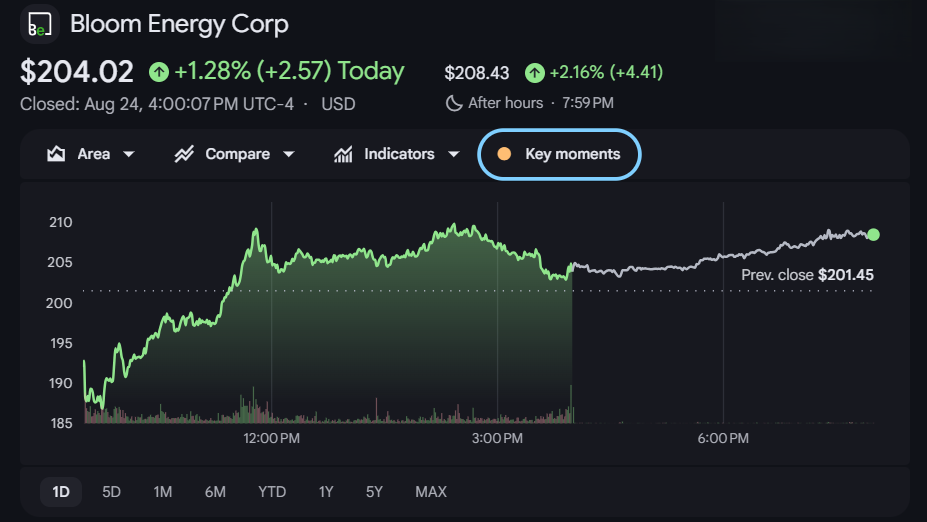
Bloom Energy stock is hovering near $204 per share, giving the solid-oxide fuel cell maker a market capitalization of roughly $59 billion to $60 billion.
| Metric | Details |
| Current Share Price | ~$204.02 USD |
| 52-Week Range | $47.83 - $351.28 USD |
| Market Capitalization | ~$59.3 Billion USD |
| Analyst Consensus | Buy (Average Target: ~$275.08 USD) |
| Q2 Revenue Performance | $1.065 Billion USD (+165.5% YoY) |
The equity has seen wild price swings over the past year. After touching a 52-week high of $351.28. the share price pulled back alongside broader tech sell-offs and rising interest rate pressures. Despite these recent dips, Bloom Energy stock remains up more than 350% over the last 12 months.
Wall Street analysts retain an overall bullish stance on Bloom Energy stock, holding a consensus "Buy" rating and an average 12-month price target near $275. with high-end projections stretching toward $380 to $390 per share.
Investors analyzing congressional trading patterns are zeroing in on a few main reasons behind Pelosi’s new stake in Bloom Energy stock:
The AI Energy Demand Crisis: Big tech companies running huge data centers face major power shortages. Local electric grids often take three to seven years to connect new facilities, but Bloom Energy’s fuel cell servers can be set up directly on-site to supply power right away.
Strong Policy Support: Federal clean energy incentives continue to fund hydrogen infrastructure and alternative energy equipment, giving direct financial boosts to manufacturers.
Record Revenue Numbers: Bloom Energy recently posted its strongest financial quarter yet, pulling in $1.065 billion in revenue—a massive 165.5% jump from last year—and earning $240 million in operating income.
Pelosi's portfolio adjustments point toward a clear strategy: backing both sides of the domestic AI boom by investing in Intel's chip manufacturing and Bloom Energy's power generation.
| Metric / Dimension | Bloom Energy ($BE) | Intel ($INTC) |
| Primary Industry | On-site Clean Energy & Fuel Cells |
| Pelosi Position Taken | 15.000 shares + 100 Call Options ($100 Strike, Exp. June 2027) |
| Core Growth Driver | Data center electricity generation & hydrogen power |
| 2027 LEAPS Exposure | Leverage to long-term energy transition |
By buying long-dated call options (LEAPS) that expire in June 2027 alongside regular shares, Pelosi lowers her upfront costs while giving her portfolio plenty of room to grow over the next few years.
Bloom Energy stock presents a compelling mix of hyper-growth metrics alongside elevated valuation risks:
Bullish Catalysts: Strong demand from data centers, massive quarterly revenue growth, and long-term contracts that provide steady cash flow over time.
Bearish Risks: High market volatility, supply chain challenges as production scales, and potential shifts in government clean energy policies.
Management expects full-year revenue to reach between $3.9 billion and $4.2 billion, which is roughly double what the company generated in the previous fiscal year. Bloom Energy has also shown strong operating leverage by expanding its profit margins without letting fixed costs run wild. On top of that, the company holds a leading position in on-site fuel cell setups, making it a go-to option for tech companies that need power fast.
Because Bloom Energy stock carries a high beta, its share price usually moves much faster and harder than the broader market during downturns. Scaling up manufacturing to meet growing backlogs also requires heavy capital investments and precise operational execution.
Market participants continue to debate whether Bloom Energy stock is ready for another big rally or if current prices already reflect its short-term potential.
The Bull Case: With power grids running close to maximum capacity, major tech firms will keep making direct power deals with Bloom Energy, filling up its order books well into 2027.
The Bear Case: Any broader market pullback, interest rate jump, or delay in delivering customer orders could cause investors to trim back higher-priced growth stocks.
Nancy Pelosi’s multi-million dollar disclosure reinforces the growing institutional consensus that power infrastructure remains one of the most critical bottlenecks in modern technological expansion.
Nancy Pelosi's entry into Bloom Energy stock highlights the intersection of political capital, energy transition policy, and AI power requirements. While short-term price volatility persists around $204 per share, Bloom Energy’s revenue metrics, expanding profit margins, and secular industry tailwinds offer a substantial growth story. Investors tracking Bloom Energy stock will watch third-quarter operational updates closely to confirm whether execution matches the market's high expectations.