Published on: 2026-04-17
Updated on: 2026-04-17
CAT hit an all-time closing high of $794.25 on April 14, 2026 before pulling back to $769.86 on April 16. The 52-week high of $798.54 and the psychological $800 level form a resistance ceiling that Q1 earnings on April 30 could resolve.
The stock is up 32% year-to-date, trading well above all major moving averages, with the 200-day SMA at $565.65, which is more than 35% below the current price. RSI at 76 is in overbought territory, raising the risk of a pre-earnings pullback.
Caterpillar’s rally is being driven by dual catalysts: traditional infrastructure and mining demand, plus a newer AI data center power generation story that has expanded the stock’s valuation multiple.
Caterpillar reached an all-time closing high of $794.25 on April 14, gave back 3% over the following two sessions, and closed at $769.86 on April 16, with Q1 earnings on April 30 now less than two weeks away. The April 16 session itself was telling: CAT traded in a $33 range from a low of $756.65 to a high of $789.97 before settling near the middle, reflecting the tug-of-war between profit-takers and buyers near the highs. The question the chart is asking is straightforward: Does CAT break $800 before earnings, or does it consolidate and let the report do the work?
The 32% year-to-date rally has been driven by something unusual for an industrial stock. Beyond the traditional construction, mining, and infrastructure demand that forms Caterpillar’s core business, Wall Street has increasingly treated the company as an AI infrastructure play. Caterpillar’s power generation segment, which produces diesel and natural gas engines for data center developers, has become a significant growth driver as hyperscalers scramble for reliable electricity to power AI campuses. That dual narrative has pushed the stock well beyond where most analysts expected it to be.
Indicator |
Value |
Signal |
| Price (April 16 Close) | $769.86 | – |
| 5-Day SMA | $776.50 | Bullish (price near) |
| 20-Day SMA | $745.20 | Bullish (price above) |
| 50-Day SMA | $710.85 | Bullish (price above) |
| 200-Day SMA | $565.65 | Bullish (price well above) |
| 20-Day EMA | $750.30 | Bullish (price above) |
| 50-Day EMA | $718.40 | Bullish (price above) |
| RSI (14) | 76.19 | Overbought |
| MACD (12,26,9) | +13.43 | Bullish (above signal line) |
| ADX (14) | 40.69 | Strong trend |
| CCI (14) | 118.13 | Overbought |
| Stochastic %K | 82.5 | Overbought |
Every moving average from the 5-day through the 200-day is flashing a buy signal. Price sits above all of them, and the distance between the current price and the 200-day SMA ($565.65) is over 35%, which reflects the parabolic nature of the 2026 rally. The ADX at 40.69 confirms a strong directional trend in place, not just a drift.
The concern sits in the oscillators. RSI at 76, CCI at 118, and Stochastic at 82 are all in overbought territory simultaneously. In CAT’s recent history, this triple-overbought condition has preceded pullbacks of 5-8% before the trend resumed. It does not guarantee a reversal, but it signals that the risk-reward for new long entries is less favorable until the stock either consolidates or pulls back to the 20-day EMA near $750.
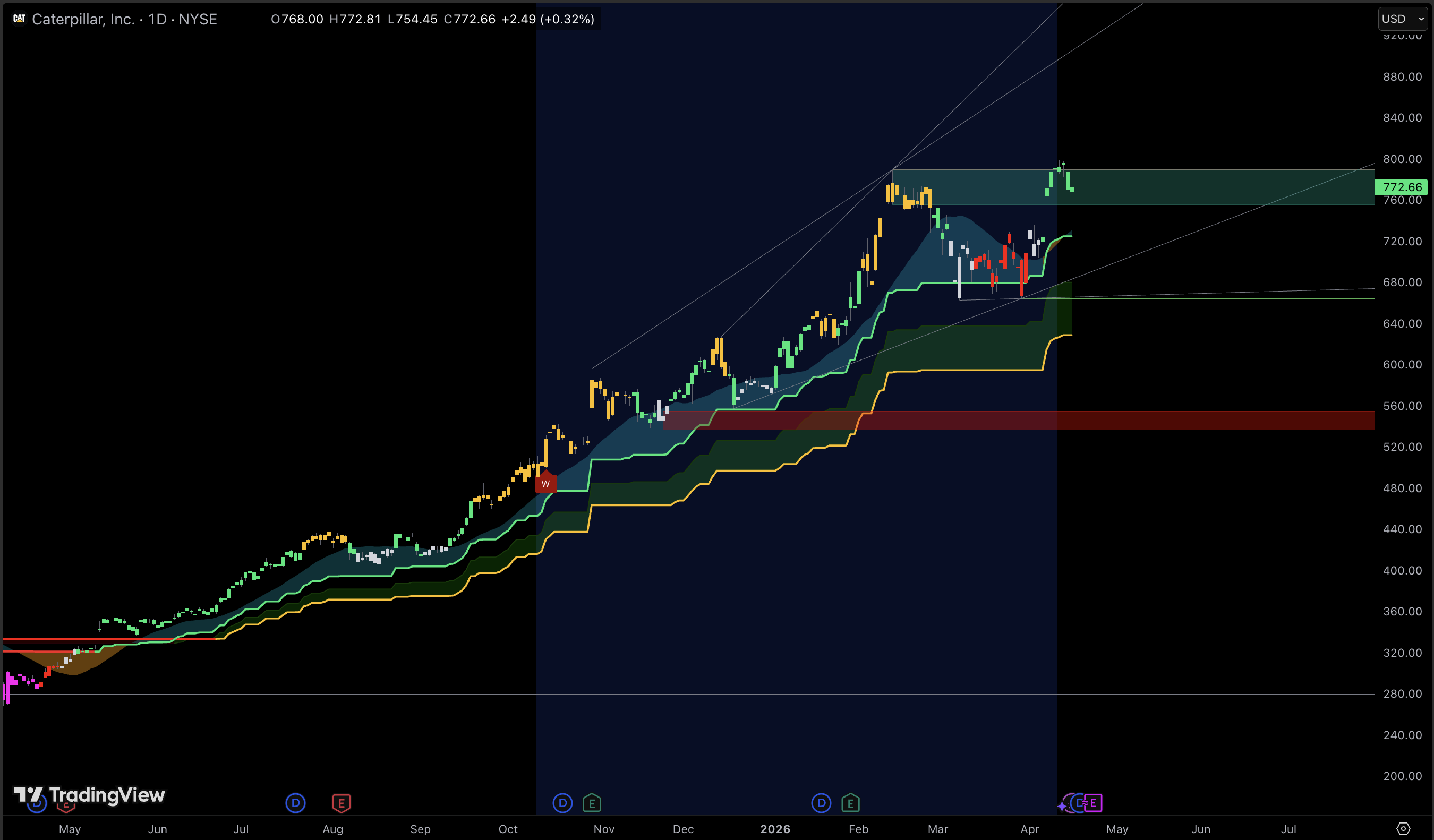
Measured from the 52-week low of $282.46 to the 52-week high of $798.54:
Fibonacci Level |
Price |
Significance |
| 0% (52-Week High) | $798.54 | Current resistance / prior peak |
| 23.6% Retracement | $676.75 | First major Fibonacci support |
| 38.2% Retracement | $601.40 | Deep correction level |
| 50% Retracement | $540.50 | Mid-range structural support |
| 61.8% Retracement | $479.61 | Major trend support |
| 100% (52-Week Low) | $282.46 | Cycle low |
The current price of $769.86 sits between the 52-week high ($798.54) and the 23.6% retracement at $676.75. That $676 level aligns with the consolidation zone from early March and would represent the first meaningful Fibonacci support on any correction. In a healthy pullback scenario, the 23.6% level is where institutional buyers typically re-enter a strong uptrend.
Level |
Price Zone |
Type |
| R3 | $800.00 | Psychological round number |
| R2 | $798.54 | 52-week high |
| R1 | $794.25 | All-time closing high |
| S1 | $745.00 - $750.00 | 20-Day SMA / EMA zone |
| S2 | $710.00 - $718.00 | 50-Day SMA / EMA zone |
| S3 | $676.75 | Fibonacci 23.6% retracement |
| S4 | $565.65 | 200-Day SMA |
For CAT to break $800 before the April 30 earnings report, it needs to clear three layers of resistance within nine trading sessions: the all-time closing high of $794.25, the 52-week intraday high of $798.54, and the psychological $800 mark. All three sit within a $6 window.
The bullish case rests on continued momentum from the AI power generation narrative and pre-earnings positioning. Caterpillar reported Q4 2025 EPS of $5.16, beating estimates by 9.27%, and revenue of $19.13 billion, beating by 6.12%. If the market expects another beat on April 30, buyers may front-run the report and push through $800 in the final week of April.
The cautionary case is the overbought technical condition and the analyst target gap. With the average price target at $737-$751 and the stock trading at $769, CAT is already above where most of Wall Street thinks fair value sits. Bernstein raised its target on strong demand in early April, and Barclays moved to $700 from $625, but Morgan Stanley remains at $430, reflecting a wide range of valuation opinions.
One fundamental risk that the chart cannot capture is the tariff exposure Caterpillar flagged in its most recent filings. The company identified approximately $2.6 billion in potential tariff costs for 2026, and how management addresses margin pressure on the April 30 call could determine whether the stock holds above $750 or gives back a portion of its gains. Strong demand alone may not be enough if margins are being compressed under trade policy costs.
Breakout above $798. If CAT clears the 52-week high on volume, the measured move from the March consolidation range ($680-$720, roughly $40 in height) projects a target of $838-$840. Round-number resistance at $800 could cause a brief stall, but a close above $798 would confirm a new all-time high and likely attract momentum-driven capital.
Pre-earnings consolidation. If the overbought RSI triggers profit-taking before April 30, the first support zone is $745-$750, where the 20-day moving averages converge. A deeper pullback would target $710- $718 at the 50-day moving averages. This scenario would actually improve the risk-reward setup for earnings, as a pullback into the 20-day zone followed by a strong report could launch the stock through $800 from a more sustainable base.
CAT is technically positioned to test $800, but the path depends on whether traders are willing to push into overbought territory ahead of a catalyst that could go either way. The trend is unambiguously bullish, every moving average confirms it, and the ADX at 40 says the trend has real strength behind it. A stock trading above its average analyst target, with RSI at 76 and Q1 earnings nine trading days away, is one where patience may pay better than urgency. The $745-$750 zone on a pullback offers a cleaner entry than chasing the $794 high, and the April 30 report will likely resolve the $800 question one way or the other.