Published on: 2026-04-27
Updated on: 2026-04-27
Key Takeaways
TSLA closed at $376.30 on April 25, 2026, down 3.4% since reporting Q1 earnings on April 22 that beat on both EPS ($0.41 vs $0.36 estimate) and revenue ($22.39B vs $22.10B). The stock is trading between its 200-day SMA ($374.12) and 50-day SMA ($387.65), a compression zone that typically resolves with a sharp directional move.
The post-earnings sell-off was driven by Tesla’s $25B+ capex guidance for 2026, a warning of negative free cash flow for the rest of the year, and a P/E ratio of 343x that leaves little room for execution risk.
The $400 resistance level and $350 support level define the range. A confirmed close above $400 reopens the path toward $442. A breakdown below $350 targets $330 and the 52-week low at $259.63.
Tesla reported Q1 2026 earnings on April 22 that beat Wall Street on every headline metric. EPS came in at $0.41 versus $0.36 expected, a 15.9% surprise. Revenue reached $22.39 billion, beating the $22.10 billion estimate. Automotive gross margins improved to 19.2%. Energy storage margins hit a record 39.5%. The company reported its highest Q1 order backlog in over two years.
The stock dropped 3.4% over the following three sessions and closed the week at $376.30. The sell-off tells you exactly where the market’s focus is: not on Q1 results, but on what Tesla plans to spend in 2026 and beyond. Management guided for $25 billion or more in capital expenditure this year, the highest in company history, to fund factory expansion, AI infrastructure, the Cybercab launch, and the Optimus humanoid robot program. Tesla expects negative free cash flow for the remainder of 2026.
At a P/E ratio of 343x, that combination of record spending, negative cash flow, and a valuation built on future products puts TSLA in a technical position where the chart needs to do the talking.
| Indicator | Value | Signal |
|---|---|---|
| Price (April 25 Close) | $376.30 | – |
| 5-Day SMA | $375.59 | Neutral (price at) |
| 20-Day SMA | $366.98 | Bullish (price above) |
| 50-Day SMA | $387.65 | Bearish (price below) |
| 200-Day SMA | $374.12 | Neutral (price at) |
| 20-Day EMA | $368.91 | Bullish (price above) |
| 50-Day EMA | $387.71 | Bearish (price below) |
| RSI (14) | 42.39 | Neutral (below midpoint) |
| MACD (12,26,9) | -3.77 | Bearish (below signal line) |
| Bollinger Bands (25) | $354.31 – $391.97 | Price in middle |
| Bollinger Bands (100) | $382.46 – $452.64 | Price below lower band |
| P/E Ratio | 343.78 | – |
| Average Volume | 71.59M | – |
The moving average structure is mixed, and that is the key read. TSLA is trading above its 20-day SMA and EMA, which shows the April 7 low of $352.08 has held and short-term momentum has stabilized. But the stock sits below both the 50-day SMA ($387.65) and the 50-day EMA ($387.71), which means the medium-term trend is still pointing down.
The 200-day SMA at $374.12 is directly under the current price, acting as a floor. If TSLA loses that level on a daily close, the technical picture shifts from consolidation to breakdown. The RSI at 42 and negative MACD confirm that momentum is weak but not oversold, placing the stock in a neutral zone where the next catalyst determines direction.
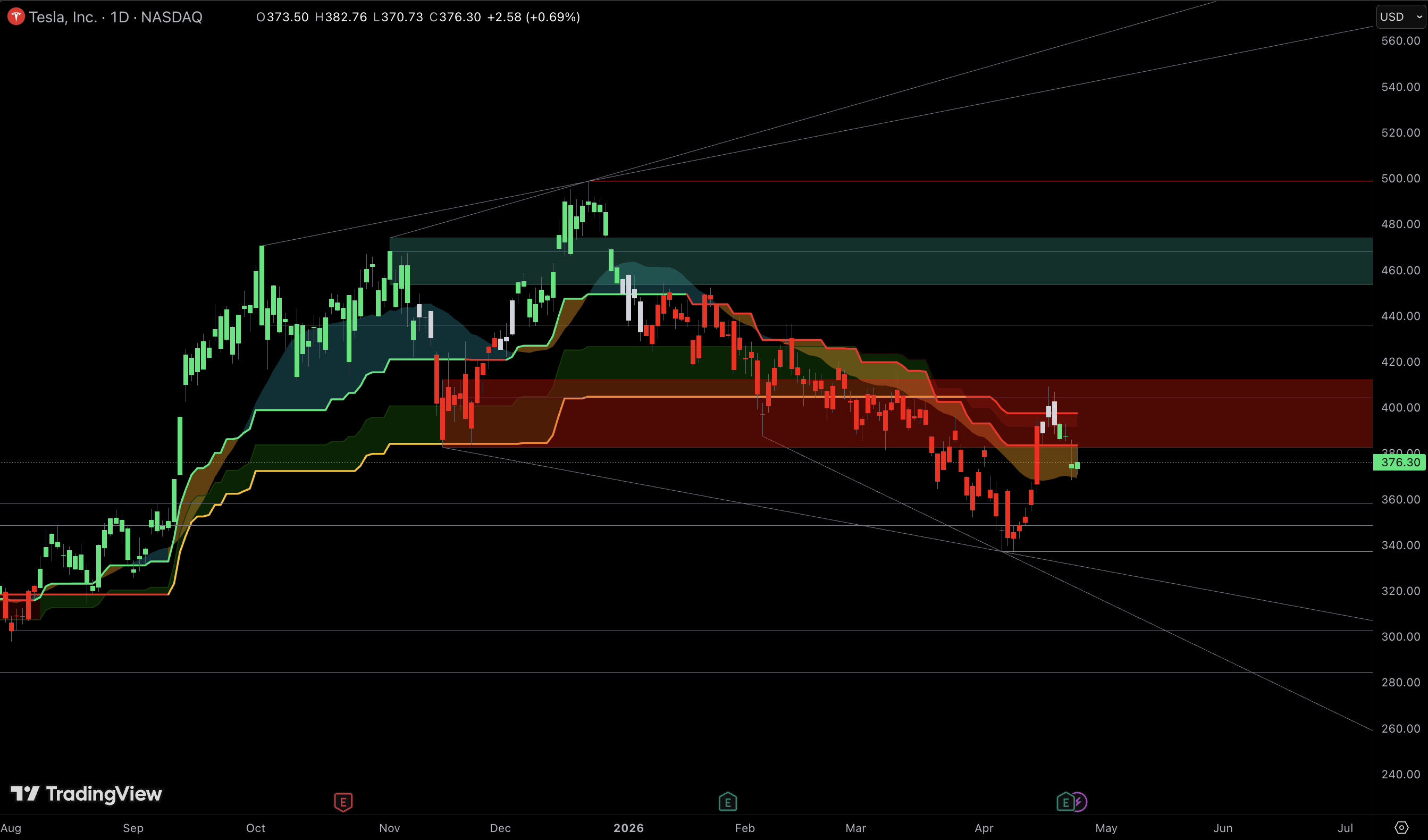
Measured from the 52-week low of $259.63 to the 52-week high of $498.83:
| Fibonacci Level | Price | Significance |
|---|---|---|
| 0% (52-Week High) | $498.83 | Prior peak (December 2025) |
| 23.6% Retracement | $442.38 | First major overhead resistance |
| 38.2% Retracement | $407.46 | Aligns with $400 round-number resistance |
| 50% Retracement | $379.23 | Current price zone |
| 61.8% Retracement | $351.00 | Aligns with April 7 low ($352.08) |
| 100% (52-Week Low) | $259.63 | Cycle low |
The current price of $376.30 sits just below the 50% Fibonacci retracement ($379.23), which means TSLA has given back exactly half of its 52-week rally. The 61.8% level at $351 aligns almost perfectly with the April 7 low of $352.08, creating a double-layered support zone. On the upside, the 38.2% retracement at $407.46 sits just above the psychological $400 mark, reinforcing that level as the resistance to watch.
| Level | Price Zone | Type |
|---|---|---|
| R3 | $442.38 | Fibonacci 23.6% / breakout target |
| R2 | $400.00 – $407.46 | Psychological + Fibonacci 38.2% |
| R1 | $387.65 – $391.97 | 50-Day SMA / Bollinger upper (25) |
| Current Price | $376.30 | – |
| S1 | $374.12 | 200-Day SMA |
| S2 | $350.00 – $352.08 | April low / Fibonacci 61.8% |
| S3 | $330.00 | Measured move target |
| S4 | $259.63 | 52-week low |
Three factors explain the post-earnings decline.
First, the capex number. $25 billion in planned spending for 2026 exceeds any prior year and redirects cash from shareholders toward Cybercab manufacturing, Optimus development, and AI compute infrastructure. Management explicitly warned that free cash flow will be negative for the rest of the year. For a stock trading at 343x earnings, negative near-term cash flow is a direct challenge to the valuation.
Second, the analyst split has widened. The average 12-month price target is $419, roughly 11% above the current price. But the range spans from $123 (GLJ Research) to $600, reflecting deep disagreement about whether Tesla is an automaker, an AI company, a robotics company, or all three.
JPMorgan’s Ryan Brinkman maintained his sell rating and sees 61% downside, while DZ Bank upgraded to hold from sell on the same day.
Third, the Musk factor. Elon Musk acknowledged on the earnings call that Tesla’s full self-driving claims had been overstated, and confirmed he would reduce his time at DOGE to focus on Tesla. The Musk v. Altman trial begins next week.
For a stock where narrative premium accounts for a large share of the valuation, headline risk from non-operational events remains elevated.
Reclaim $400: If TSLA can push back above the 50-day SMA ($387.65) and close above $400 with volume, the path opens toward the Fibonacci 23.6% at $442, which also aligns with the pre-Hormuz crisis levels from early March. The catalysts would be Cybercab production ramp confirmation, a Musk v. Altman resolution, or broader tech sector rotation back into megacap growth.
Break below $350: If the 200-day SMA at $374 fails and the April low of $352 gives way, the Fibonacci 61.8% support is gone and the measured move target drops to $330. That would represent a 34% decline from the 52-week high and likely trigger another wave of institutional de-risking. A breakdown below $350 would also confirm a lower-low pattern on the daily chart, shifting the intermediate trend from neutral to bearish.
TSLA is compressed between the 200-day SMA at $374 and the 50-day SMA at $387, with the broader $350-$400 range defining the battlefield.
The Q1 earnings beat was real, but the market is pricing in the cost of Tesla’s transformation from an automaker into an AI and robotics company, and that cost is $25 billion in capex, negative free cash flow, and execution risk on products that do not yet generate revenue.
At 343x earnings, the stock needs the next catalyst to justify the premium. Until then, the 200-day SMA is the line that separates consolidation from something worse.