Published on: 2026-06-08
Updated on: 2026-06-08
MRVL has a real June 22 catalyst, but not a clean bargain setup. Index demand can support the stock near term; the harder question is whether Nvidia-linked AI revenue can defend a valuation already pulled toward the $1T debate.
Marvell joins the S&P 500 on June 22, with MRVL already priced like more than a routine index addition. Jensen Huang’s $1T signal gives the stock a powerful AI narrative, while Nvidia-linked optics, custom silicon, and scale-up networking now have to defend that premium in revenue. The setup is bullish, but the cleanest answer comes after the forced buyers arrive.
June 22 is the flow event: Marvell enters the S&P 500 before the open, creating benchmark demand but not guaranteed upside.
Huang is the valuation signal: Nvidia’s $2B investment in Marvell gives the $1T comment strategic weight.
AI revenue is now visible: Q1 fiscal 2027 revenue reached $2.418B, with Q2 guided to $2.7B.
The $1T case is demanding: MRVL needs more than index buying to justify a 4x-plus valuation path.
The danger signal is a fade: If MRVL loses the post-selloff range after June 22, the inclusion trade was likely pulled forward.
The first question is not whether Marvell has catalysts, but how many of them are already visible in the price.
| Signal | Market Read |
|---|---|
| S&P 500 debut | June 22, before the open; benchmark demand arrives, but earnings do not change. |
| Huang’s $1T call | Turns MRVL from an index-addition story into an AI infrastructure valuation test. |
| Nvidia partnership | $2B investment gives strategic weight to the custom silicon and networking thesis. |
| Q1 fiscal 2027 revenue | $2.418B, up 28%; AI demand is now visible in reported results. |
| Q2 revenue guide | $2.7B midpoint; the next test is whether acceleration survives the hype. |
| Market value | About $235B; the $1T case still requires a roughly 4.25x repricing path. |
The most important figure is not June 22; it is the gap between Marvell’s roughly $235B market value and the $1T valuation now attached to Huang’s signal.
June 22 changes ownership mechanics before it changes earnings reality. S&P Dow Jones Indices confirmed Marvell will enter the S&P 500 before the open, replacing Pool Corp, while Flex replaces The Campbell’s Company. Marvell moves into a benchmark tracked by trillions in passive and benchmark-linked capital.
The index bid can support MRVL into the rebalance without creating new earnings power. Funds tracking the S&P 500 buy because the rulebook changes; conviction capital buys when the growth path improves. The distinction becomes visible after the forced buying window closes.
MRVL already reflects that tension. MRVL fell 16.74% to $263.47 on June 5 during the U.S. semiconductor selloff, then rose 7.7% pre-open after the S&P 500 inclusion news. The index catalyst arrived as the chip rout was spilling into Asia, including the June 8 KOSPI crash.
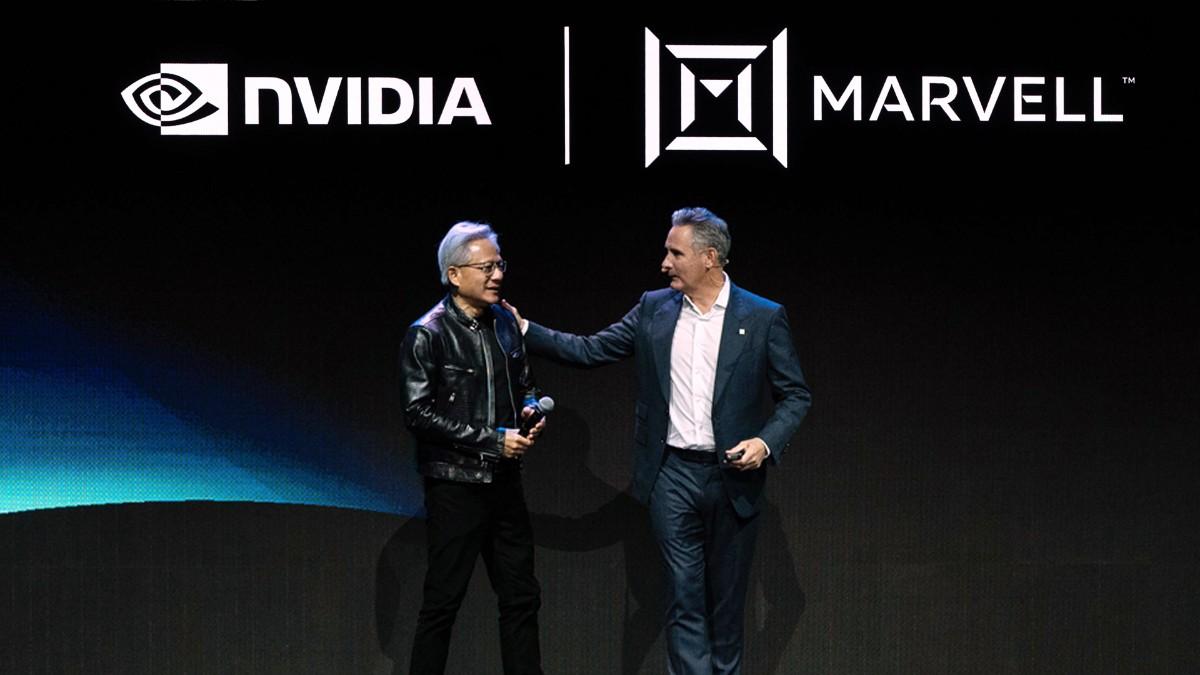
Huang’s $1T signal carries weight because it is backed by capital, architecture, and timing. Nvidia has already invested $2 billion in Marvell and tied the company to NVLink Fusion. The market is evaluating Marvell as part of the AI infrastructure stack, not as another index addition.
The partnership gives the claim substance. Marvell is linked to custom XPUs, NVLink Fusion-compatible scale-up networking, silicon photonics, and Nvidia’s broader AI factory ecosystem. These products sit near the bottleneck where AI clusters require faster connectivity, lower latency, and more efficient data movement.
The market is no longer valuing Marvell as a semiconductor supplier. It is valuing Marvell as a toll road for AI scale. Huang’s comment carries more force than the S&P 500 inclusion because it points to where the next AI scarcity premium may form.
Marvell’s bull case no longer rests on product slides or future design wins. Q1 fiscal 2027 revenue hit a record $2.418 billion, up 28% year over year, with non-GAAP diluted EPS of $0.80 and operating cash flow of $638.8 million. Q2 guidance calls for $2.7 billion in revenue, plus or minus 5%, implying roughly 35% year-over-year growth at the midpoint.
AI demand is now showing up in reported revenue, not just investor imagination. Optics, switching, interconnect, and custom silicon have moved from optional upside to the centre of Marvell’s revenue base.
Fiscal 2026 set that shift in motion. Revenue rose 42.1% to $8.195 billion, while data-centre revenue reached $6.100 billion, or 74% of total revenue. Marvell is no longer asking the market to believe in an AI pivot before the numbers arrive; it is asking the market how much that pivot is worth.
A trillion-dollar Marvell would require the market to believe that connectivity, optics, and custom silicon deserve a platform premium once reserved for compute monopolies. At a market value near $235.4 billion, the $1T case requires roughly a 4.25x increase. Against fiscal 2026 revenue of $8.195 billion, a $1T valuation would equal roughly 122x trailing annual sales.
The math does not kill the bull case. It raises the execution threshold. A high-multiple AI infrastructure stock can survive volatility when revenue acceleration continues to improve; it cannot survive weak conversion of bookings into sales.
The valuation question is no longer whether Marvell can grow. The question is whether the market is already paying for an earnings base that still has to be built.
Pre-inclusion strength is easier to explain than post-inclusion strength. A rally into June 22 can reflect front-running, passive flow, and momentum chasing. A bid that survives after the rebalance points to something more durable.
The recent selloff makes the test cleaner. Semiconductor stocks were hit hard in the broader risk-off move, with the PHLX Semiconductor Index dropping 10.3% in its worst single-day decline since March 2020, while the Nasdaq fell 4.2%. MRVL’s recovery against that backdrop shows buyers still want exposure, not that they will pay any price for it.
One signal matters after June 22: whether MRVL can hold above the post-selloff range while AI peers remain volatile. A failure would suggest the inclusion trade was pulled forward. Strength would imply the market is still building a position in Marvell’s AI infrastructure role.
The risk is not that Marvell lacks an AI story. The risk is that the story becomes too expensive before the earnings base is large enough to defend it.
Customer concentration is the clearest structural pressure point. Marvell disclosed that its ten largest customers represented 82% of fiscal 2026 revenue, with two customers each accounting for at least 10% of total revenue. Concentration can accelerate growth during an AI capex boom, then magnify downside when spending pauses, shifts, or moves in-house.
AI capex adds the second pressure point. Marvell’s own risk disclosures warn that current AI infrastructure spending may not be sustainable over the long term and that customers could decelerate or reallocate capital expenditures. Marvell may be strategically important and still too dependent on a spending cycle it cannot control.
Marvell enters the S&P 500 before the market opens on June 22, replacing Pool Corp.Index-linked funds will need exposure, which can support short-term demand. The harder test comes after the rebalance, when MRVL has to hold without mechanical buying.
Not completely. MRVL already carries a large AI premium, with a market value near $235.4B, so the easy rerating has likely passed. The remaining upside depends on AI revenue growth, margin expansion, and evidence that Marvell’s infrastructure role can scale beyond a single index catalyst.
Nvidia’s $2B investment gives Huang’s praise financial weight. Marvell is tied to NVLink Fusion, custom XPUs, scale-up networking, and silicon photonics, placing it near the connectivity bottleneck inside AI clusters. The investment turns Marvell from a supplier story into an ecosystem story.
Yes. Stocks often rally before a known catalyst when demand is anticipated early. If MRVL rises into June 22 and then fades after inclusion, the market is saying the rebalance was already priced in. The warning signal is a break back into the post-selloff range.
Marvell needs AI bookings to become durable revenue, data-centre growth to keep compounding, and margins to expand as scale improves. Customer concentration also has to stay contained. A $1T valuation requires investors to treat Marvell as AI infrastructure rather than a cyclical chipmaker.
June 22 is the scheduled catalyst; the real signal comes after it. A stock that holds once index demand clears is no longer trading only on inclusion mechanics.
If MRVL can defend its post-selloff range after the rebalance, Huang’s $1T call stops being a headline and becomes the market’s next valuation problem.