Published on: 2026-06-08
Updated on: 2026-06-08
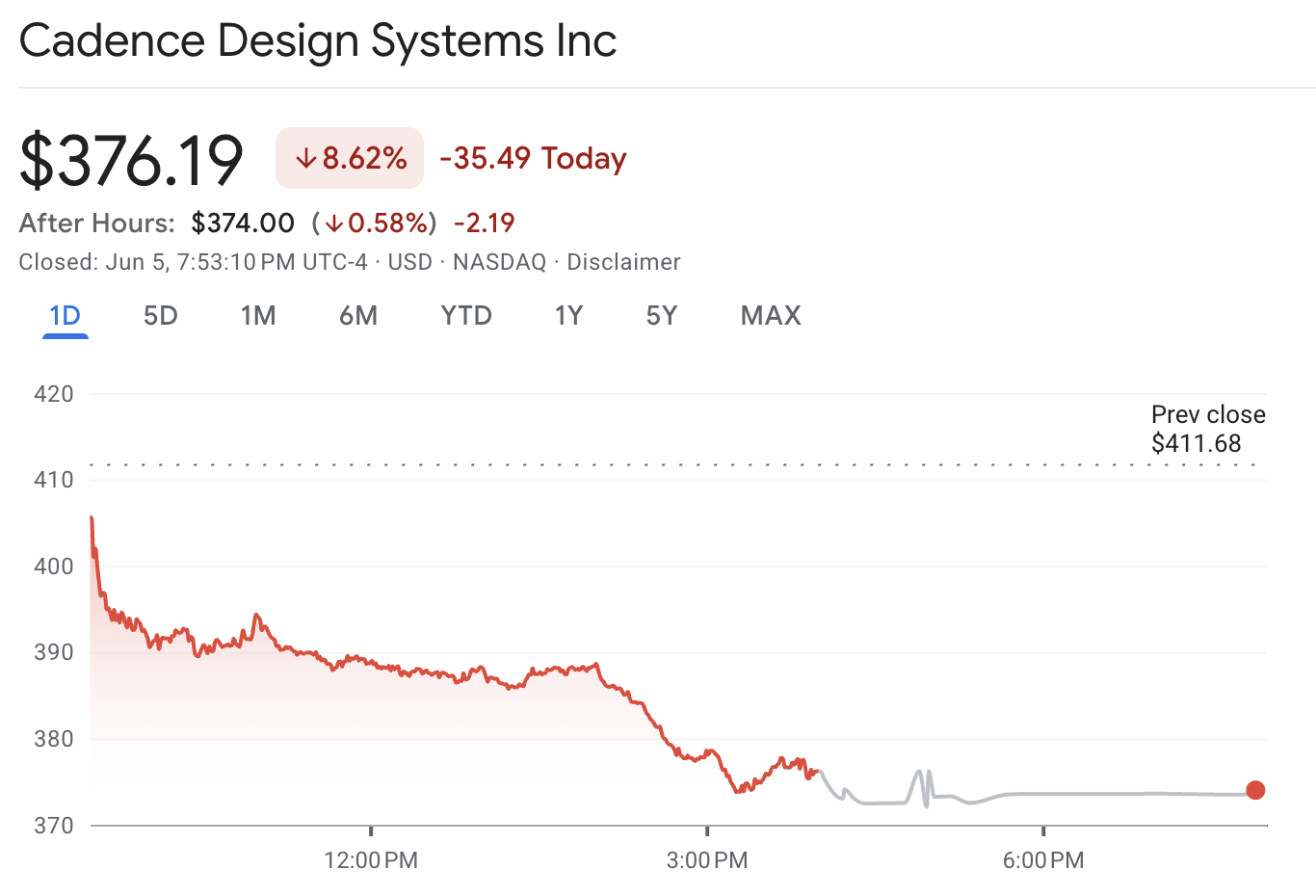
Cadence Design Systems (Nasdaq: CDNS) closed at $376.19 on June 5, with CDNS stock down 8.62% on the day, more than double the Nasdaq Composite's 4.18% decline, itself the index's worst session since April 2025.
The S&P 500 lost about 2.6%. For a company with a record $8.0 billion backlog and guidance for 17% revenue growth this year, the size of the move demands a better explanation than "tech sold off."
There is one, and it has two parts. The first repriced AI expectations. The second repriced the discount rate. Cadence sat at the intersection of both.
CDNS fell 8.62% to $376.19 on June 5, twice the Nasdaq’s 4.18% drop, with no fresh negative company-specific disclosure. Volume of about 3.4 million shares ran well above the 50-day average near 2.4 million.
Catalyst one: Broadcom guided Q3 AI semiconductor revenue to $16 billion, below Street and buyside expectations that ranged from roughly $16.4 billion to more than $17 billion, and declined to raise its full-year AI target, cracking the assumption that AI spending forecasts only move up.
Catalyst two: May payrolls rose 172,000 versus expectations near 80,000, pushing Treasury yields higher and sharply lifting market-implied odds of at least one Fed rate increase by year-end.
Cadence’s Q1 was strong on the details: revenue grew 19%, core EDA rose 18%, IP grew 22%, hardware delivered a record quarter, and backlog reached $8.0 billion.
The vulnerability is the multiple. Near 88 times trailing GAAP earnings and about 47 times forward non-GAAP guidance, CDNS is a long-duration asset, and long-duration assets fall hardest when rate expectations flip.
Broadcom reported fiscal Q2 results after the close on June 3. By normal standards they were excellent: revenue of $22.19 billion, up 48%, with AI semiconductor revenue of $10.8 billion growing 143% and AI bookings above $30 billion.
The market sold the guidance instead. Q3 AI revenue of $16 billion came in below Street and buyside expectations that ranged from roughly $16.4 billion to more than $17 billion, and management reiterated rather than raised its full-year AI target, while emphasizing long-term AI commitments with major customers including Google, Anthropic, OpenAI, and Meta. Broadcom fell about 14% on June 4 and kept falling Friday.
The signal investors took was narrow but important: AI infrastructure demand is on track rather than accelerating. After eighteen months in which the trade was underwritten by upward revisions, “on track” read as a downgrade. Nvidia lost 6.2%, AMD around 11%, Micron about 12%.
Then came Friday morning’s jobs report. May payrolls rose 172,000 against expectations near 80,000, with unemployment steady at 4.3%. Treasury yields jumped, the two-year reaching its highest level in a year, and futures markets sharply raised the probability of at least one Fed rate increase by year-end, with several reports putting the odds above 50% after the data.
Cadence carries one of the highest multiples in large-cap software: about 88 times trailing GAAP earnings, and roughly 47 times the midpoint of its own 2026 non-GAAP EPS guidance of $7.85 to $7.95. A multiple like that is a statement about cash flows far in the future, which makes the stock behave like a long-duration bond.
When the rate outlook flips from cuts to a possible hike, the present value of those distant cash flows compresses mechanically, before anyone changes a single revenue estimate.
Positioning amplified the math. CDNS had rallied into the week, up more than 15% over the prior month, and before Friday’s selloff had gained roughly one-third year to date; after the decline, the year-to-date advance was closer to 20%, depending on the data provider. Much of that run came on enthusiasm for its agentic AI announcements at Computex.
Stocks that have just rerated on a story are the first source of funds when the story’s sector wobbles. The June 5 decline took back the ChipStack pop and then some.
Both EDA leaders fell, but Cadence fell harder, despite Synopsys carrying its own China-related guidance baggage from earlier in the cycle. The market was not discriminating on fundamentals on Friday. It was selling duration and crowding, and Cadence had more of both.
The fundamental record argues against reading June 5 as a demand signal. Cadence’s first quarter, reported April 27, showed broad-based acceleration rather than fatigue. Revenue rose 19% to $1.474 billion.
Core EDA grew 18%. IP revenue grew 22% on AI, high-performance computing, and automotive demand; on the earnings call, CEO Anirudh Devgan cited a record-sized IP deal at a leading global foundry tied to 2-nanometer work.
Management called it the best hardware-emulation quarter in company history, driven by AI and HPC customers, and bookings beat plan to push backlog to a record $8.0 billion, of which $4.0 billion converts to revenue within twelve months.
| Q1 2026 | Result | Detail |
|---|---|---|
| Revenue | $1.474B, +19% | Beat guidance of $1.42B to $1.46B |
| Core EDA growth | +18% | Best hardware-emulation quarter on record |
| IP growth | +22% | Record 2nm foundry deal cited on the call |
| Non-GAAP EPS | $1.96, +25% | Above the $1.89 to $1.95 guided range |
| Backlog | $8.0B record | $4.0B converting within 12 months |
| 2026 outlook | $6.125B to $6.225B | Raised from $5.9B to $6.0B, about 17% growth |
Two balance-sheet details deserve more attention than they get. The Hexagon Design and Engineering acquisition adds about $160 million of revenue this year but dilutes non-GAAP EPS by roughly $0.28, which is why the 2026 EPS range came down even as revenue guidance went up; management expects accretion in 2027.
Funding it left Cadence with $2.925 billion of debt against $1.407 billion of cash, a modest net-debt position that is new for this company. Neither is alarming. Both belong in any honest account of why the EPS guide moved.
The week’s earlier rally came from the ChipStack AI Super Agent, unveiled with Nvidia at Computex and described as a Level-5 autonomous virtual engineer for chip design and verification, running on Cadence’s AgentStack framework.
Early-access customers arrive in the second half of 2026, and reports indicated Nvidia engineers already use it for automated verification.
The commercial thesis is that autonomous agents increase EDA consumption, running more simulation and verification cycles, not fewer. Q1’s emulation record is consistent with that. But as of today, ChipStack has no disclosed revenue, no published adoption metrics, and no named paying customers beyond the development partner.
The market paid for it on announcement, then clawed the payment back within seventy-two hours. That round trip is the week’s most precise illustration of how this stock now trades.
Three things would move the stock for reasons Cadence controls: early-access adoption disclosures for ChipStack in the second half, backlog growth beyond $8.0 billion at the July Q2 report against revenue guidance of $1.555 to $1.595 billion, and evidence that Hexagon integration is tracking toward 2027 accretion.
One thing moves it for reasons Cadence cannot control: the December rate decision and every payroll and inflation print between now and then. At 47 times forward earnings, CDNS will keep trading as a long-duration AI asset first and a design-software franchise second. June 5 did not reveal anything new about the business.
It revealed, precisely and expensively, which of those two identities the market prices when the discount rate moves.