Published on: 2026-08-19
Calls to boycott Neutrogena spread across social media in August 2026 after claims involving Hayden Panettiere’s former relationship with the brand resurfaced, while parent Kenvue fell 2.14% on August 17. Neither Kenvue nor Kimberly-Clark linked the share move to the boycott, and no post-boycott sales data is available yet. These five historical episodes show why a stock falling during a boycott does not necessarily mean the boycott caused it.
The first stock reaction reflects expectations rather than confirmed financial damage. Four signals help distinguish temporary sentiment from a boycott that is reaching the business:
Substitution: Can customers easily switch to another product?
Revenue exposure: How important is the affected brand or customer group?
Persistence: Does demand recover quickly or remain weak across reporting periods?
Fundamental confirmation: Do traffic, sales, market share or guidance deteriorate?
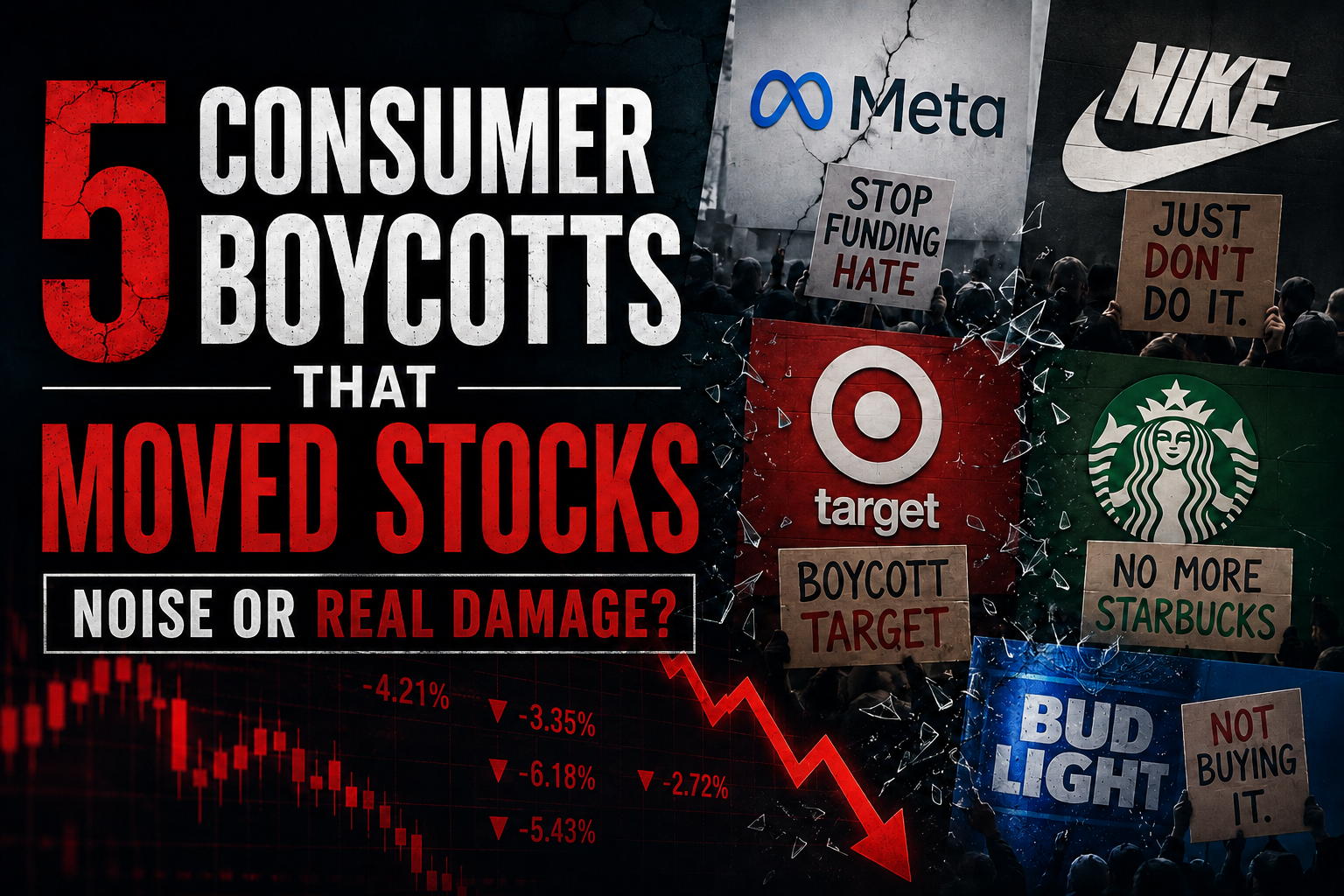
The five cases below range from short-lived market shocks to persistent changes in consumer behaviour.
In June 2020, major advertisers joined the Stop Hate for Profit campaign and paused advertising on Facebook over concerns about how Meta platform handled hate speech. Facebook shares fell 8.3% on June 26, wiping roughly $56 billion from its market value as companies including Unilever joined the campaign.
The financial damage proved far smaller than the initial stock reaction suggested. By the third quarter, Facebook reported advertising revenue of $21.22 billion, up 22% from a year earlier, while advertiser demand remained strong.
Facebook’s broad advertising base limited the effect of individual brands leaving temporarily. The boycott created an immediate valuation shock, yet the company’s core revenue engine continued growing.
Nike faced boycott calls in September 2018 after featuring former NFL quarterback Colin Kaepernick in its 30th-anniversary “Just Do It” campaign. Social-media users posted videos destroying Nike products, while shares closed 3.2% lower on September 4.
Sales evidence soon challenged fears of lasting damage. Edison Trends estimated that Nike’s online sales increased 31% over the Labour Day period compared with the equivalent period a year earlier.
The episode exposed a weakness in judging boycotts through social-media volume alone. A highly vocal group can generate damaging headlines without representing enough spending power to materially weaken the company. The more useful question is how much revenue the boycotting customers actually represent.
Target faced backlash in 2023 over its Pride merchandise, including calls for boycotts and confrontations in some stores. Its shares subsequently endured a nine-session losing streak through May 31, although concerns about weakening discretionary spending were already weighing on the retailer.
Target later reported second-quarter comparable sales down 5.4%, traffic down 4.8% and total revenue down 4.9%. Management acknowledged that reaction to the Pride assortment affected traffic and top-line trends, while also saying the separate financial impact could not be reliably quantified.
That distinction makes Target an important case. Sales and traffic weakened, yet broader consumer pressure was already present. A stock falling during a boycott can therefore exaggerate the boycott’s importance if the underlying business was deteriorating beforehand.
Boycott calls involving Starbucks spread across several markets from late 2023, just as customer traffic was weakening. By fiscal Q2 2024, global comparable-store sales had fallen 4%, while U.S. comparable sales declined 3% and comparable transactions fell 7%.
Starbucks shares dropped about 12% in extended trading after the company reported those results and cut its annual outlook. However, the boycott was only one part of a broader problem. Starbucks also faced cautious consumers, softer traffic and operating challenges, while management acknowledged that brand “misperception” had affected its Middle East business.
The case shows why operating confirmation needs context. Weak sales can make a boycott look financially decisive even when several pressures are affecting demand at the same time.
Bud Light provides the clearest example of a boycott becoming measurable business damage. Backlash followed an April 2023 social-media promotion involving Dylan Mulvaney, and consumers had an easy alternative: buy another beer.
By May 31, AB InBev shares had fallen roughly 20% from March 31. The operating damage was also visible. During the four weeks ended June 3, Bud Light sales were down 24.6% from a year earlier, while Modelo Especial sales rose 10.2%. Modelo captured an 8.4% share of U.S. retail beer sales during the period, ahead of Bud Light’s 7.3%.
The weakness persisted. AB InBev later reported U.S. revenue down 9.5% for 2023, with shipments falling 12.7% and retailer depletions down 11.9%, driven primarily by Bud Light.
Bud Light shows what turns a reputational crisis into structural damage: customers switch, competitors gain share, and the lost demand survives long after the original controversy fades.
| Case | Initial market reaction | What happened afterward | Verdict |
| Meta | 8.3% one-day decline | Advertising revenue kept growing | Mostly noise |
| Nike | 3.2% initial decline | Online demand remained resilient | Mostly noise |
| Target | Extended share weakness | Sales fell amid several pressures | Mixed |
| Starbucks | Sharp post-earnings decline | Boycott coincided with broader demand weakness | Mixed |
| Bud Light | Roughly 20% decline over two months | Sales and market share losses persisted | Real damage |
The stock reaction is only the first signal. Meta lost roughly $56 billion of market value in one session even though advertising growth remained strong, while Nike’s early decline was followed by resilient demand. Bud Light produced the opposite pattern because customers switched products and competitors captured the lost spending.
The stronger evidence appears in customer behaviour. Falling store traffic, transaction counts, unit volumes, or comparable sales become more meaningful when direct competitors gain at the same time.
The next check is persistence. One weak week can reflect publicity. Repeated weakness across reporting periods, combined with market-share loss or reduced guidance, suggests the controversy is entering the company’s earnings outlook.
A boycott should therefore be analysed as a business problem only when consumer behaviour confirms what the headlines initially imply.
Yes. Investors can sell before revenue data appears because share prices reflect expected future earnings. The initial decline therefore reflects a change in perceived risk rather than proof that the boycott has already damaged sales.
Usually several weeks or reporting periods. Sales volumes, customer traffic, market share and management commentary provide stronger evidence than social-media activity or the stock’s movement during the first few trading sessions.
Persistent market-share loss is one of the strongest signals. When customers repeatedly buy competing products instead, the company loses current sales and may need heavier marketing or promotions to win those customers back.
Yes. A stock can recover when later data shows resilient demand or limited revenue exposure. Meta and Nike demonstrate how expectations can reverse when operating results fail to confirm the initial boycott fears.
Boycotts can erase billions in market value before companies report any measurable sales damage. Meta and Nike showed how quickly markets can overestimate visible outrage, while Bud Light showed the consequences when consumers genuinely switch and stay away. Traffic, volumes, market share, comparable sales and guidance provide the evidence that separates a temporary sentiment shock from lasting financial damage.