Published on: 2026-08-31
Anyone holding IREN stock had a rough week. The shares took a sharp 12.5% dive, landing around $35.45 after the company dropped its latest numbers. And honestly, it’s easy to see why investors panicked. The report showed a bizarre double reality: massive demand for their AI servers on one hand, and a mountain of red ink, heavy write-downs, and eye-watering bills on the other.
If you’ve been following Iris Energy (now just IREN), you know they’ve been trying to shed their skin as a basic Bitcoin miner and rebranded themselves as a heavy-hitting AI cloud powerhouse. But Wall Street’s knee-jerk sell-off proved one thing: pivoting a massive data business is ridiculously expensive, and the market isn't in the mood to wait around quietly while the money burns.
The main reason IREN stock caught a beating was a bottom-line figure that shocked even hardened analysts. IREN posted a staggering net loss of roughly $684 million for the quarter. A big chunk of that mess came from non-cash hit charges—over $450 million worth—as they scrapped old crypto gear to clear physical space for high-end Nvidia GPU racks.
Revenue took a hit too, dropping to $137.2 million compared to $180.6 million a year ago. Basically, the business got caught in an awkward middle ground: crypto income is shrinking, but the new AI cloud business isn't fully paying the bills yet.
Still, it wasn't all bad news under the hood:
AI Took the Driver's Seat: For the first time ever, AI cloud services brought in more money than crypto mining, generating $70.5 million—up 110% from the previous quarter.
The Big Guys Are Signing On: Annual recurring revenue hit the $1 billion mark after Microsoft verified initial setups, with management eyeing a massive $4 billion target as new capacity opens up.
Insane Capital Demands: Building facilities for clients like Microsoft takes real money, leading to billions in ongoing construction commitments.
The demand is clearly there, but traders were way more focused on how much cash the company is burning through just to stay in the race.
Putting together gigawatt-scale data centers isn't cheap. In this quarter alone, IREN spent $2.1 billion on infrastructure, leaving them with a quarterly cash burn of $303 million. To keep the lights on and the construction moving, their long-term debt shot up to over $7.4 billion. Compare that to under $1 billion just a year ago, and it’s clear why people holding IREN stock are sweating.
To make matters worse, investors were already annoyed about executive pay from earlier this summer. Seeing leadership pocket heavy stock rewards while the company bleeds cash left a bad taste in everyone's mouth. Throw in the threat of stock dilution to pay off loans, and you get a recipe for a massive exit.
The plunge in IREN stock has split analysts right down the middle.
The skeptics argue that building data centers is a endless money pit. If AI compute prices drop or if big tech companies just build their own centers, margins will get squeezed fast. From where they sit, switching from mining to AI carries way too much operational risk to justify holding the stock right now.
The bulls, however, view this crash in IREN stock as a discount sale. Firmly bullish teams at Cantor Fitzgerald and BTIG are holding onto their buy ratings. They reckon IREN’s massive power grid access and secured GPU orders make them an indispensable landlord for the AI boom. Once the heavy write-offs stop and the new centers start pumping out revenue, they believe the stock will roar back.
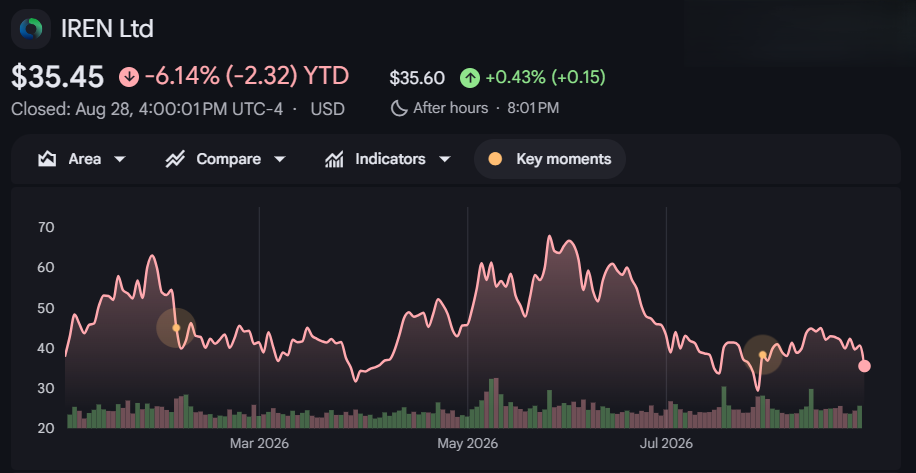
Looking at the daily chart, IREN stock broke through some key floor levels after the earnings call. Once it lost support at $40. it slid right down into the $35–$38 neighborhood. Technical indicators like the RSI are leaning heavily bearish. If buyers don't step in to defend these levels soon, the stock could test lower support around $29 or $30 before finding solid footing.
The sudden slide in IREN stock is a reminder of how tough tech pivots really are. Building the backbone of the AI era sounds great on paper, but high debt, heavy cash burn, and short-term losses will test any investor's patience. If management can hit that $4 billion revenue mark and cool down the spending, this drop might just look like a bump in the road. But until the math clears up, expect a bumpy ride.