Published on: 2026-07-03
Gold rarely moves because of one signal. Rates, the Dollar, inflation, central banks, physical demand and risk appetite often pull it in different directions. The 9 factors affecting gold price explain why gold can ignore one bearish signal when another driver becomes strong enough to take control.
 Key Takeaways
Real rates set gold’s opportunity cost because bullion pays no income.
The US Dollar usually pressures gold unless fear lifts both assets.
Central banks create structural demand, with official buying averaging 1,000 tonnes a year over the past four years.
High prices can split physical demand, weakening jewellery volumes while lifting bar-and-coin demand.
Momentum controls speed, not value, making ETF and futures flows powerful but unstable.
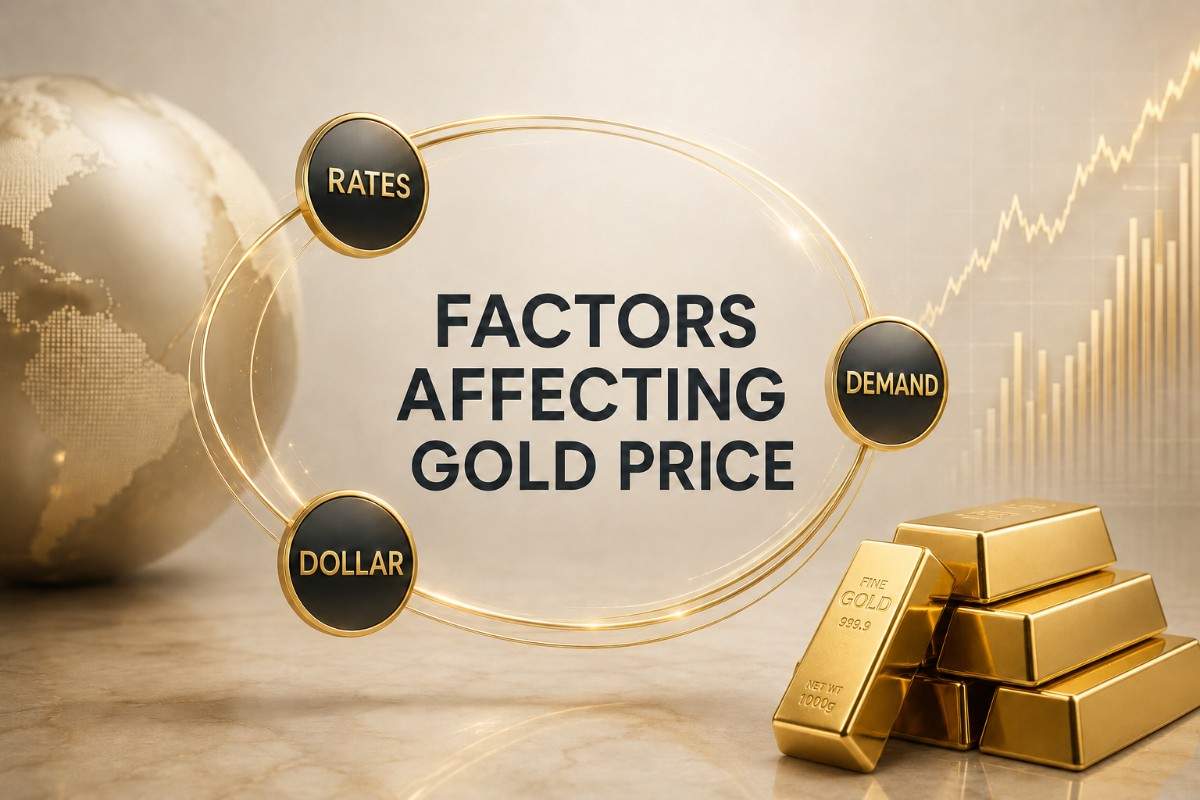
Gold’s drivers broadly fall into opportunity cost, currency pressure, risk demand, physical demand, supply and momentum. The nine factors below show how each force reaches price.
| Factor | How It Moves Gold |
|---|---|
| Real rates | Higher real yields raise gold’s opportunity cost |
| US Dollar | A stronger Dollar usually pressures global demand |
| Inflation | Gold rises when inflation weakens real returns |
| Central banks | Reserve buying creates structural support |
| ETF flows | Fast investment demand accelerates price moves |
| Jewellery demand | High prices can reduce physical buying |
| Mine supply | Slow supply response limits short-term impact |
| Geopolitical risk | Fear adds a risk premium |
| Momentum | Positioning controls the speed of moves |
The first three usually dominate calm markets. Central banks, crisis demand and positioning become more powerful when gold breaks away from its normal rate-and-Dollar relationship.
Real rates measure what cash and bonds pay after inflation. When that return rises, gold has to compete harder because it pays no income.
Falling real yields reduce that cost and usually support gold. Rising real yields pressure gold unless crisis demand, reserve buying or currency distrust becomes stronger.
Real rates are powerful in calm macro conditions. They lose influence when gold is priced less as a yield competitor and more as protection against financial stress.
Gold is priced globally in US Dollars, so a stronger Dollar usually makes it more expensive outside the United States. That can reduce demand and pressure the price.
The link breaks during stress. Gold and the Dollar can rise together when both act as defensive assets, which means risk demand has overpowered normal currency pressure.
Dollar strength usually tightens global demand. During stress, defensive demand can overpower the usual Dollar drag.
Gold does not rise on inflation alone. It rises when inflation weakens real returns, policy credibility or confidence in cash.
A high CPI print can hurt gold if it pushes rate expectations higher and lifts real yields. The same inflation pressure can support gold if policy looks behind the curve and cash returns fail to protect purchasing power.
The stronger signal is whether inflation-adjusted returns are improving or deteriorating. Headline inflation is noise unless it changes the real return on money.
Central-bank buying gives gold support that is not tied to short-term yield. The motive is reserve security, liquidity and diversification, not daily price movement.
Central banks accumulated an average of 1,000 tonnes of gold per year over the past four years, compared with an average of 500 tonnes per year in the previous decade. The 2026 Central Bank Gold Reserves Survey also found that 89% of respondents expected global official gold reserves to rise over the next 12 months, while a record 45% expected their own institution’s holdings to increase.
Rates, the Dollar and market flows still drive short-term moves. That steady reserve demand can absorb pressure when rates, the Dollar and investment flows turn less supportive.
Investment demand moves faster than physical consumption. Gold-backed ETFs, futures and bar-and-coin flows can respond immediately to rate expectations, Dollar moves and crisis premiums.
Q1 2026 showed the split inside gold demand. Gold-backed ETFs added 62 tonnes, far below the 230 tonnes added in Q1 2025, while bar and coin demand rose 42% y/y to roughly 474 tonnes.
ETFs can cool while bar-and-coin demand strengthens. Futures positioning can move price faster than both, especially when rate or Dollar signals shift quickly.
Jewellery demand remains a major physical channel, especially across Asia and the Middle East. It is also price-sensitive.
When gold rises too far, too fast, jewellery demand often adjusts by weight. Q1 2026 jewellery demand volumes fell 23% y/y, even as spending rose 31%, showing how high prices can reduce tonnage without removing gold’s role in physical demand.
Jewellery demand is not the engine of every gold rally. It often becomes the first pressure point in a high-price regime.
Gold supply adjusts slowly because new mine production takes years of exploration, permits, financing and construction.
That slow response limits supply’s influence over short-term price swings. Q1 2026 total gold supply rose only 2% y/y, with mine production up 2% and recycling up 5%.
Gold supply cannot adjust quickly enough to absorb sudden demand shocks. Price usually moves first, while new mine output follows years later.
Geopolitical stress supports gold when uncertainty changes capital flows, policy expectations or reserve behaviour. The price impact usually appears as a risk premium.
That premium fades when fear loses market relevance. A ceasefire, liquidity rebound or stronger Dollar can compress the same premium that lifted gold earlier.
Ordinary headlines do not guarantee sustained upside. Gold’s crisis role is strongest when uncertainty threatens confidence in financial assets or government liabilities.
Momentum accelerates gold moves once a macro signal has already taken hold. ETF inflows, futures positioning, trend-following models and technical breakouts can stretch a rally beyond what fundamentals alone justify.
Crowded positioning cuts both ways. The same force that accelerates the rally can sharpen the reversal when rates, the Dollar or liquidity turn against gold.
Momentum controls velocity. Direction still needs support from real rates, currency pressure, risk demand or physical flows.
Real rates usually dominate calm macro conditions. The US Dollar usually dominates when currency pressure becomes the main market signal.
For the current cycle, three signals deserve priority:
Real rates because they decide whether gold faces rising or falling opportunity cost.
The US Dollar because it controls global purchasing power and short-term currency pressure.
Central-bank flows because reserve demand can absorb weakness when investment flows turn unstable.
Crisis risk, reserve buying and inflation stress change the hierarchy. In those regimes, gold can rise despite signals that normally hold it down.
Gold does not need all 9 factors to turn bullish. One dominant driver can overpower five weaker ones.
Real interest rates are usually the biggest macro factor. Gold pays no income, so higher inflation-adjusted bond returns raise the cost of holding it. Lower real returns usually make gold more competitive as a store of value.
Higher interest rates can pressure gold when they lift real yields. Income-producing assets become more attractive when yields rise faster than inflation. The pressure weakens when rate hikes coincide with crisis risk or declining policy credibility.
Yes. A strong Dollar usually pressures gold through currency translation, yet crisis demand can lift both. When fear dominates, gold and the Dollar can attract defensive flows at the same time.
No. Gold rises during inflation when real returns deteriorate, or confidence in money weakens. If inflation pushes central banks toward credible tightening and real yields rise, gold can struggle even while headline inflation remains high.
Central banks buy gold for reserve diversification, liquidity, crisis performance and reduced dependence on foreign liabilities. The 2026 survey showed that performance during crises, portfolio diversification, inflation hedging, geopolitical risk hedging and reserve diversification were key reasons for holding gold.
The next gold move should be read through hierarchy, not headlines. A hot inflation print, stronger dollar, or weaker jewellery demand only counts if it changes the leading driver. Gold does not follow the loudest signal. It follows the one with the most force.