Published on: 2026-06-11
Elliott Wave Theory is a way to analyse markets by identifying recurring wave patterns in price movements. The theory holds that prices move in waves because traders' emotions shift among optimism, doubt, fear, and greed.
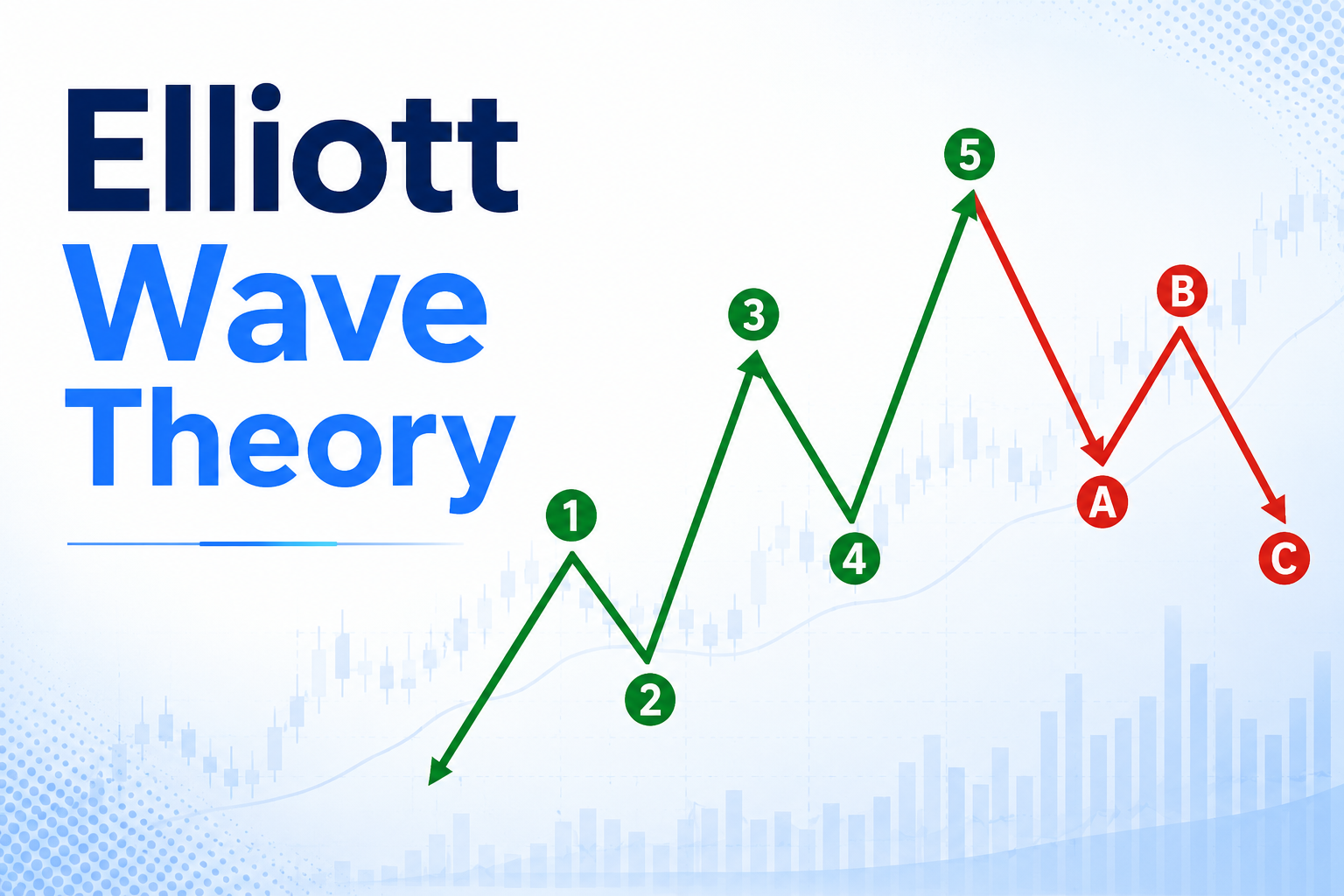
The easiest way to understand Elliott Wave Theory is to think of markets often moving in five waves in the main direction, followed by three waves in the opposite direction. This pattern is usually shown as 1-2-3-4-5, then A-B-C.
Elliott Wave Theory gives traders a framework for reading market structure and possible turning points.
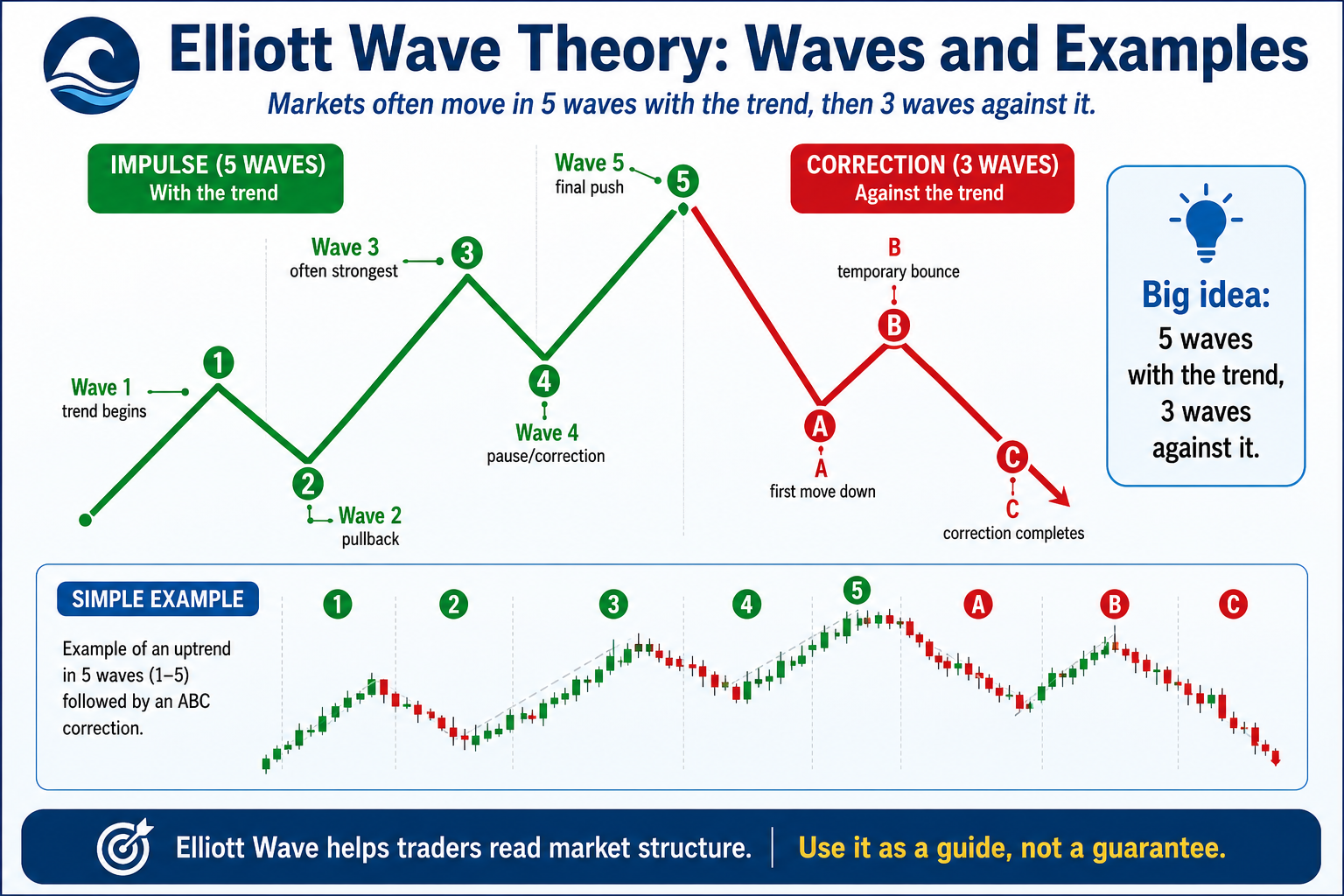
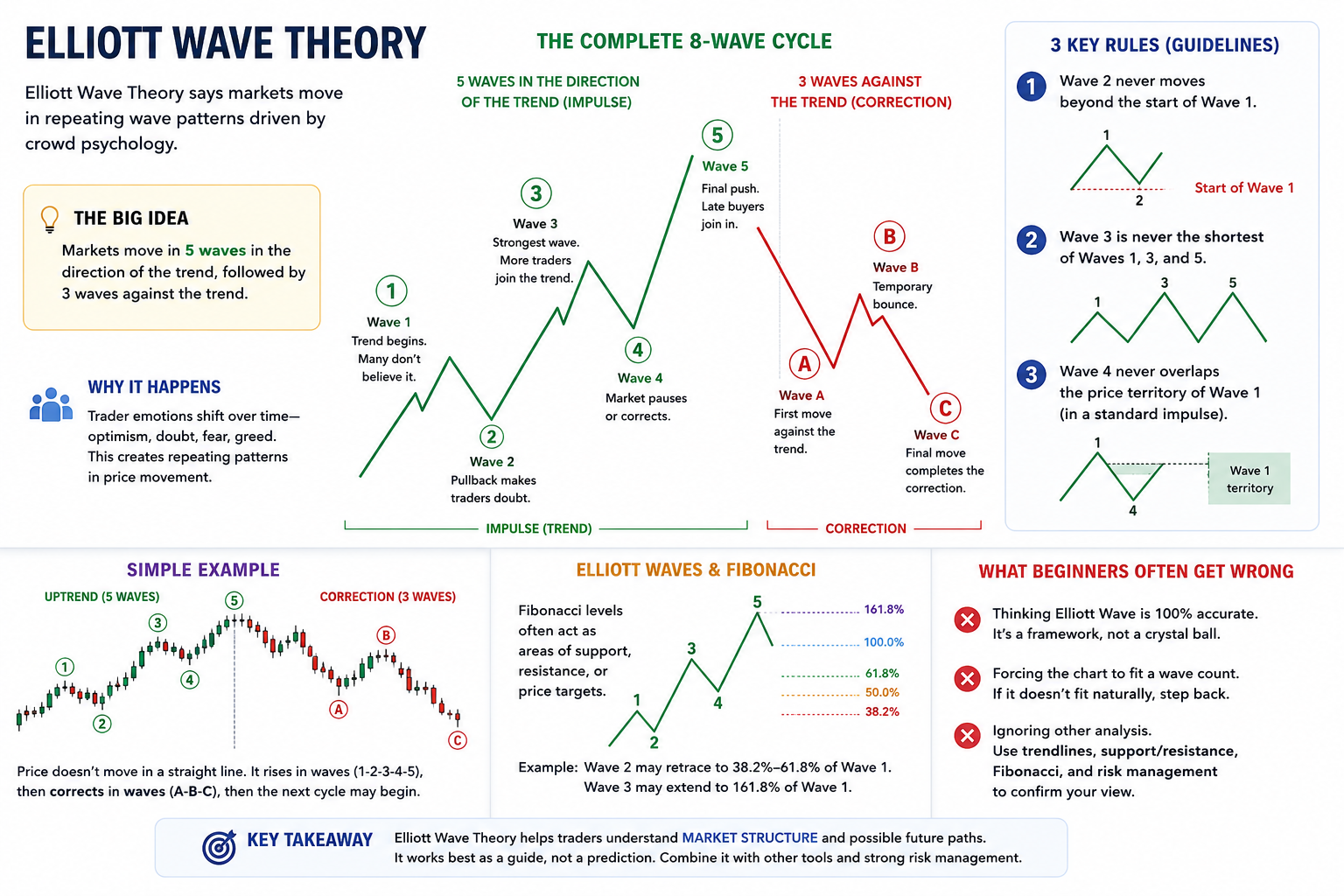
A basic Elliott Wave cycle has two parts: an impulse move and a correction. The impulse move has five waves that go in the direction of the main trend.
Wave 1: A new trend starts, but many traders are still unsure about it.
Wave 2: The price pulls back after the first move.
Wave 3: This is often the strongest wave, as more traders join the trend.
Wave 4: The price pauses or pulls back after the strong move.
Wave 5: The last push happens when late traders enter the trend.
After the five waves, the market often goes into a correction. The correction usually has three waves: A, B, and C. Wave A goes against the trend, Wave B is a short bounce, and Wave C finishes the correction.
Traders use Elliott Wave Theory to figure out where the market is in a bigger trend or correction.
It helps traders ask useful questions, like: Is the market starting a new trend? Is this move just a pullback? Is the trend getting crowded? Could the price be close to a correction? This makes Elliott Wave Theory helpful for understanding different market phases. It helps traders see beyond random price movements.
However, traders should not use it on its own. They often combine Elliott Wave analysis with trendlines, Fibonacci levels, support and resistance, price action, and risk management.
Elliott Wave Theory is closely connected to how crowds think and act in the market.
When a trend starts, many traders feel unsure. As the price rises or falls, people become more confident, and more traders join in, strengthening the trend. By the last wave, emotions can get too high, and the market might be ready to correct.
That is why Elliott Wave Theory is not just about drawing waves on a chart. It is also about understanding how traders' behaviour changes at different stages of the market.
Many traders who use Elliott Wave Theory also use Fibonacci retracement and extension levels.
Fibonacci retracement can help estimate how far a correction might go. The Fibonacci extension can help identify potential targets for the next wave.
For example, Wave 2 might pull back part of Wave 1, while Wave 3 can go much further than the earlier move.
These levels are not perfect. They are used as guides, not fixed rules. Traders should always confirm them with the market structure and risk control.
Elliott Wave Theory has many guidelines, but beginners should focus on three main rules:
Wave 2 should not move beyond the start of Wave 1.
Wave 3 is usually not the shortest of Waves 1, 3, and 5.
Wave 4 should not overlap the price area of Wave 1 in a standard impulse pattern.
These rules help traders avoid forcing a wave count that does not match what they see on the chart.
The main weakness of Elliott Wave Theory is its subjectivity. Two traders might look at the same chart and count the waves in different ways.
This can be confusing for beginners if they think the theory is a perfect prediction tool. Markets can go further, reverse, or move sideways longer than people expect.
It is safer to use Elliott Wave Theory as a guide to market structure. It can help traders plan for different scenarios, but it should not replace stop-losses, position sizing, or a clear trading plan.
Fibonacci Retracement: A tool traders use to estimate possible pullback areas during a trend.
Fibonacci Extension: A tool used to estimate possible price targets beyond the current move.
Technical Analysis: The study of price charts, patterns, and indicators to analyse market behaviour.
Trend: The general direction of price movement, either upward, downward, or sideways.
Price Action: The study of price movement itself, often without relying heavily on indicators.
Risk Management: The process of controlling potential losses before and during a trade.
Elliott Wave Theory can help beginners learn about trends and corrections, but it might seem hard at first. New traders should start with the basic 5-wave and 3-wave patterns before moving on to more advanced ideas.
No. Elliott Wave Theory cannot predict the market for sure. It gives traders a possible way to understand price movement. Since wave counts can change, traders should use them along with other tools and good risk management.
The basic pattern has five waves that move with the main trend, followed by three corrective waves that move against it. This is usually written as 1-2-3-4-5, then A-B-C.
Traders use Fibonacci levels to guess where pullbacks and targets might be in a wave pattern. For example, a correction might stop near a Fibonacci retracement level, while a trend wave could reach a Fibonacci extension level.
Elliott Wave Theory is a way to study markets by looking for repeating wave patterns. The main idea is that markets often move in five waves with the trend, then three waves against it.
Elliott Wave Theory is helpful because it shows how market structure works. It helps traders spot trends, pullbacks, and corrections more easily. But since wave counts are subjective, the theory should be used as a guide rather than as a sure prediction.