Published on: 2026-05-21
ELF stock fell after earnings as investors looked beyond e.l.f. Beauty’s strong fourth-quarter sales beat and focused instead on a slower fiscal 2027 growth outlook.
The beauty company reported Q4 net sales of $449.3 million, up 35% year over year, with adjusted diluted earnings per share of $0.32. The headline numbers were solid, but the market reaction showed that investors are now asking a harder question, which is, how much of e.l.f.’s next phase of growth can come from the core brand?
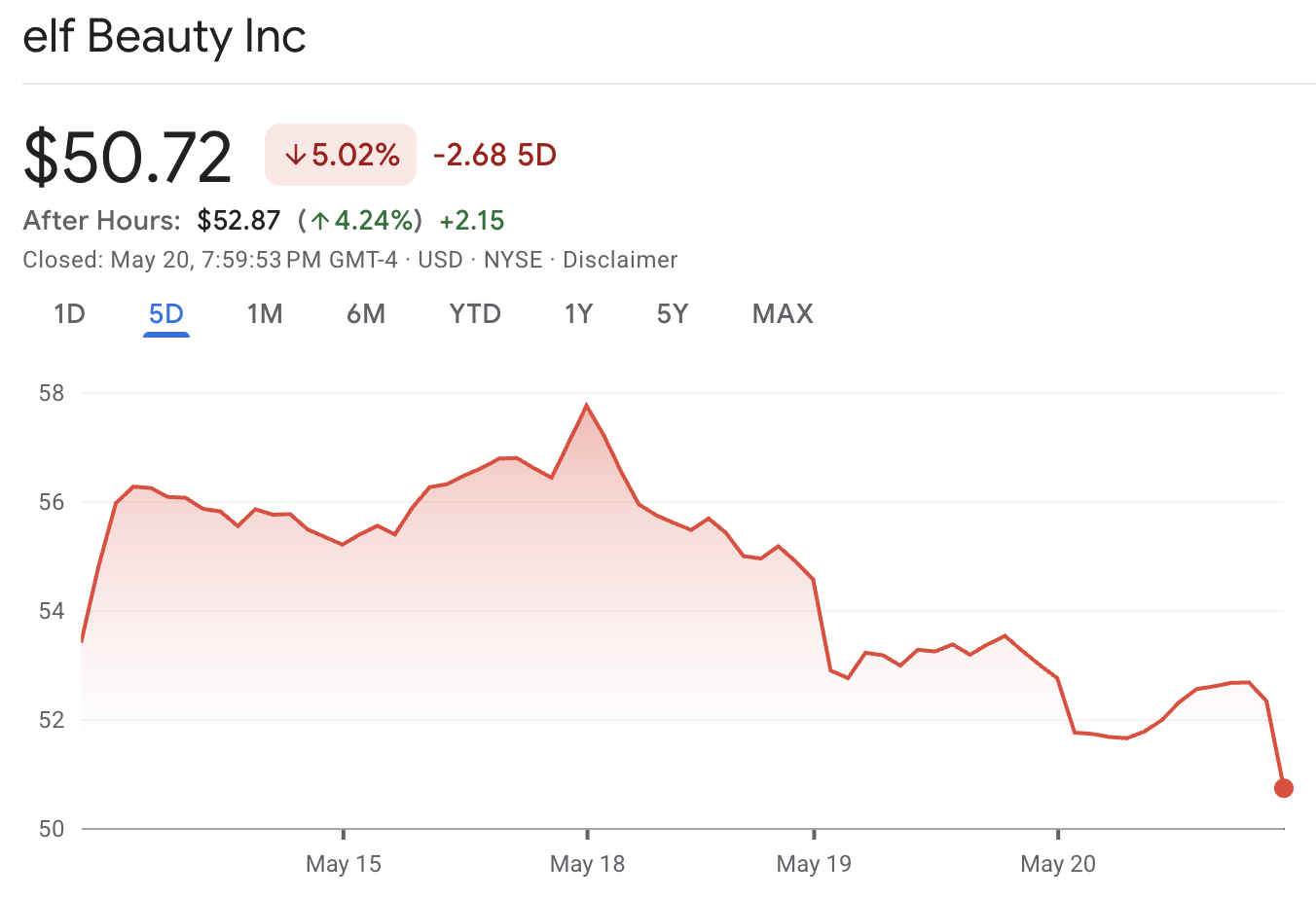
The stock closed near $50.72 after the report, down roughly 4% in the session and close to its 52-week low of $50.13. That price action marked a sharp reset for a company once priced as one of the most reliable growth names in consumer beauty. e.l.f. is still expanding, but the market is no longer treating every sales beat as proof of durable momentum.
Q4 sales beat expectations: Net sales rose 35% to $449.3 million, supported by U.S. retail, digital sales, international expansion and rhode.
FY2027 growth slows: Management guided for net sales of $1.835 billion to $1.865 billion, implying 12%-14% growth after 25% growth in fiscal 2026.
Core brand momentum cooled: Excluding rhode, organic Q4 net sales rose about 1%, shifting investor attention toward growth quality.
Profit guidance disappointed: FY2027 adjusted EPS guidance of $3.27 to $3.32 came in below Wall Street expectations near $3.61.
Tariffs remain a major pressure point: Guidance assumes an average tariff rate of about 35%, while a potential $58.5 million tariff refund is not included.
Pricing discipline is back in focus: Targeted price cuts, including the Halo Glow Skin Tint reduction from $18 to $14, suggest e.l.f. is prioritising unit demand and consumer value.
e.l.f. Beauty’s fourth quarter was not weak. Revenue increased from $332.6 million a year earlier to $449.3 million. Gross margin rose 140 basis points to 73%, helped by pricing actions that offset part of the tariff drag. Adjusted net income reached $19.4 million, while adjusted EBITDA came in at $58.8 million, equal to 13% of net sales.
The concern is not whether e.l.f. can still grow. It can. The concern is where that growth is coming from.
rhode contributed $113 million of Q4 sales, accounting for roughly 34 percentage points of the quarter’s 35% growth. Excluding rhode, organic growth was only about 1%. For a company long valued as a high-velocity mass beauty disruptor, that slowdown changes the conversation.
| Metric | Q4 FY2026 | FY2026 | Market Signal |
|---|---|---|---|
| Net sales growth | 35% | 25% | Strong headline growth, helped by rhode |
| Net sales | $449.3 million | $1.636 billion | Scale remains a clear advantage |
| Gross margin | 73% | 71% | Tariffs still weigh on full-year margins |
| Adjusted EPS | $0.32 | $3.13 | Q4 earnings fell from last year |
| Adjusted EBITDA | $58.8 million | $335.2 million | Profit growth is slower than sales growth |
| FY2027 sales outlook | N/A | $1.835B to $1.865B | Growth resets to 12%-14% |
The full-year numbers still show a business with scale and brand strength. Fiscal 2026 net sales rose 25% to $1.636 billion, while adjusted EBITDA increased 13% to $335.2 million. Cash rose to $289.7 million from $148.7 million a year earlier.
Debt, however, increased to $841.7 million from $256.7 million after the rhode acquisition, giving investors another reason to focus on execution.
The sharpest pressure came from management’s fiscal 2027 outlook. e.l.f. expects net sales of $1.835 billion to $1.865 billion, adjusted EBITDA of $379 million to $385 million and adjusted diluted EPS of $3.27 to $3.32.
The sales forecast still points to double-digit growth. The earnings guidance, however, offers only modest improvement from fiscal 2026 adjusted EPS of $3.13. For a stock that previously commanded a premium multiple, limited operating leverage is a problem.
The market had expected stronger profit expansion. When a consumer growth company delivers slower sales growth and softer-than-expected earnings guidance in the same update, investors usually move quickly to reprice the stock. That is what happened to ELF.
rhode remains e.l.f. Beauty’s most powerful new growth engine. The brand delivered approximately $390 million in fiscal 2026 net sales and more than $500 million in annualized global retail sales. It has also gained strong traction at Sephora North America, where it reached the No. 1 beauty brand position.
The brand gives e.l.f. a stronger position in skincare, premium beauty and global retail. It also brings a different challenge. e.l.f. must now prove it can scale rhode internationally while restoring stronger organic momentum in the core e.l.f. brand.
That balance is important. If rhode continues to drive most of the growth, investors may view the company as more dependent on acquisition-led expansion. If the core e.l.f. brand reaccelerates, the market will have a stronger reason to restore confidence in the broader growth story.
Tariffs remain one of the biggest variables for ELF stock. Full-year gross margin fell about 50 basis points to 71%, mainly because of higher tariff costs. Management’s fiscal 2027 outlook assumes an average tariff rate of about 35%, lower than the roughly 55% average rate in fiscal 2026.
The company has made progress reducing supply-chain concentration. Manufacturing outside China now accounts for more than 45% of production, up from about 1% three years ago. That shift lowers geopolitical risk, but it does not remove tariff sensitivity from the earnings model.
Pricing is another pressure point. e.l.f. raised prices by $1 across e.l.f. brand products in August 2025, partly to offset tariffs and inflation. Management later saw weaker unit volume and responded with targeted price cuts. The Halo Glow Skin Tint price reduction from $18 to $14 lifted demand on Amazon and across retail partners, showing that consumers still respond strongly to clear value.
For e.l.f., the message is direct. The brand’s advantage comes from accessible pricing, strong product appeal and rapid social discovery. If price increases weaken velocity, the company may need to protect market share before pushing for margin expansion.
Management said international net sales grew 75% in Q4 and 38% for fiscal 2026. The business launched across 14 countries and eight retail partners, yet international sales still represent only about 20% of total net sales.
That leaves a meaningful runway. Larger global beauty companies often generate a much higher share of sales outside the United States. If e.l.f. continues to win shelf space, digital awareness and local retail partnerships, international growth could help offset slower U.S. category momentum.
rhode adds another layer to that opportunity. The brand is expanding into Sephora Europe across 19 countries in September 2026, following earlier launches in North America, the U.K., Australia and New Zealand. A successful rollout would give e.l.f. a second global growth engine at a time when investors are questioning the pace of the core brand.
The next phase for ELF stock depends less on headline revenue growth and more on the quality of that growth. Investors will want to see several signals over the next few quarters.
First, organic sales need to reaccelerate. A 1% organic Q4 growth rate is too low for a stock still valued around a premium growth narrative.
Second, unit demand must stabilise. Targeted price cuts can support volume, but investors will watch whether that comes at the expense of margin recovery.
Third, tariff mitigation needs to show up in earnings. Supply-chain diversification and a potential tariff refund could help, but the market will need visible margin improvement.
Fourth, rhode must keep scaling without overwhelming the core e.l.f. story. The acquisition gives the company powerful upside, but dependence on one high-growth brand creates its own risk.
ELF stock fell after earnings because investors looked past the $449.3 million Q4 revenue beat and focused on a more cautious fiscal 2027 setup. Sales are still growing, but the mix is changing. rhode is contributing heavily, organic growth has slowed and tariff costs continue to pressure margins.
e.l.f. Beauty remains a strong brand with international runway, digital relevance and a broader portfolio than it had a year ago. The market, however, is asking for more than growth. It wants cleaner growth, stronger unit demand and clearer profit leverage. Until those signals improve, ELF stock may struggle to reclaim the premium valuation it once enjoyed.