Published on: 2026-07-06
Updated on: 2026-07-06
Defense investing has traditionally centered on companies that manufacture aircraft, naval vessels, missiles and heavy military equipment. While those industries remain essential, the nature of defense spending is evolving.
Governments are increasingly allocating resources toward artificial intelligence, cybersecurity, unmanned systems, satellite infrastructure and advanced data analytics. The Global X Defense Tech ETF (SHLD) is designed to reflect this transformation.

For investors, the central question is whether SHLD genuinely captures the technological evolution of modern defense or simply repackages traditional defense companies under a more contemporary label.
SHLD tracks the Global X Defense Tech Index and trades on NYSE Arca.
The ETF focuses on defense-related technologies such as AI, cybersecurity, drones and surveillance systems.
Despite its theme, the portfolio still includes major traditional defense contractors.
Its long-term appeal depends on sustained growth in technology-driven defense spending.
Key risks include concentration, valuation pressure and reliance on government policy.
Defense budgets are no longer defined solely by large-scale hardware procurement. While governments continue to invest in aircraft, ships and weapons systems, modern military strategies increasingly emphasize digital capabilities. Cyber-defense, real-time intelligence, autonomous systems and AI-driven decision-making are becoming central to national security.
Global military spending reached approximately $2.9 trillion in 2025, marking more than a decade of continuous growth. NATO commitments to increased defense spending further reinforce this trend.
Importantly, a growing portion of these budgets is directed toward modernization, resilience and technological advancement rather than traditional equipment alone.
This shift is what SHLD aims to capture. The ETF is positioned to reflect how defense priorities are evolving, not just how much governments are spending.
SHLD launched in September 2023 and seeks to track the Global X Defense Tech Index. The fund focuses on companies involved in defense-related technologies, including artificial intelligence, cybersecurity, robotics and advanced military systems.
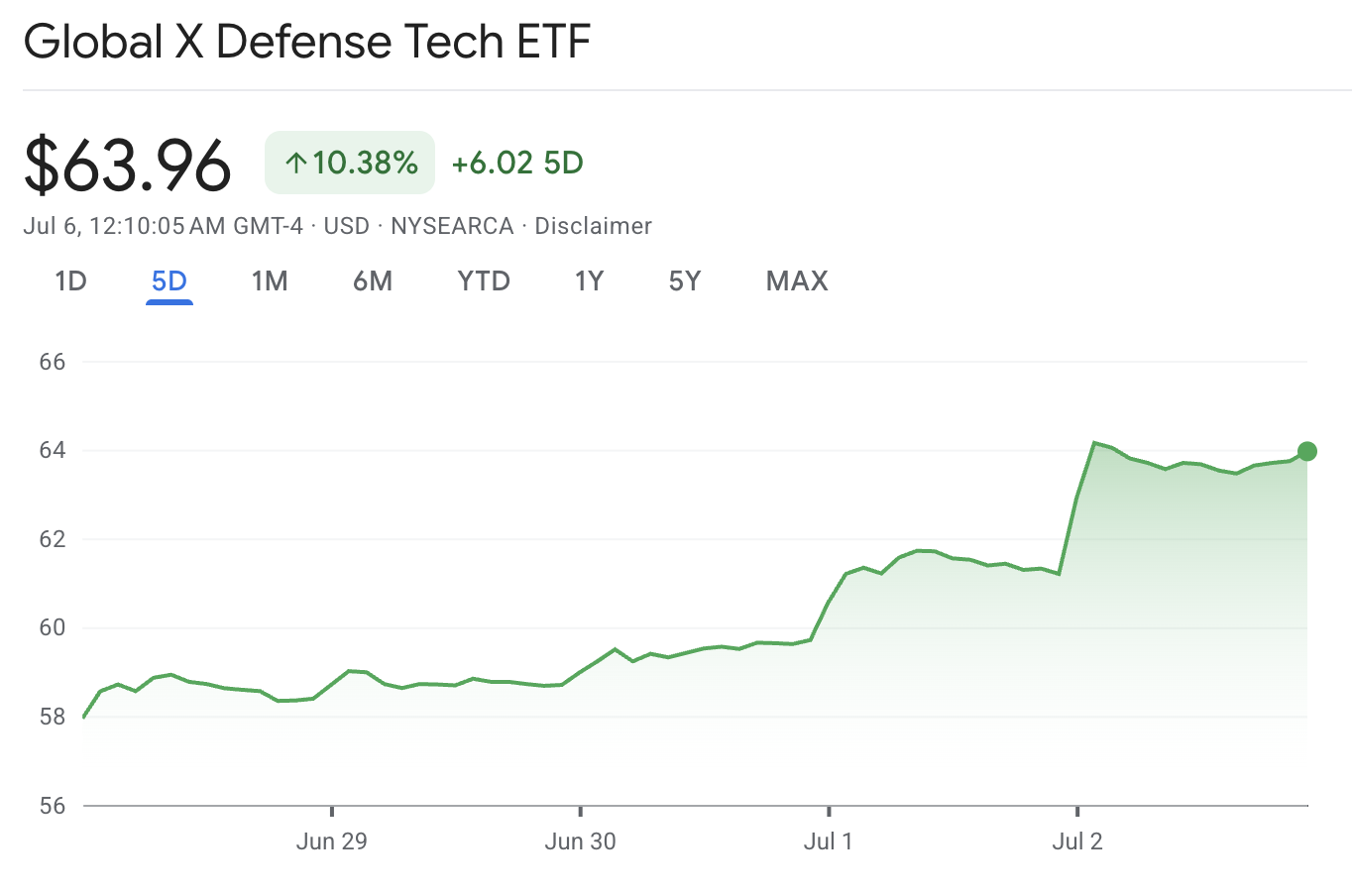
Key characteristics include:
Expense ratio: 0.50%
Strategy: Thematic exposure to defense technology
Assets under management: Multi-billion-dollar scale, indicating strong investor interest
Unlike broad market ETFs, SHLD is not designed to provide low-cost exposure to a wide index. Instead, it offers targeted access to a specific theme. Investors are effectively paying a premium for exposure to the intersection of defense and technology.
SHLD’s portfolio combines traditional defense contractors with technology-oriented firms. A typical snapshot of its top holdings includes:
RTX Corp ~7.5%
Lockheed Martin ~7.2%
Northrop Grumman ~6.8%
General Dynamics ~6.5%
Boeing ~5.5%
Palantir Technologies ~4.5%
L3Harris Technologies ~4.3%
Thales ~4.0%
BAE Systems ~3.8%
Leidos Holdings ~3.5%
These weights fluctuate over time, but the composition highlights an important reality: SHLD is not purely focused on emerging technology companies. Established defense contractors still represent a significant portion of the portfolio.
The term “defense tech” may suggest a concentrated basket of AI, drone and cybersecurity firms. In practice, SHLD is more balanced. Traditional defense companies remain central because they continue to dominate large-scale government contracts and are actively investing in next-generation technologies themselves.
This hybrid structure means SHLD often behaves similarly to a large-cap defense ETF, particularly when major contractors drive sector performance. While the fund includes exposure to newer technologies, it does not fully separate itself from legacy defense industries.
As a result, SHLD is best understood as a bridge between traditional defense and emerging technological capabilities rather than a pure-play technology ETF.
| Defense Tech Theme | Why It Matters |
|---|---|
| AI and battlefield data | Enables faster decision-making and targeting systems. |
| Drones and robotics | Provides scalable, cost-efficient military solutions. |
| Cybersecurity | Expands national security into digital infrastructure. |
| Satellites and surveillance | Supports intelligence gathering and monitoring. |
| Advanced systems | Integrates software, sensors and automation. |
| European defense exposure | Reflects increased NATO spending and rearmament. |
These themes illustrate how defense spending is evolving. SHLD is designed to capture not just the scale of military budgets, but the direction in which those budgets are moving.
When compared with traditional defense ETFs such as ITA or PPA, SHLD introduces a distinct technological dimension. Conventional funds tend to focus heavily on aerospace manufacturers and weapons systems, while SHLD incorporates companies involved in AI, cybersecurity and data-driven defense solutions.

However, the overlap between these funds is significant. Large defense contractors remain prominent in SHLD’s holdings, meaning its performance can closely track traditional defense ETFs during certain market conditions.
The differentiation becomes more apparent when investor attention shifts toward modernization themes such as autonomous systems, cyber threats or AI-driven warfare. In those environments, SHLD may offer more targeted exposure.
One of SHLD’s primary strengths is its alignment with a structural shift in defense priorities. Modern conflicts have demonstrated the importance of drones, cyber resilience, satellite intelligence and real-time data processing.
Unlike many thematic ETFs that rely on short-term trends, SHLD is tied to government spending and long-term policy objectives. Defense budgets tend to be relatively stable and are often driven by geopolitical considerations rather than purely economic cycles. This can provide a degree of durability to the investment theme.
Additionally, SHLD offers broader geographic exposure than some traditional defense ETFs. The inclusion of European defense companies allows investors to benefit from increased regional spending and NATO-driven rearmament efforts.
Despite its strengths, SHLD carries several important risks:
Not a pure tech ETF: Large defense contractors still dominate the portfolio, which may limit exposure to emerging technologies.
Valuation risk: Popular themes can attract high valuations, increasing the risk of price corrections.
Policy dependence: Defense companies rely heavily on government contracts, making them sensitive to political decisions and budget changes.
Concentration: A relatively small number of holdings can significantly influence overall performance.
Ethical considerations: Some investors may avoid defense-related investments due to ethical concerns.
These risks highlight the importance of understanding what SHLD actually represents before investing.
Before comparing SHLD with other defense ETFs, investors should consider several key factors:
Cost: The 0.50% expense ratio is reasonable for a thematic ETF but higher than many broad index funds.
Concentration: Top holdings carry significant weight, which can amplify both gains and losses.
Exposure: Reviewing the portfolio is essential to determine how much of the fund is truly focused on technology.
Purpose: SHLD is a thematic investment, not a simple hedge against geopolitical risk.
Understanding these elements can help investors determine whether SHLD aligns with their investment objectives.
SHLD is the Global X Defense Tech ETF, designed to track companies involved in defense-related technologies such as AI, cybersecurity and advanced military systems.
No. While it overlaps with traditional defense ETFs, SHLD includes additional exposure to technology-driven defense sectors like AI, drones and surveillance.
Yes, SHLD includes companies involved in AI and drone technologies. However, it also holds major defense contractors, so it is not a pure-play technology ETF.
SHLD has an expense ratio of 0.50%, which is typical for thematic ETFs but higher than many broad market funds.
The main risks include concentration, valuation pressure, dependence on government spending and potential policy changes.
SHLD reflects a meaningful shift in defense investing. Military spending is no longer focused solely on physical hardware. Increasingly, it includes software, data analytics, autonomous systems and intelligence capabilities.
However, the ETF is not a pure technology play. Its performance remains closely tied to large defense contractors and traditional procurement cycles. This hybrid nature can be both a strength and a limitation, depending on market conditions.
For investors, SHLD is best viewed as a way to gain exposure to defense modernization rather than as a straightforward AI investment or geopolitical hedge. Understanding its composition and risks is essential before incorporating it into a portfolio.