Published on: 2026-07-02
Updated on: 2026-07-02
Palantir stock (NASDAQ: PLTR) moved sharply higher on July 1, 2026, closing at $125.73, up $9.06, or 7.77%, after trading as high as $128.21. The rebound coincided with renewed attention on Palantir’s work with Nvidia in secure AI deployment environments. [1]
The key question is whether the move improves the medium-term Palantir stock forecast, or whether PLTR stock still requires exceptional execution to support its valuation.
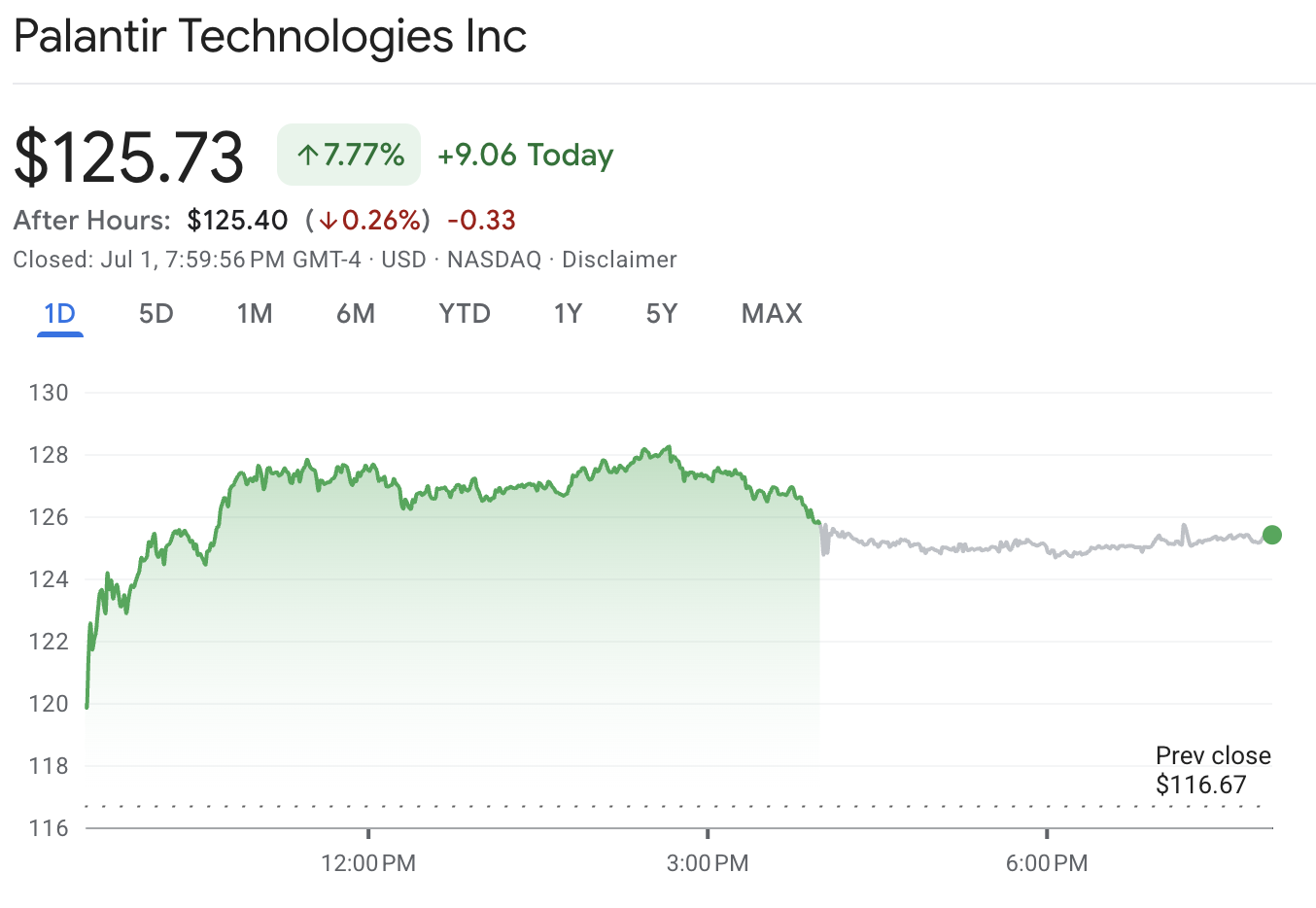
Palantir stock rebounded sharply after PLTR closed at $125.73 on July 1, 2026, supported by renewed investor interest in AI software stocks and Palantir’s expanded work with Nvidia.
The Palantir Nvidia deal strengthens the AI deployment thesis, particularly for sovereign, government and critical infrastructure environments where data control, security and operational reliability are important.
Government and defense demand remain core to the bull case, with recent momentum in programs such as the U.S. Army’s Next Generation Command and Control initiative supporting Palantir’s long-term positioning.
Palantir’s financial performance remains strong, with Q1 2026 revenue up 85% year over year, high operating margins and substantial adjusted free cash flow.
Valuation remains the main risk for PLTR stock, as the market is already pricing in sustained growth, strong execution and successful conversion of AI partnerships into durable revenue.
The selloff may be stabilizing, but it is not fully resolved. A more durable recovery will likely depend on continued contract momentum, strong earnings execution and clearer evidence that AI-related demand is translating into recurring revenue.
| Metric | Latest figure | Investor relevance |
|---|---|---|
| Latest closing price | $125.73 | Confirms the rebound in PLTR stock. [1] |
| One-day move | +$9.06 / +7.77% | Shows renewed short-term buying interest. [1] |
| Intraday range | $117.70–$128.21 | Indicates a wide session. [1] |
| Trading volume | 58.6 million shares | Signals elevated market participation. [1] |
| Market capitalization | About $323.2 billion | Shows the scale of expectations in the share price. [1] |
| Q1 2026 revenue | $1.633 billion, +85% YoY | Demonstrates strong top-line growth. [2] |
| Q1 2026 U.S. revenue | $1.282 billion, +104% YoY | Highlights the U.S. business as the growth engine. [2] |
| Q1 2026 U.S. government revenue | $687 million, +84% YoY | Supports the government-demand thesis. [2] |
| GAAP operating income | $754 million, 46% margin | Shows high profitability. [2] |
| Adjusted free cash flow | $925 million, 57% margin | Reinforces the cash-generation case. [2] |
| Cash, equivalents and short-term U.S. Treasuries | $8.0 billion | Provides financial flexibility. [2] |
| FY2026 guidance | Revenue of $7.650 billion–$7.662 billion; adjusted FCF of $4.2 billion–$4.4 billion | Sets a high execution benchmark. [2] |
The table explains why Palantir AI stock remains closely watched. Palantir is reporting revenue growth, margins and cash flow that are unusually strong for a large enterprise software company. The same data also explains the risk: investors are assigning substantial credit for future growth.
The latest rally appears to reflect both company-specific and sector-level factors. The most important company-specific catalyst is the Palantir Nvidia deal. Palantir and Nvidia have been expanding an AI architecture designed for operational and sovereign environments, where customers need greater control over data, infrastructure and model deployment. [3]
Palantir’s investment case depends on whether its platforms stay central as governments and enterprises move from AI pilots to production systems, the transition the Nvidia work is built to serve. If customers need AI tools that connect models to sensitive operating data, Palantir’s AIP, Foundry and Ontology framework could remain relevant in high-compliance environments.
The sector backdrop also helped. AI software stocks had been under valuation pressure, so a credible partnership tied to Nvidia supported a reassessment of sentiment. Still, the move should be viewed as an improvement in market tone, not confirmation of a sustained uptrend.
The strategic value of the Palantir Nvidia deal is that it links Palantir’s software layer with Nvidia’s AI infrastructure and model ecosystem. Nvidia has said Palantir is integrating Nvidia accelerated computing, CUDA-X libraries and open-source Nemotron models into the Ontology framework at the core of Palantir AIP. [4]
In March 2026, Palantir also announced a sovereign AI operating system reference architecture with Nvidia. The architecture includes Nvidia AI infrastructure, Nvidia AI Enterprise, CUDA-X libraries and Nemotron open models, alongside Palantir AIP, Foundry, Apollo, Rubix and AIP Hub. [3]
For investors, the payoff is concrete. Government agencies, critical infrastructure operators and large enterprises often require secure AI systems that can operate under strict data-control requirements. Palantir is trying to position itself as the deployment layer for those use cases. Investors should look for deployments, contract expansion and repeatable revenue.
Palantir’s government business remains central to the investment case. In Q1 2026, U.S. government revenue rose 84% year over year to $687 million, while overall U.S. revenue rose 104% to $1.282 billion. [2]
On June 22, 2026, the U.S. Army said it had established the common data layer baseline for its Next Generation Command and Control program. Anduril is leading the initiative while partnering with Palantir to provide an edge-to-cloud data mesh using Anduril’s Lattice and Palantir Foundry, along with related deployment tools. [5]
Palantir’s platforms have historically been used in complex government and defense settings where data integration, security and operational decision-making are important. However, government programs can involve long procurement cycles and uneven implementation timelines. These opportunities support the long-term investment case, but they do not eliminate execution risk.
Palantir valuation remains the central issue. With a market capitalization of about $323.2 billion and 2026 revenue guidance near $7.66 billion, the stock trades at more than 40 times guided 2026 revenue on a simple market-cap-to-revenue basis. [1]
That multiple may be defensible only if Palantir continues to deliver high growth, strong margins and expanding cash flow. Q1 results support that argument, but the market is pricing in sustained execution rather than a short period of strength.
The main risk is not that Palantir lacks growth. The risk is that expectations are already elevated. Any moderation in U.S. commercial growth, slower conversion of AI partnerships into contracts, or uneven government spending could pressure the stock’s multiple.
The rebound improves the near-term setup, but it is premature to declare the selloff over. The Palantir Nvidia deal, government momentum and Q1 financial results all give investors credible reasons to revisit PLTR stock.
A durable recovery would likely require evidence that AI demand is converting into production-scale deployments and that free cash flow remains strong. Until then, the rally should be viewed as a constructive reset rather than a confirmed resolution of valuation concerns.
Palantir stock is rising after investors responded to renewed Nvidia-related AI momentum, strong recent financial results and government-related demand. The stock closed at $125.73 on July 1, 2026, up 7.77%. [1]
The Palantir Nvidia deal links Palantir’s AI software and Ontology framework with Nvidia accelerated computing, CUDA-X libraries and Nemotron open models to support operational and sovereign AI deployments. [3]
Palantir’s growth profile is strong, but the stock’s market value remains high relative to management’s 2026 revenue guidance. That makes execution, contract conversion and margin durability central to the investment case. [1]
Palantir remains a high-quality growth company trading at a demanding valuation. The constructive case rests on rapid revenue growth, strong profitability, substantial free cash flow, government momentum and a deeper Nvidia relationship. The cautious case rests on valuation risk and the need for consistent execution.
For investors with a long-term view on secure AI deployment, the recent pullback may make Palantir stock more interesting than it was near prior highs. For valuation-sensitive investors, it may be more prudent to wait for clearer evidence that Nvidia-related initiatives and defense programs are translating into durable revenue growth.