Published on: 2026-07-27
Updated on: 2026-07-27
Chile mines about 23% of the world’s copper, and a storm just knocked one of its biggest producers offline for weeks. Copper prices jumped 2.6%, then gave back almost the entire move within a week. That reversal, not the outage, is the real story: it shows how little spare capacity stands between the market and a genuine copper shortage, just as AI-driven demand starts to climb.
Caserones, Lundin Mining’s high-altitude copper-molybdenum mine in Chile’s Atacama Region, has had no grid power since 18 July, after inspectors found two damaged transmission towers. On 27 July, Lundin said a full restart could take another two to three weeks. Elsewhere the damage stayed contained: Antofagasta’s Los Pelambres resumed operations on 23 July, and Lundin’s Candelaria mill never stopped, running through the disruption on stockpiled ore.

The US copper benchmark rose 2.6% to about $6.51 per pound on 21 July as the outage hit the market. By 27 July it had fallen back to roughly $6.33, up around 0.5% on the day. The market has decided the outage is manageable. What it reveals about the industry underneath it is not.
Chile produced an estimated 5.3 million tonnes of copper in 2025, about 23% of global mine output.
Caserones has had no grid power since 18 July. Two transmission towers were damaged, and restoration plus a gradual restart may take another two to three weeks.
Los Pelambres restarted on 23 July with no material damage reported, and Candelaria’s mill never stopped, running on stockpiled ore throughout the disruption.
Copper rose 2.6% to about $6.51 per pound on 21 July, then faded back to roughly $6.33 by 27 July.
LME copper stocks stood at 276,775 tonnes on 24 July, down 4,650 tonnes in a single session.
| Measure | Latest figure | Market relevance |
|---|---|---|
| Chile’s 2025 mine production | 5.3 million tonnes | About 23% of global output |
| Caserones 2025 production | 132,881 tonnes | Roughly 364 tonnes per calendar day |
| Caserones outage | Since 18 July | Tower repairs and restart may need another 2–3 weeks |
| Antofagasta H1 production | 285,000 tonnes | 9.5% lower year on year |
| LME warehouse stocks, 24 July | 276,775 tonnes | Down 4,650 tonnes in one session |
| US copper benchmark, 27 July | About $6.33/lb | Down from about $6.51 on 21 July |
| S&P 2040 demand forecast | 42 million tonnes | Up from 28 million tonnes in 2025 |
Sources: USGS, Lundin Mining, Antofagasta, S&P Global, LME market data.
Caserones has had no grid power since 18 July, and the 27 July update changed the shape of the problem: this is no longer a mine simply waiting out a storm.
Inspectors found damage to two transmission towers feeding the site, in terrain where repairs are never quick. Backup generators are keeping critical infrastructure running while access roads reopen in stages, but full production now depends on rebuilt transmission lines, a contractor’s timetable rather than a weather forecast.
Now the arithmetic. Caserones produced 132,881 tonnes of copper in 2025, an average of roughly 364 tonnes a day. Nine days had passed by 27 July. Add Lundin’s estimated two to three weeks and the total interruption runs to somewhere between 23 and 30 days, which puts scheduled output exposure at approximately 8,400 to 10,900 tonnes.
That is an exposure estimate, not a confirmed loss. Copper is not mined at a constant daily rate, and some of the missed tonnes may be recovered later through higher throughput, rescheduled maintenance or drawn-down stockpiles once the mine restarts. Lundin has not put a number on the final hit to annual production.
The guidance itself has moved carefully. Lundin’s initial update on 21 July kept its full-year guidance unchanged, saying weather disruption was already built into the operating plan. The 27 July release disclosed the longer repair timeline without announcing a change to that guidance, and without explicitly restating it either.
Elsewhere, the damage stayed contained. Rain disrupted mining at Candelaria, but the concentrator kept running on stockpiled ore, and mining there has since returned to full capacity, proof that a mine outage does not automatically become a metal outage. Los Pelambres shut down in an orderly sequence and was back by 23 July, with Antofagasta reporting no material damage to key infrastructure.
Copper’s 21 July rally faded because the market priced in a disruption, then re-priced it as temporary.
The initial move was straightforward. Several Chilean operations went offline at the same time visible inventory was already thinning: LME copper stocks fell 4,650 tonnes in the 24 July session alone, to 276,775 tonnes, while stronger Chinese import demand added to the bid.
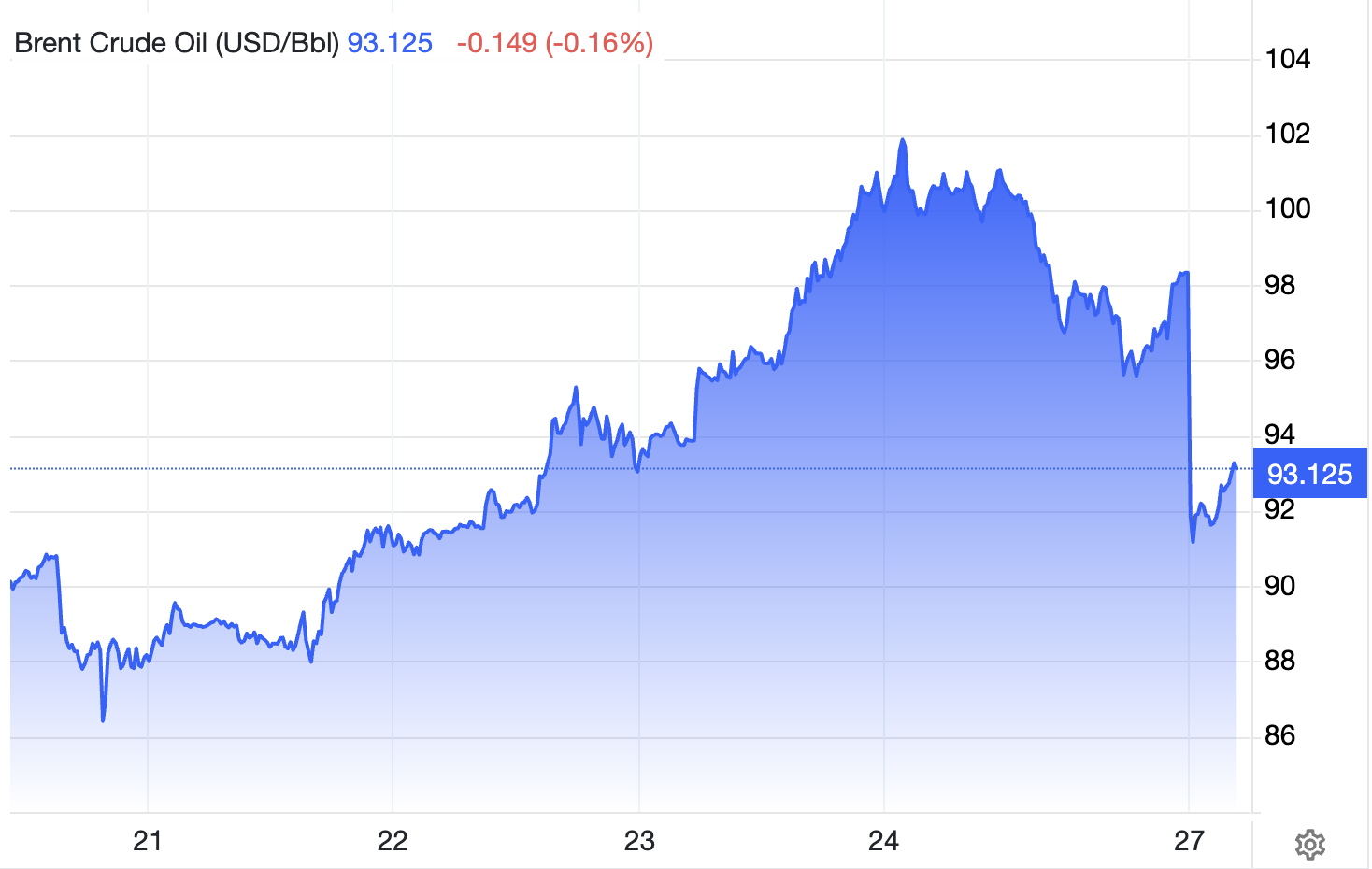
Exchange warehouses hold only a fraction of the world’s copper, but the thinner that buffer gets, the harder prices swing on the next piece of bad news, because there is simply less slack to absorb it. That kind of rapid repricing shows up quickly in copper futures positioning whenever a supply headline hits.
The fade was just as rational. Los Pelambres is running again. Candelaria never stopped processing ore. No producer had cut guidance by 27 July. Set against a market that consumes roughly 28 million tonnes of copper a year, ten thousand tonnes of exposure is close to noise.
Chile’s storm alone has not produced a global shortage. What it has shown is how little spare capacity exists to replace lost tonnes quickly, and that limit matters more than the outage itself.
AI’s copper bill is not mainly about servers. It is about the electricity that runs them.
Copper fills the power cables, transformers, busbars, switchgear, cooling systems, backup generators and grid connections that keep a data centre running. AI workloads run at far higher power density than conventional computing, which multiplies both the electrical hardware inside the building and the redundancy built around it.
S&P Global expects total copper demand to rise from about 28 million tonnes in 2025 to 42 million tonnes by 2040. Without major new supply, its analysis points to a possible shortfall of 10 million tonnes a year by then.
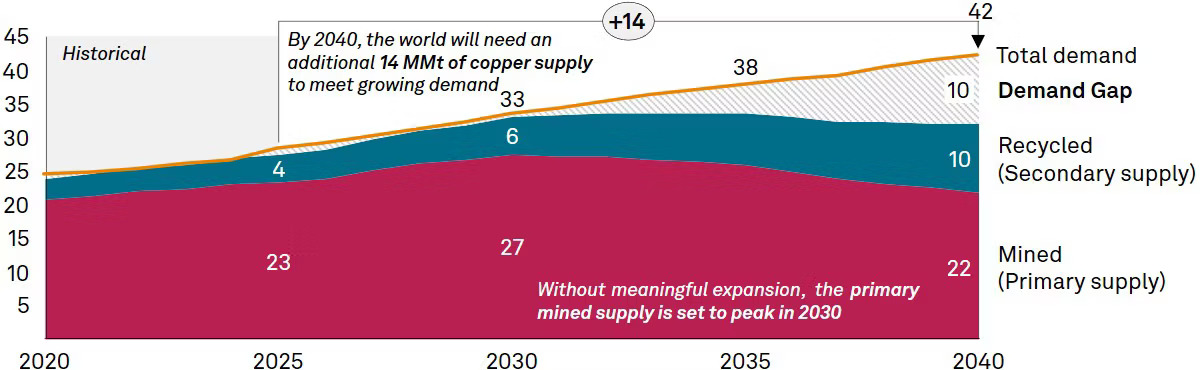
Note: Recycled supply represents end-of-life scrap. Mined supply includes operating production and risked production from committed, probable and possible projects. Source: S&P Global
Within that, S&P sees installed global data-centre capacity reaching roughly 550 gigawatts by 2040, up from 100 gigawatts in 2022, with the copper demand attached to it more than doubling from 1.1 million to 2.5 million tonnes. AI-training facilities alone are expected to account for 58% of data-centre copper demand by 2030.
Data centres are still a smaller demand category than construction, transport and power networks, and the largest single increase in S&P’s outlook comes from the broader energy transition, not from AI alone. Even so, the AI infrastructure buildout is adding a fast-growing layer of demand for power, grid equipment and the metals underneath them, copper included, on top of a market where copper supply and demand were already tightening.
The cost risk runs wider than the metal price alone. Dearer copper and dearer electrical equipment raise the capital needed to build a facility, connect it to the grid and expand the generation behind it. For hyperscalers writing multi-billion-dollar cheques, copper is one line item among many, but it is also one of the hardest to design out of a high-capacity electrical system.
Copper supply cannot answer a price signal the way a factory can. New mines take an average of 17 years to go from discovery to production, according to the IEA.
Average global ore grades have fallen 40% since 1991, and capital intensity for brownfield mine expansions is up 65% since 2020, per the IEA. Lower grades set off a cost chain: more rock has to be crushed and hauled, more power and water go into every tonne of metal recovered, and more waste is left behind.
Antofagasta’s own accounts show the strain, and showed it before the storm. First-half production came in at 285,000 tonnes, 9.5% down year on year. Cash costs before by-product credits rose 23% to $2.85 per pound, driven by weaker output, labour costs and higher prices for diesel and sulphuric acid.
The group is also spending roughly $900 million on a water pipeline and pumping system at Zaldívar, which will run on reprocessed wastewater from the city of Antofagasta and take the mine off continental water from mid-2028. Increasingly, keeping a mine running means building things that have nothing to do with mining copper itself.
None of this is unique to one company. Falling grades and rising costs are feeding a broader debate about whether the current run marks a genuine commodity supercycle for copper and other critical metals.
Chilean copper has always been a water-scarcity story. July added the opposite problem.
Intense rainfall, heavy snowfall, damaged power infrastructure and blocked roads all hit at once. Some of Chile’s mines now have to manage both ends of the same risk: desalination for chronic shortage, and storage, drainage and grid resilience for rare, violent precipitation. That is two capital programmes, not one.
Whether this dents Chile’s annual copper production depends on how fast Caserones normalises and whether another storm system arrives during the restart. Antofagasta’s half-year results on 13 August should add detail on Los Pelambres.
Three factors will decide whether Caserones’ outage stays a one-mine story through the rest of 2026 or becomes a genuine supply problem. For traders watching near-term price action, the matters as much as the fundamentals below.
Lundin’s guidance. A cut would convert Caserones from an operating problem into a measurable annual supply loss.
Visible inventory. Further drawdowns across LME, Comex and Shanghai warehouses would leave the market more exposed to the next disruption.
Producer costs. Falling grades, water projects and higher input costs were already pressuring margins before the storm, and the cost of restoring Caserones’ power infrastructure is still unknown.
Those who trade copper directly, rather than through mining equities, can track these levels via commodity CFDs, where price moves show up immediately in position value.
Chile’s storm did not create a global copper shortage, and the market has already said so by handing back most of the rally. What it did show is how fast prices react when the world’s largest copper producer loses power at a single mine.
AI is pulling demand for grids, generation and data centres higher at the same time new copper supply is getting slower and costlier to bring online, and that mismatch between accelerating demand and constrained supply, not this month’s storm, is the copper shortage risk actually worth watching. Some of the tonnes lost at Caserones may be recovered later, but it is too early to know how much. The structural constraint underneath it will take far longer to resolve than any single mine’s repair timetable.