Published on: 2026-04-06
Updated on: 2026-04-06
Century Aluminum is one of the biggest beneficiaries of the latest U.S. metal tariff regime.
CENX stock has posted remarkable gains over the past year, far outpacing sector peers.
The Trump administration’s Section 232 tariffs have tightened domestic aluminum supply, directly lifting Century’s margins.
Risks remain, including legal uncertainty around tariff policy and broader macro headwinds.
CENX surged nearly 28% following President Trump's announcement of a 50% tariff on imported steel and aluminum, which hit markets on April 2, 2026.
The stock reached a 52-week high of $63.90, up from a 52-week low of $13.05, a move that reflects how dramatically policy has reshaped the domestic aluminum landscape.
So why is Century Aluminum stock up so aggressively? The answer comes down to one word: exposure.
As of April 3, 2026, the Trump administration finalized an adjusted tariff regime levying a 50% duty on the full value of imported steel, aluminum, and copper, the most aggressive protectionist shift the U.S. metals industry has seen in a generation.
Products containing less than 15% metal content will not be subject to the metals tariff but will instead face a separate 10% global minimum tariff, prompting importers to reassess their product compositions and supply chains in their entirety.
The immediate market effect has been significant:
The "Midwest Premium," the benchmark cost for delivering aluminum to the American heartland, soared to an unprecedented $1.05 per pound.
Global aluminum prices hit a four-year high of $3,424 per tonne, driven by both tariff pressure and Middle East supply disruptions.
Century Aluminum praised the policy changes, stating they will close valuation loopholes exploited by importers and strengthen protection for U.S. aluminum markets.
It is also worth noting the geopolitical backdrop layering on top of the tariff regime. Iranian airstrikes on Gulf aluminum infrastructure rattled global supply chains in late March 2026, and aluminum futures have surged nearly 12% since the onset of those attacks, adding further fuel to what was already a tariff-driven price rally.
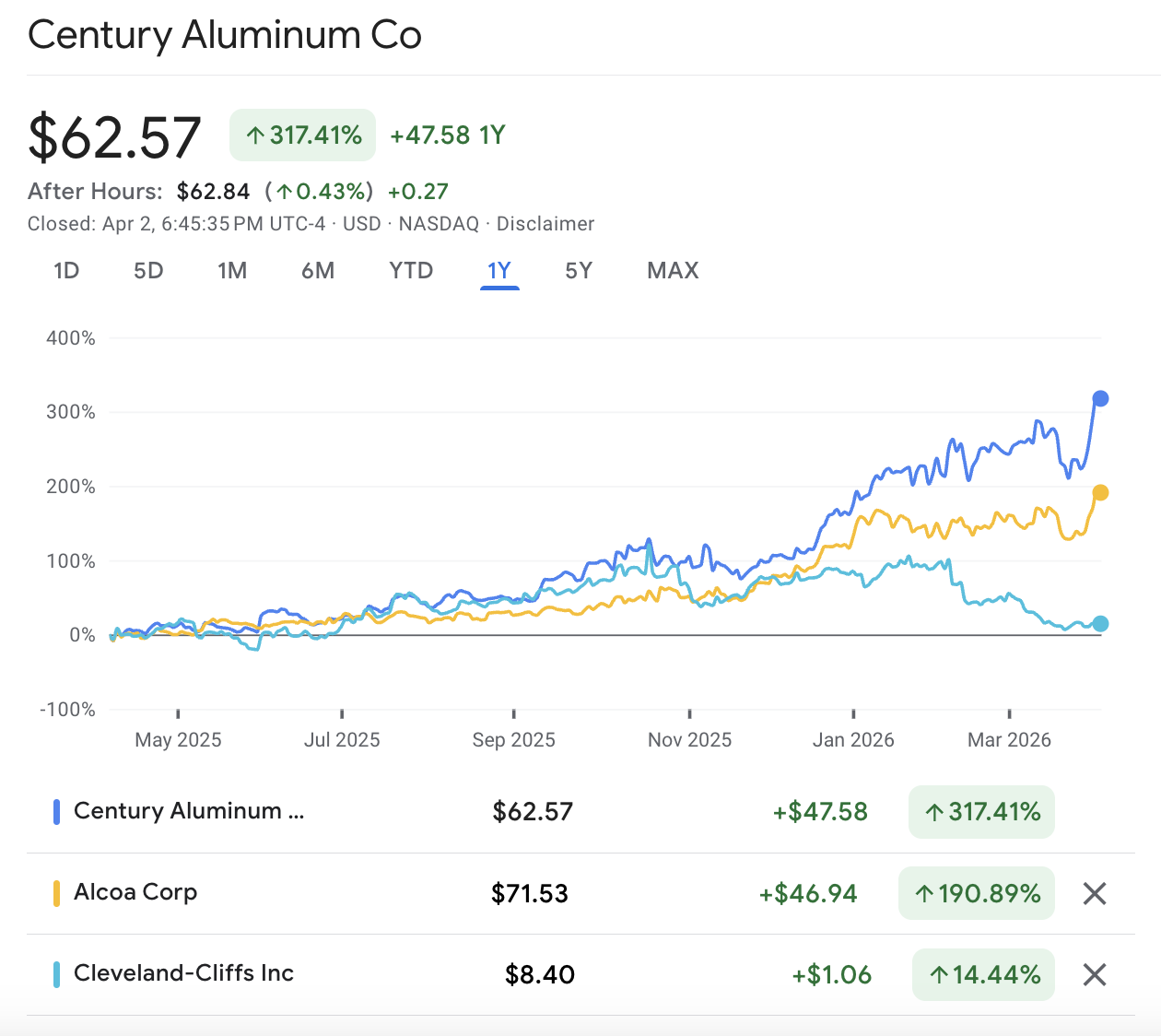
Not every metals company is reacting the same way. Century Aluminum surged as a pure-play beneficiary of tariff-driven domestic aluminum deficits, while Cleveland-Cliffs gained just 2% due to its more complex global operations.
The difference is structural. Because Century is a pure-play smelter, its earnings are more sensitive to fluctuations in the LME price and domestic trade protections, making it the preferred vehicle for investors betting on a U.S. manufacturing renaissance.
Here is how Century's revenue drivers stack up under the current tariff regime:
| Revenue Driver | Impact Under 50% Tariff |
|---|---|
| LME Aluminum Price | Strongly positive; prices at multi-year highs |
| Midwest Premium | Record highs, directly boosting realized prices |
| Value-Added Products | Higher-margin billets and foundry alloys |
| Green Aluminum Premium | Additional upside via low-carbon Natur-Al line |
Institutional ownership has ticked up, with hedge funds increasingly using CENX as a proxy for both inflation protection and infrastructure growth.
Investor interest in the tariff trade has extended across the metals sector, but performance tells a clear story about which business model wins in this specific policy environment.
| Company | Ticker | Tariff Exposure | 1-Year Performance |
|---|---|---|---|
| Century Aluminum | CENX | Pure-play U.S. smelter | ~167% (as of March 2026) |
| Alcoa | AA | Integrated global miner | Mixed; higher input costs offset gains |
| Cleveland-Cliffs | CLF | Complex global operations | ~2% gain |
Alcoa is more profitable during alumina price spikes and more geographically diversified, and is currently pivoting heavily toward monetising land for data centres. Century, by contrast, has no such complexity buffering its tariff exposure, which is precisely why its stock moves harder and faster when policy shifts.
Alcoa reported over $115 million in tariff-related costs in late 2025 due to its integrated global supply chain, a headwind Century largely avoids as a domestic primary producer.
Century Aluminum and Emirates Global Aluminium announced a joint development agreement to build a new primary aluminum smelter in Inola, Oklahoma. EGA will own 60% of the joint venture, with Century owning the remaining 40%.
The new plant is expected to produce 750,000 tonnes of aluminum per year, larger than previously envisioned, more than doubling current U.S. production, and marking the first new U.S. primary smelter since 1980.
The project will use EGA's latest state-of-the-art EX technology, the most advanced ever installed in the United States, and is expected to create 1,000 permanent direct jobs and approximately 4,000 construction jobs. Construction is targeted to start by the end of 2026, with production expected by the end of the decade.
The tariff story drives the headlines, but the underlying financials are what will determine whether CENX can hold its gains.
| Metric | Figure |
|---|---|
| 2025 Net Sales | $2.53 billion |
| 2025 Adjusted EBITDA | $425.1 million |
| Q1 2026 Adjusted EBITDA Guidance | $215 million to $235 million |
| Liquidity (Dec. 31, 2025) | $418.0 million |
| Operating Cash Flow | $102.8 million |
| Forward P/E | ~8.3x vs. 10-year median of 15.4x |
Despite the sharp run, shares trade at approximately 8.3x forward earnings, well below the company's 10-year median of 15.4x, suggesting the re-rating still has room to run if earnings revisions continue moving higher.
Earnings estimates have surged for this year and next year, and sales are projected to climb sharply this year and again the following year.
For investors already holding CENX or evaluating an entry, these are the key upcoming catalysts that will shape the stock's next leg:
May 6, 2026 earnings report: Century Aluminum is scheduled to release its next earnings report on May 6, 2026, which will be the first full quarter reflecting the 50% tariff environment. Management guidance on realised prices and EBITDA margins will be critical.
Oklahoma smelter groundbreaking timeline: Any update on construction start dates or power supply agreement with Public Service Company of Oklahoma will be a meaningful catalyst.
Tariff legal developments: Any Supreme Court rulings or Congressional action on the permanence of Section 232 protections will move the stock immediately.
LME aluminum prices: The base metal price remains the single most direct input to Century's earnings. Watch the London Metal Exchange for direction.
Mt. Holly restart progress: Production at Mt. Holly is expected to be restored by the second quarter of 2026, which would push Century closer to full nameplate capacity utilisation.
Analysts rate CENX a Buy and Strong Buy respectively, citing tariff tailwinds and the new Oklahoma smelter. However, legal uncertainty around tariff policy and recession risks mean it carries meaningful volatility. Always assess your own risk tolerance.
Century Aluminum produces primary aluminum including standard-grade ingots, value-added billets, foundry alloys, and low-carbon green aluminum through its Natur-Al product line. It operates smelters in the U.S. and Iceland.
No. Century Aluminum does not currently pay a dividend, focusing instead on reinvesting capital into operations and expansion projects such as the new Oklahoma smelter.
Century Aluminum is scheduled to release its next earnings report on May 6, 2026.
Century Aluminum (CENX) stock surges on new metal tariffs because the company is one of the market’s clearest direct beneficiaries of tighter import enforcement.
The policy shift matters, but so do the fundamentals. Century is coming into this period with stronger earnings, a better pricing environment, and a domestic expansion pipeline that fits the broader US industrial policy push.
The stock has surged because all three are pointing in the same direction, at least for now.
Disclaimer: This material is for general information purposes only and is not intended as (and should not be considered to be) financial, investment or other advice on which reliance should be placed. No opinion given in the material constitutes a recommendation by EBC or the author that any particular investment, security, transaction or investment strategy is suitable for any specific person.