Published on: 2026-08-06
Updated on: 2026-08-06
Sandisk delivered record quarterly revenue of $8.97 billion on August 5 and still lost about 13% across regular and extended trading. Revenue and adjusted earnings comfortably beat the FactSet consensus, yet the $10.55 billion guidance midpoint fell below FactSet’s higher forecast as consumer revenue dropped 32% and the guided gross-margin midpoint slipped to 84%.
The market had priced in another major upgrade, not merely another earnings beat.
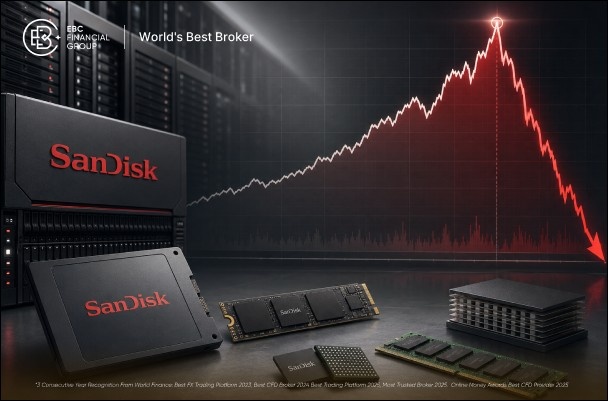
Revenue of $8.97 billion beat the FactSet consensus by 5.7%, while adjusted EPS of $39.25 exceeded the forecast by 12.3%, confirming that the completed quarter was not the problem.
The $10.55 billion revenue-guidance midpoint topped LSEG’s $10.47 billion estimate but fell below FactSet’s $10.80 billion forecast.
Data-centre revenue doubled to $2.98 billion as consumer revenue fell 32% to $556 million, revealing a split NAND market.
Pricing generated two-thirds of sequential growth, leaving the 84% guided gross-margin midpoint as the next test of earnings durability.
Sandisk had gained nearly 470% in 2026 before the report, so strong growth alone no longer offered a positive surprise. The share price required another material increase in forward revenue and margin expectations.
Sandisk fell 5.4% during regular trading and about 8% in extended trading. At roughly $1,243 after hours, the shares stood about 12.9% below their previous close. The earnings release deepened an existing decline rather than causing the entire move.
Record growth had become the baseline. A narrow guidance beat against one estimate set, and a slight margin step-down were enough to challenge the assumptions supporting the rally.
Sandisk’s fiscal Q1 revenue-guidance midpoint of $10.55 billion exceeded LSEG’s $10.47 billion consensus but fell below FactSet’s $10.80 billion estimate. The same outlook therefore supported opposite verdicts, depending on which analyst average was used.
| Benchmark | Q1 revenue | Guidance gap |
|---|---|---|
| Sandisk midpoint | $10.55B | Baseline |
| LSEG consensus | $10.47B | 0.8% above |
| FactSet consensus | $10.80B | 2.3% below |
Adjusted EPS guidance told a stronger story. The $45 midpoint exceeded FactSet’s $44.72 consensus and LSEG’s $43.12 estimate, leaving revenue and margins as the main sources of disappointment.
The higher FactSet revenue forecast better reflected the expectations embedded in the share price. Sandisk beat the completed quarter without delivering the upgrade expected for the next one.
Data-centre revenue rose 103% sequentially to $2.98 billion, while consumer revenue fell 32% to $556 million. Sandisk’s record quarter was driven by enterprise storage demand rather than evenly distributed growth across the business.
Consumer represented only about 6% of quarterly revenue, so the decline did not derail total sales. It still exposed the weaker side of the NAND market, with enterprise infrastructure supporting record results while consumer channels contracted.
Higher pricing generated roughly two-thirds of Sandisk’s sequential revenue growth, while shipment volume contributed the remaining third. Record revenue depended far more on rising NAND prices than on customers buying additional product.
Gross margin reached 84.6% in fiscal Q4 before management guided to an 83% to 85% range for the following quarter. The 84% midpoint remains extremely strong but sits 60 basis points below the reported result.
Slower NAND price increases would pressure revenue growth and margins at the same time. Until shipment growth carries more of the increase, Sandisk’s earnings remain heavily tied to pricing.
Sandisk disclosed $93.9 billion of minimum contracted revenue assuming floor pricing. The company has eight agreements with six customers, with a median duration of four years. Half of fiscal 2027 production and two-thirds of fiscal 2028 output are expected to move under those arrangements.
The agreements improve demand visibility and reduce reliance on short-term price negotiations. They do not guarantee when revenue will be recognised or how much profit each contract will produce.
Their value will depend on whether committed demand leads to sustained shipment growth. Higher shipments would support the case that Sandisk has become less exposed to the traditional NAND cycle. Continued price-led growth would show that the contracts reduced uncertainty without removing the company’s core cyclical risk.
No. Sandisk fell 5.4% during regular trading and about 8% after hours. The 13% figure measures the combined decline from the previous close.
Sandisk’s $10.55 billion midpoint exceeded LSEG’s $10.47 billion consensus but fell below FactSet’s $10.80 billion forecast. Different analyst panels therefore produced opposite verdicts on the same guidance.
Sandisk is primarily exposed to NAND flash and enterprise storage. Micron and SK Hynix have broader DRAM and high-bandwidth-memory businesses tied more directly to AI computing.
Possibly. The guided midpoint is 60 basis points below Q4, while pricing generated two-thirds of sequential revenue growth.
Sandisk’s August 13 Investor Day must quantify how much fiscal 2027 growth will come from bit shipments rather than higher NAND prices. Contracted demand already provides visibility; the unanswered question is how quickly it reaches reported revenue.
Record revenue confirmed the strength of the current NAND cycle. Shipment growth will show whether Sandisk has become less dependent on it.