Published on: 2026-06-15
Roku stock rose 20.08% on June 12, 2026; the ~32% figure is year-to-date performance, not the daily move.
Sale or combination talks, reported by Bloomberg, explain the repricing, but no buyer, deal, or PIPE has been confirmed.
Q1 2026 revenue rose 22% year over year to $1.25 billion, with platform revenue up 28% to $1.13 billion.
Roku surpassed 100 million streaming households, reinforcing its role as an independent CTV gateway.
Valuation is less forgiving after the rally, with some data providers placing ROKU above 50x forward earnings.
Roku stock (NASDAQ: ROKU) surged 20.08% on June 12, 2026, closing at $143.66 in a single session. The spark was a Bloomberg report that Roku had discussed a sale or combination. But this was more than a takeover trade. It was a repricing of Roku as a scaled connected-TV (CTV) platform with returning profitability, accelerating ad revenue, and a strategic grip on streaming distribution.
Roku sits between viewers and every major app, including Netflix, YouTube, Disney+, Prime Video, and Peacock. Its home screen, operating system, ad tools, and billing rails shape how content gets discovered, monetized, and converted into subscriptions. The valuation case now rests on that platform role, not the hardware.
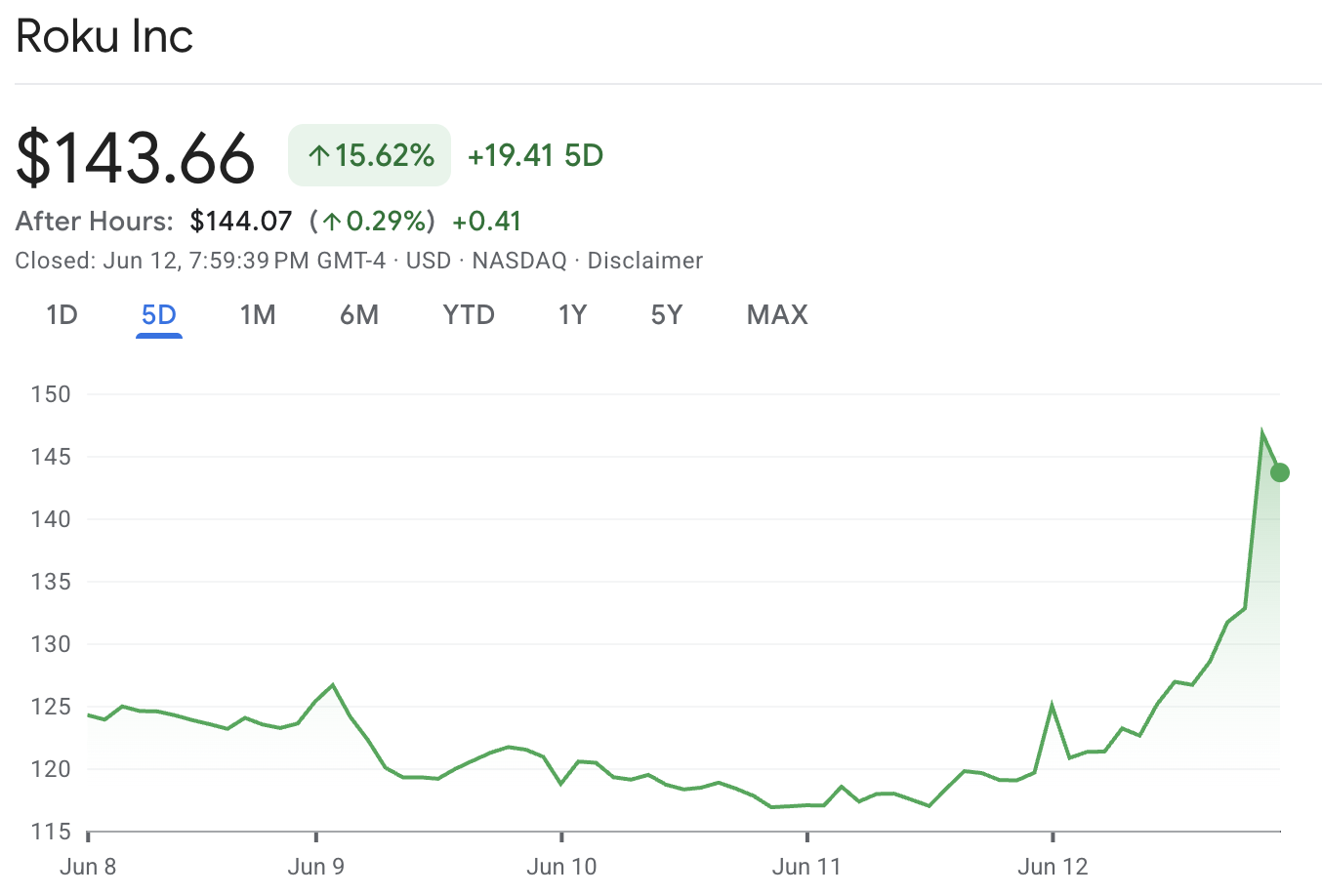
One clarification matters for framing: the 20% jump was a single-day move. Roku’s year-to-date gain sits near 32%, and its one-year return runs roughly 87% to 93%, depending on the source.
The catalyst was clear. Per Bloomberg, Roku has explored strategic options including a sale, a combination with a U.S. media company, or a private investment in public equity (PIPE).
But reports are not deals. No buyer has been named, and the names floated in coverage, Amazon, Comcast, and Netflix, are speculation. They also carry different odds: an Amazon or Google move would invite antitrust scrutiny, while a media or cable buyer like Comcast would face a cleaner path. Until a filing confirms terms, the takeover angle is a catalyst, not a fact.
The deeper story is Roku’s grip on the connected-TV interface. The operating system and home screen sit above the fight for attention, letting Roku monetize search, discovery, subscriptions, and advertising before viewers open an app.
That position is valuable but not uncontested: Amazon Fire TV, Google TV, Samsung’s Tizen, and Walmart-owned Vizio chase the same OS and ad real estate. Roku’s edge is its U.S. installed base and ad stack, which is why a buyer would pay up for distribution, first-party data, or the interface itself.
Roku’s Q1 2026 earnings gave the rally fundamental support. Total net revenue rose 22% year over year to $1.25 billion, platform revenue rose 28% to $1.13 billion, and adjusted EBITDA jumped 165% to $148.4 million. Net income was $86 million and diluted EPS was $0.57, a swing from a prior-year loss.
| Metric | Q1 2026 | YoY Change | Read-Through |
|---|---|---|---|
| Total net revenue | $1.25 billion | +22% | Growth accelerated |
| Platform revenue | $1.13 billion | +28% | Core business expanded |
| Advertising revenue | $612.7 million | +27% | CTV ad demand improved |
| Subscriptions revenue | $518.5 million | +30% | Conversion strengthened |
| Devices revenue | $117.6 million | -16% | Hardware remained weak |
| Adjusted EBITDA | $148.4 million | +165% | Operating leverage improved |
| Diluted EPS | $0.57 | Positive swing | Profitability returned |
The revenue mix explains the rerating. Devices revenue is smaller, declining, and exposed to component costs, while platform revenue spans advertising, subscriptions, distribution, and home-screen monetization, the kind of mix that earns a higher multiple.
One caveat: adjusted EBITDA adds back sizable stock-based compensation, so the GAAP swing to $86 million in net income is the more conservative proof that profitability is real.
Roku’s move beyond 100 million streaming households, defined as distinct accounts that streamed within a 30-day period, anchors the investment case. As viewers hop between Netflix, YouTube, Disney+, FAST channels, and sports apps, Roku’s interface becomes the layer where they decide what to watch, and that gatekeeping role carries commercial value.
The Roku Channel deepens that advantage. Per Nielsen’s The Gauge, it ranked as the #2 free ad-supported app on Roku’s platform and the #5 streaming app overall in the U.S., a measure of engagement within Roku’s own ecosystem rather than across every free service.
Roku’s platform segment runs on two engines. Advertising rose 27% to $612.7 million in Q1, and subscriptions rose 30% to $518.5 million, a record quarter for Premium Subscription sign-ups. The CTV ad opportunity extends beyond The Roku Channel to the home screen, search, and performance placements around the viewing experience.
The home-screen refresh anchors the bull case. Jefferies estimated that one to three biddable home-screen ad tiles could lift FY2027 platform revenue by roughly 4% to 7% over time, an analyst estimate rather than guidance, but it captures the idea that Roku may still under-monetize its most valuable screen.
On subscriptions, the $2.99 Howdy service has expanded to Prime Video, mobile, and Mexico, and Antenna estimates it has passed 1 million subscribers, a figure Roku has not confirmed.
Roku raised its full-year 2026 outlook to platform revenue near $5.0 billion (up about 21%), devices revenue around $535 million, total revenue near $5.5 billion, and adjusted EBITDA of $675 million. Q2 guidance calls for platform revenue up about 20%, devices down high single digits, total revenue of $1.3 billion, and adjusted EBITDA of $170 million.
The guidance shows platform growth offsetting device weakness, but it raises the bar. After a 20% single-day gain, Roku must keep ad demand durable and subscription conversion firm. Memory-chip costs are a specific risk: Roku has warned that tighter supply may pressure device margins in late 2026, though its operating system uses less DRAM and flash memory than rival platforms.
After a 20% jump, valuation becomes the hardest part of the case to defend. At $143.66 against trailing-twelve-month EPS near $1.33, Roku trades around 108x trailing earnings and above 50x forward earnings by some estimates, a premium that only resolves if earnings ramp quickly. Netflix trades at a far lower forward multiple on established margins, so Roku’s premium is a bet on margin expansion that has not fully arrived.
Analyst views are split. Evercore ISI lifted its target to $185, near the high end, while low-end targets sit around $95 to $120 depending on the source. The spread shows the market still disagrees on how much premium Roku’s platform position deserves.
Roku stock rose 20.08% to $143.66 after a Bloomberg report of possible sale or combination talks, amplified by strong Q1 2026 results and raised guidance.
No acquisition has been confirmed. Roku has reportedly explored strategic options but has not named a buyer, and no deal or PIPE has been announced.
At around $143.66, Roku trades near 108x trailing earnings and above 50x forward earnings by some estimates. Whether that is justified depends on how quickly platform growth and margins expand.
Roku stock rallied because the market no longer treats it as a simple streaming-device name. Sale talks lit the spark, but Q1 results, raised guidance, and 100 million households gave the move weight. The surge reprices Roku’s scarce, if contested, position in connected TV: the home screen, ad inventory, and subscription conversion.
The opportunity is that scarcity; the risk is valuation, which leaves little room for slower ad growth, weaker device margins, or fading deal speculation.