Published on: 2026-09-17
Updated on: 2026-09-17
The Bank of Japan paid ¥2.71 trillion of interest last fiscal year to the financial institutions that hold accounts with it. Its entire portfolio of Japanese government securities earned ¥2.52 trillion over the same period.

The Policy Board meets on Thursday and Friday, and 66 of 68 economists in a Reuters poll expect a quarter-point move to 1.25% on September 18. A hike would again raise the rate paid on those balances.
Whether it lifts the total bill is a separate question. Balance-sheet reduction has already cut current deposits by about ¥47 trillion, although the interest-bearing excess-reserve base is narrower than that total.
Japanese financial institutions hold current accounts at the central bank. Balances held above the level they are legally required to keep are remunerated under the complementary deposit facility, and the Bank sets that rate alongside its guideline for the uncollateralised overnight call rate.
At the June meeting, the Policy Board voted 7-1 to guide the call rate to around 1.0% and, by the same margin, to apply 1.0% to the complementary deposit facility, excluding required reserve balances. The basic loan rate under the complementary lending facility was set at 1.25%. Both changes took effect on June 17.
The cost of remunerating those balances has climbed quickly as the policy rate has risen.
BOJ Interest Income and Reserve Expense
| Metric | FY2024 | FY2025 |
|---|---|---|
| JGB interest income | ¥2.08tn | ¥2.52tn |
| Excess-reserve interest expense | ¥1.25tn | ¥2.71tn |
| Operating profit | ¥2.79tn | ¥2.34tn |
| Net income | ¥2.26tn | ¥1.93tn |
The Bank’s published statements of income show reserve remuneration more than doubling between the two fiscal years, from ¥1,251.7 billion to ¥2,710.5 billion. Interest and discounts on Japanese government securities rose by roughly a fifth over the same period.
Fiscal 2025 produced a crossover. The Bank paid ¥2,710,482,638,906 in interest on excess reserve balances and earned ¥2,518,222,114,531 in interest and discounts on Japanese government securities. The expense exceeded that single income line by about ¥192 billion.
This is a comparison between two specific items, not a statement that the bond portfolio loses money. The Bank reported operating income of ¥5.77 trillion in fiscal 2025, drawn from loans, foreign currency assets, exchange-traded fund holdings and other sources. The bond portfolio remains a substantial contributor to that total.
What the crossover captures is a difference in repricing speed. The Bank can reset the complementary deposit rate alongside its policy rate, as it did in June. The coupon cash flow on an existing fixed-rate JGB does not reset when the policy rate rises. Many of those bonds were acquired during Japan’s very low-yield period, and they continue to pay their original coupon until redemption.
JGB interest income therefore adjusts more gradually as the portfolio turns over, while the liability side can move within days. This repricing gap helped produce the fiscal 2025 crossover, although shrinking reserves can offset it over time.
The tempting calculation is to multiply a 25 basis point increase by the Bank’s current deposits and present the result as the additional annual cost. That calculation would be wrong twice over.
First, the remunerated base is narrower than the headline deposit figure. The facility applies to current account balances held by financial institutions at the Bank excluding required reserve balances, so interest accrues on aggregated excess reserves rather than on every yen of current deposits.
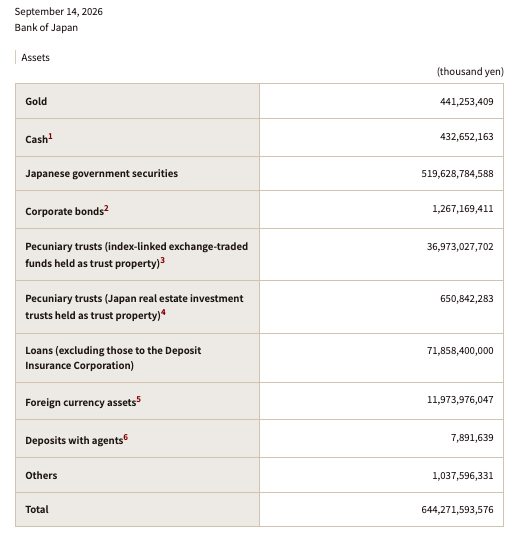
Second, the quantity is falling. The Bank’s balance sheet has contracted materially since the fiscal year closed.
The Reserve Base Is Shrinking
| Metric | March 31, 2026 | September 10, 2026 |
|---|---|---|
| Current deposits | ¥459.74tn | ¥412.66tn |
| JGB holdings | ¥530.87tn | ¥519.63tn |
| Total assets | ¥663.03tn | ¥644.27tn |
Current deposits fell by roughly ¥47.1 trillion over those five and a half months. Japanese government securities fell by about ¥11.2 trillion, and total assets by close to ¥18.8 trillion.
A higher facility rate applied to a smaller eligible balance does not produce a straightforward increase. The eventual expense depends on the average eligible reserve balance across the year, which depends on operations, government fund flows, and the pace of asset reduction rather than the policy rate alone.
The Bank confirmed its bond-purchase schedule in June. Planned monthly outright purchases of Japanese government bonds fall from about ¥2.5 trillion in the July to September quarter to about ¥2.3 trillion in October to December, about ¥2.1 trillion in January to March 2027, and about ¥2 trillion from April 2027 onward.
The Bank also said it will not conduct further interim assessments of the plan, while retaining the option to amend the pace at a policy meeting if bond-market conditions require it.
Purchases at that level fall well short of redemptions, so the portfolio continues to run down.
As it does, the reserves created during the easing years are gradually extinguished, reducing the base on which the facility rate is paid.
The income side moves less predictably. A smaller portfolio reduces the quantity of interest-earning bonds, all else equal, and the Bank booked ¥105.3 billion of losses on sales of Japanese government securities in fiscal 2025.
Replacement at higher yields can still lift income on what remains, and Japan’s 10-year yield touched 3% earlier this month for the first time since 1996. Over several years, that turnover is what narrows the gap between what the Bank earns and what it pays.
The Bank remained comfortably profitable in fiscal 2025, reporting operating profit of ¥2.34 trillion and net income of ¥1.93 trillion. It also holds a ¥7.46 trillion provision for possible losses on bond transactions, under an accounting framework expanded in 2015 to cushion profit swings during an exit from easing.
A central bank’s capacity to conduct monetary policy is not governed by the same logic as a commercial firm’s profit and loss account. The Bank creates the reserves on which it pays interest, and its ability to set the policy rate does not depend on the size of its reported surplus.
The practical consequence is narrower and fiscal in character. Net income determines what flows back to the state. The Bank paid ¥1,830.1 billion to the government out of fiscal 2025 earnings, down from ¥2,151.1 billion the year before. All else equal, a higher reserve-interest expense lowers net income and can reduce what is ultimately paid to the government.
The statement is due on Friday, with Governor Kazuo Ueda’s press conference following in the afternoon in Tokyo. The first line to read is the guideline for the overnight call rate, and whether it moves from around 1.0% to around 1.25%. The second is whether the complementary deposit facility rate and the basic loan rate are adjusted in step, and from what date they take effect.
The vote split on both the guideline and the applied interest rates will show how united the Board is after June’s 7-1 outcome. Ueda’s language on the pace of further increases carries more weight than the move itself, with the consensus now seeing 1.50% arriving as early as the fourth quarter. Any change to the bond-purchase schedule would be a surprise, and the Bank has said it may amend that pace at a meeting if bond-market conditions require it.
The yen and the long end of the government bond curve will move on the decision, and the currency has already firmed on expectations of a faster tightening path. A narrower gap between Japanese and overseas yields has also begun to draw domestic capital home, which is how a Tokyo decision reaches markets that never trade the yen. The accounts, though, will take longer to respond, and they will keep telling this story after the market reaction has faded.
Financial Statements for the 141st Fiscal Year / Fiscal 2025, released May 27, 2026.
https://www.boj.or.jp/en/about/account/zai2605a.pdf
Financial Statements for the 140th Fiscal Year / Fiscal 2024, released May 28, 2025.
https://www.boj.or.jp/en/about/account/zai2505a.pdf
Change in the Guideline for Money Market Operations, June 16, 2026.
https://www.boj.or.jp/en/mopo/mpmdeci/mpr_2026/k260616a.pdf
Plan for the Outright Purchases of Japanese Government Bonds, June 16, 2026.
https://www.boj.or.jp/en/mopo/mpmdeci/mpr_2026/k260616b.pdf
Bank of Japan Accounts (September 10, 2026), released September 14, 2026.
https://www.boj.or.jp/en/statistics/boj/other/acmai/release/2026/ac260910.htm