Published on: 2026-08-04
Updated on: 2026-08-04
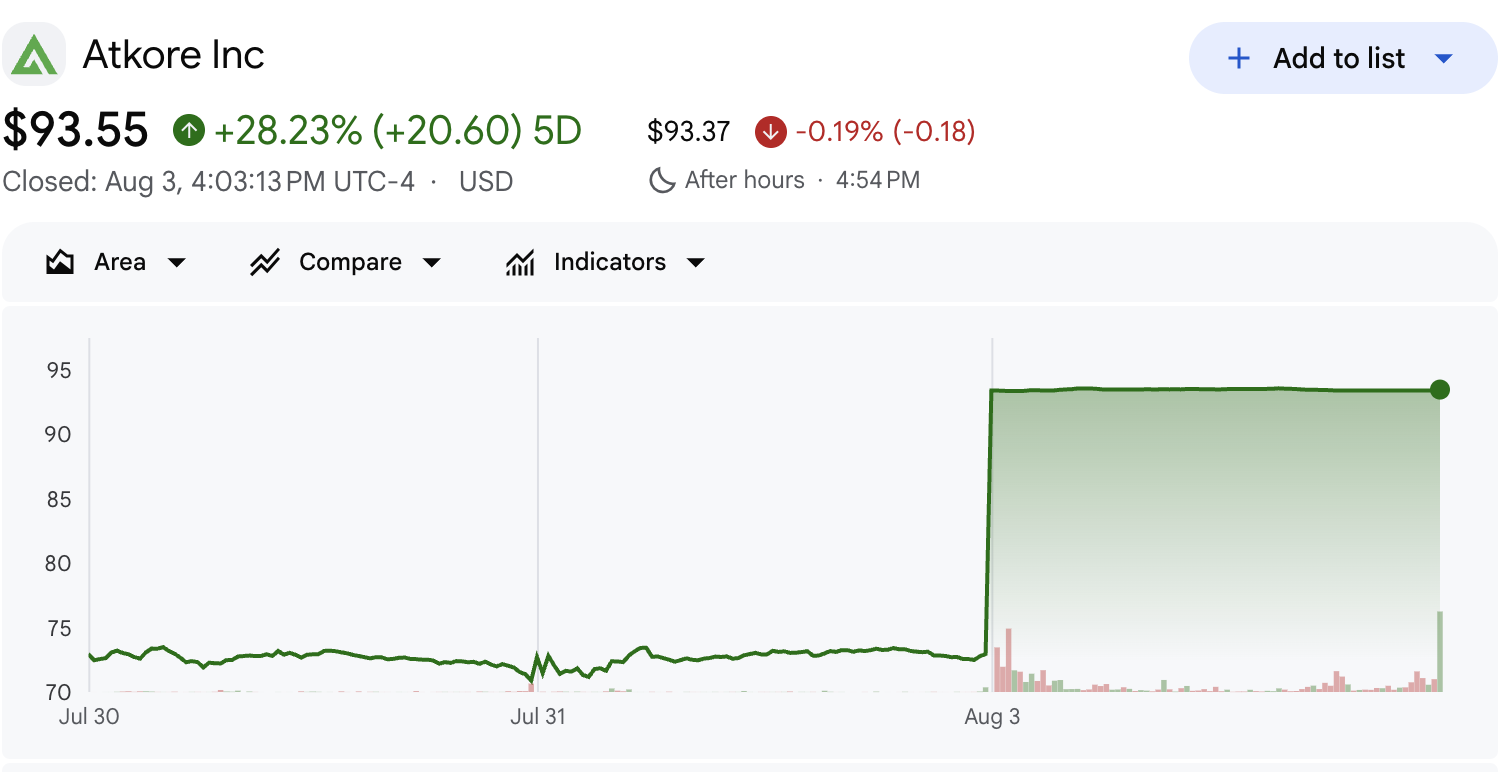
Prysmian’s Atkore acquisition extends the world’s largest cable maker into the conduit, cable-management and framing systems installed around its own products. The Italian group is paying $95.00 per share in cash, an enterprise value of roughly $3.8 billion, and Atkore shares jumped about 27% in pre-market trading on 3 August 2026 with the offer sitting 30% above the previous close of $72.96.

The price deserves more scrutiny than the premium. Prysmian quotes 9.8 times EBITDA, measured against Atkore’s fiscal 2025 result. Against Atkore’s most recent trailing-twelve-month earnings, the same $3.8 billion works out nearer 11.7 times.
Prysmian is paying a 30.2% premium to the 31 July close and 56.5% above the price before Atkore’s strategic review began.
Prysmian supplies power and data cables; Atkore supplies the conduit, trays, fittings and framing that route and protect them, through a distributor-led North American channel.
On our calculation the headline 9.8x multiple becomes 11.7x against Atkore’s latest trailing-twelve-month adjusted EBITDA of $325.8 million.
The $150 million annual run-rate target equals 46.0% of that trailing figure, before $45 million to $50 million of integration costs.
Atkore is about 11% of pro forma combined revenue but lifts North America’s share of group sales from roughly 40% to 45%.
| Measure | Detail |
|---|---|
| Buyer / Target | Prysmian S.p.A. (BIT: PRY) / Atkore Inc. (NYSE: ATKR) |
| Consideration | $95.00 per share, all cash |
| Enterprise value | Approx. $3.8 billion (€3.3 billion) |
| Premium to 31 July close | 30.2% from $72.96; approx. 23% to the 90-day VWAP |
| Stated multiple | 9.8x EV/EBITDA based on FY2025 adjusted EBITDA |
| Run-rate target | Approx. $150 million in annual pre-tax EBITDA benefits within three years |
| Integration cost | $45 million to $50 million over three years |
| Financing | Approx. 60% debt, over 20% hybrid instruments and approx. 20% equity |
| Pro forma leverage | Approx. 1.4x net debt to EBITDA at the end of 2026 |
| Target closing | Calendar year-end 2026 |
Sourced from the Prysmian and Atkore releases of 3 August 2026 and management comments to analysts the same day, reported by Reuters.
Prysmian already makes the power, building and communications cables installed in data centres and factories. Atkore makes almost everything fitted around them: steel, PVC and aluminium conduit, fittings, cable trays, ladders and baskets, armouring and framing, and plastic pipe.
| Stage of the Project | Prysmian Today | Atkore Adds |
|---|---|---|
| Power to the site | Medium-voltage and power cables | Conduit, fittings and supporting infrastructure |
| Distribution inside | Building and industrial cables | Trays, ladders, baskets and framing |
| Data | Copper and fibre-optic cables | Routing and cable-management systems |
| Channel | Utility and telecom relationships | Electrical distributors and contractors |
The last row carries the most weight. Prysmian sells largely to utilities and large contractors, while Atkore sells through the North American electrical distribution channel. That channel is harder to replicate than conduit capacity, and it explains why a business contributing roughly 11% of combined revenue matters more than its size implies: it raises North America from about 40% of group sales to 45%.
Separate computing from electrical infrastructure. Nvidia and its peers supply computing capacity, utilities supply electricity, Prysmian carries power and data through cables, and Atkore’s products route, protect and support those cables.
AI data centre power demand is rising because large accelerator clusters draw heavily and simultaneously, while cooling them creates an additional electrical load. Grid connection, transmission access and substation capacity have become primary development constraints rather than background details.
A project needs a network connection, medium and low-voltage cable, fibre, conduit protecting that cable, trays routing it through the building, structural supports for electrical and cooling plant, and pathways allowing capacity to be added later. Atkore supplies into that entire list, and its Unistrut framing carries trays, wire baskets, lighting, busbars and cooling containment.
The exposure is indirect but real. Atkore makes no chips and operates no facilities; it supplies the physical AI infrastructure without which chips cannot receive reliable power. It is also not solely an AI story, serving commercial construction, utilities, renewables and rail.
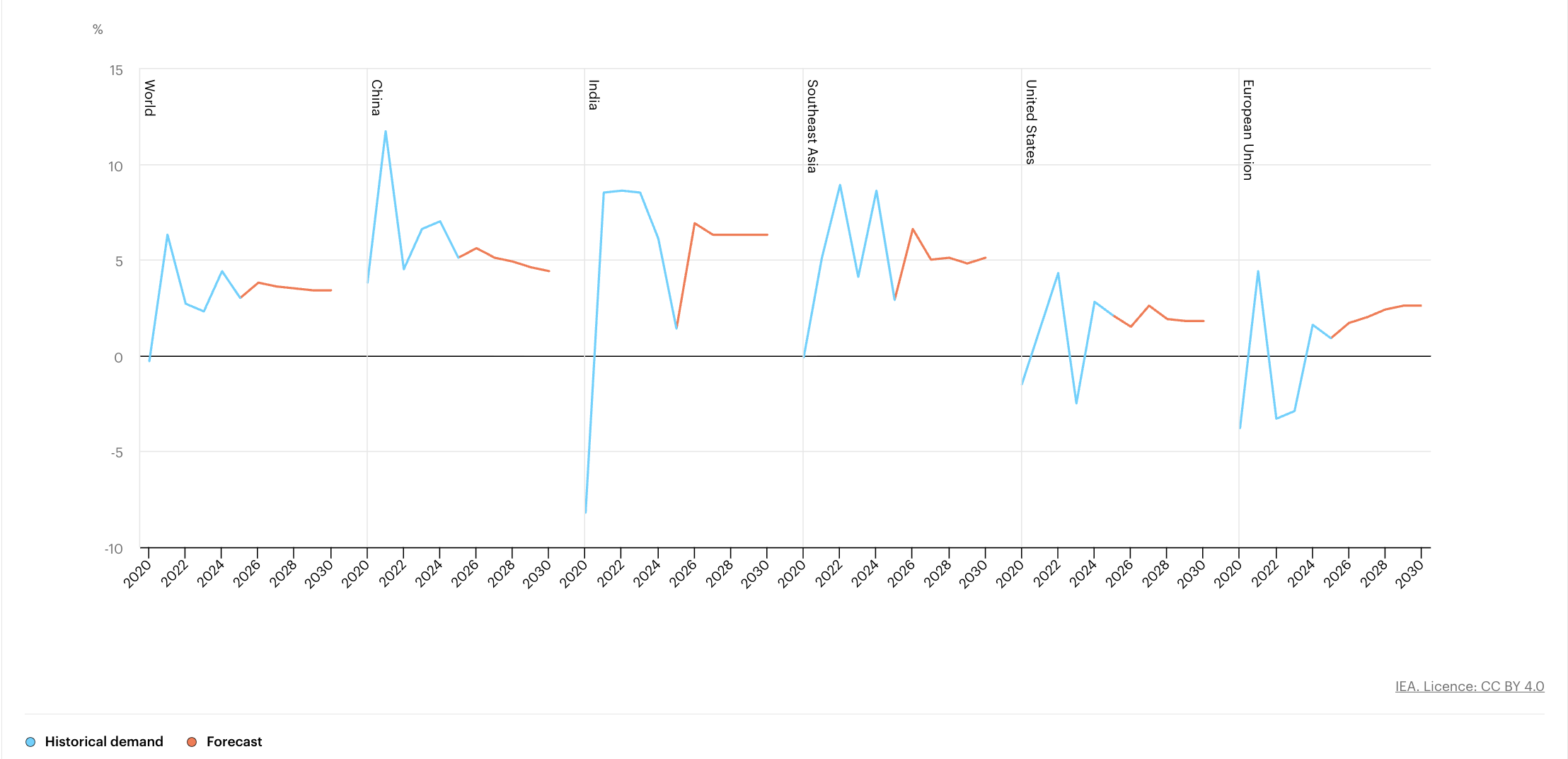
The International Energy Agency’s Electricity 2026 report forecasts global electricity demand growing 3.6% a year through 2030 against 2.8% over the previous decade, driven by industry, electric vehicles, cooling and data centres. That breadth is what stops the deal depending on a single capital expenditure cycle.
Prysmian’s stated EV/EBITDA multiple rests on Atkore’s fiscal 2025 adjusted EBITDA of $386.4 million. Atkore has since traded below that run rate. Trailing-twelve-month adjusted EBITDA through 26 June 2026 was $325.8 million, roughly 16% lower.
| Valuation Basis | Adjusted EBITDA | EV/EBITDA |
|---|---|---|
| FY2025 actual, Prysmian’s headline basis | $386.4 million | 9.8x |
| Trailing 12 months to June 2026 | $325.8 million | 11.7x |
| Last-issued FY2026 outlook midpoint | $350.0 million | 10.9x |
| Trailing 12 months plus full $150 million target | $475.8 million | 8.0x |
| Outlook midpoint plus full $150 million target | $500.0 million | 7.6x |
Enterprise value of $3,800 million divided by each base. The first row reproduces Prysmian’s disclosed figure, confirming the method is like-for-like; Prysmian’s acquisition presentation identifies the $386.4 million as adjusted EBITDA, so the bases differ by period rather than by definition.
Note that the $350 million midpoint is not live guidance. Atkore last maintained its $340 million to $360 million outlook on 5 May and did not update or reaffirm it when reporting third-quarter results alongside the merger.
Applying $95 to the 33,767,266 common shares outstanding at 1 May 2026 values those shares at roughly $3.21 billion. That is not the full equity consideration, because the merger also provides cash treatment for outstanding options and stock units.
Atkore has run a strategic review since late 2025, and the takeover concludes that process rather than arriving unsolicited. Prysmian secured it through a competitive process, which explains the 56.5% premium to the $60.69 pre-review close.
The third quarter, reported the same day, shows growth alongside margin pressure. Net sales rose 8.1% year on year to $794.8 million, the Electrical segment up 10.9% to $578.3 million and adjusted EBITDA up 4.7% to $104.7 million. Gross margin fell to 22.2% from 23.4% as $48.9 million of input cost increases outpaced $22.4 million of pricing. GAAP net income was $0.7 million, or $0.02 per diluted share, after a $50.0 million litigation settlement.
The GAAP and adjusted figures tell opposite stories, and that gap is the point. Cash lets shareholders crystallise a premium before either the opportunity or the execution risk resolves.
The $150 million is a run-rate pre-tax EBITDA benefit, not a cost-reduction programme, and Prysmian has not published a split between commercial and operational sources. Chief executive Massimo Battaini told analysts the two companies sell complementary products to the same customers and should win more work with a bundled offer, which points to a meaningful commercial component.
That distinction is important for how much confidence the target deserves. Costs a buyer strips out are within its control; persuading distributors and contractors to buy a wider bundle is not. Against a trailing base of $325.8 million, the target represents a 46.0% uplift, with $45 million to $50 million of integration spending in the first three years.
The argument here is that Prysmian is paying full price for channel reach and adjacency rather than for cheap earnings. If Atkore’s margins recover toward fiscal 2025 levels as input costs normalise, the effective multiple compresses toward 9.8x and the price looks reasonable. If cost reductions alone approach $150 million, the scepticism above is misplaced.
On the deal itself, a majority of outstanding Atkore shares must approve the merger and antitrust clearances are outstanding in several jurisdictions, including under Hart-Scott-Rodino and in Austria, Australia and Canada. Financing looks the lesser concern: there is no financing condition, and Prysmian guides to roughly 1.4 times pro forma leverage at end-2026, falling toward one time in 2027. Approvals and integration, two of the central merger and acquisition risks, are the binding constraints.
Prysmian agreed to buy the company for $95.00 per share in cash, 30.2% above the previous close, removing the uncertainty hanging over Atkore since its strategic review began.
About $3.8 billion in enterprise value, of which roughly $3.21 billion is the value of currently outstanding common shares at the offer price.
Cables must be protected, routed and supported through conduit, fittings, trays, baskets and framing. That is what Atkore manufactures.
30.2% to the 31 July close of $72.96, about 23% to the 90-day VWAP, and 56.5% to the pre-review price of $60.69.
Holders receive $95.00 per share in cash. Until then shares may trade below that level, reflecting time value and residual regulatory and closing risk.