Published on: 2023-11-16
Updated on: 2026-05-05
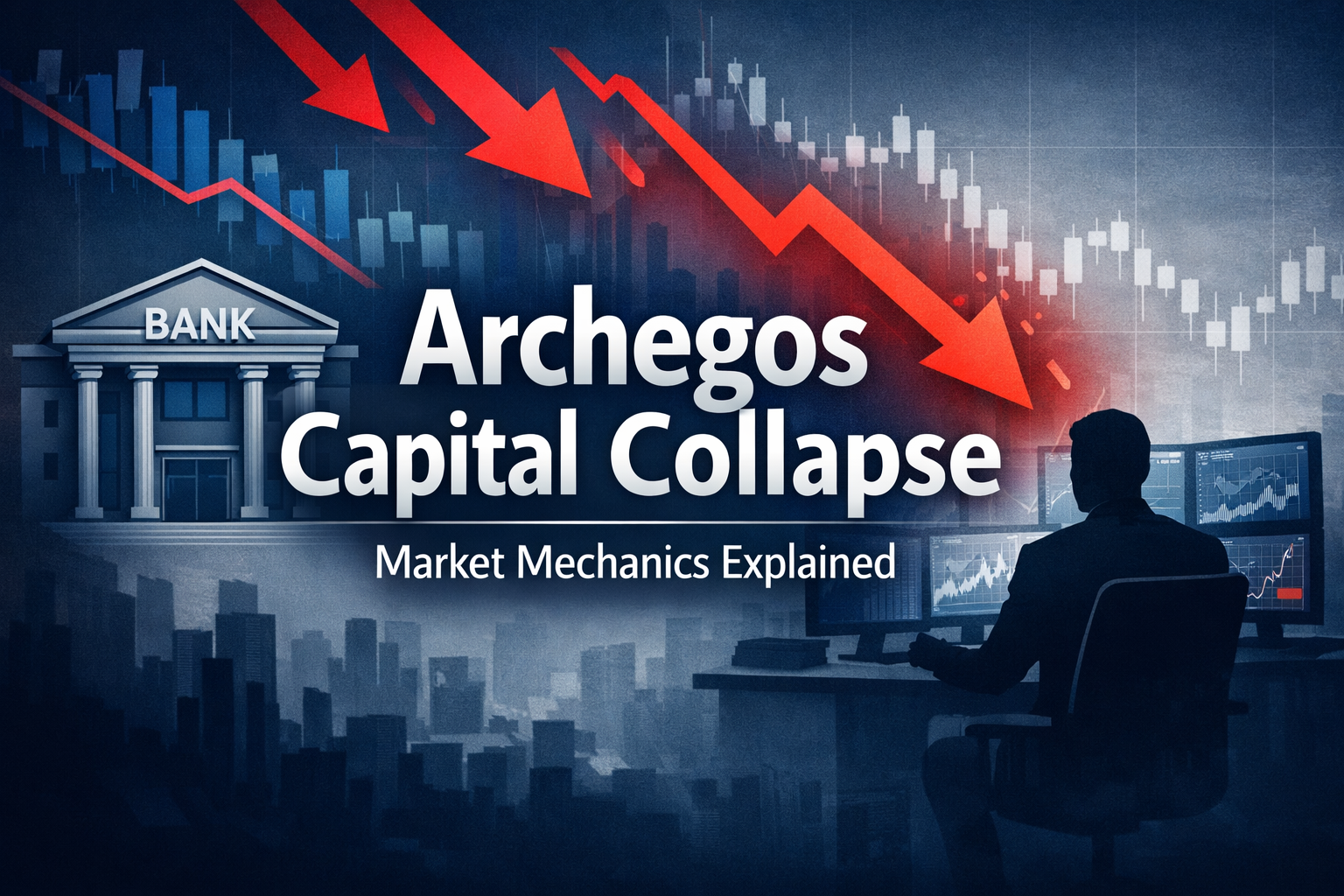
Bill Hwang turned Archegos Capital Management into one of Wall Street’s most powerful hidden buyers, then lost a fortune faster than almost any investor in modern market history. His collapse was not a normal bad trade. It was a leverage event, a disclosure failure and a risk-management breakdown compressed into a few violent trading days.
The story still matters because the market has not moved beyond the forces that destroyed Archegos. Crowded trades, synthetic exposure, and cheap balance-sheet financing remain central to modern finance. Hwang’s 2024 conviction and 18-year prison sentence only sharpened the lesson: when leverage is hidden, liquidity can vanish before investors understand the real risk.
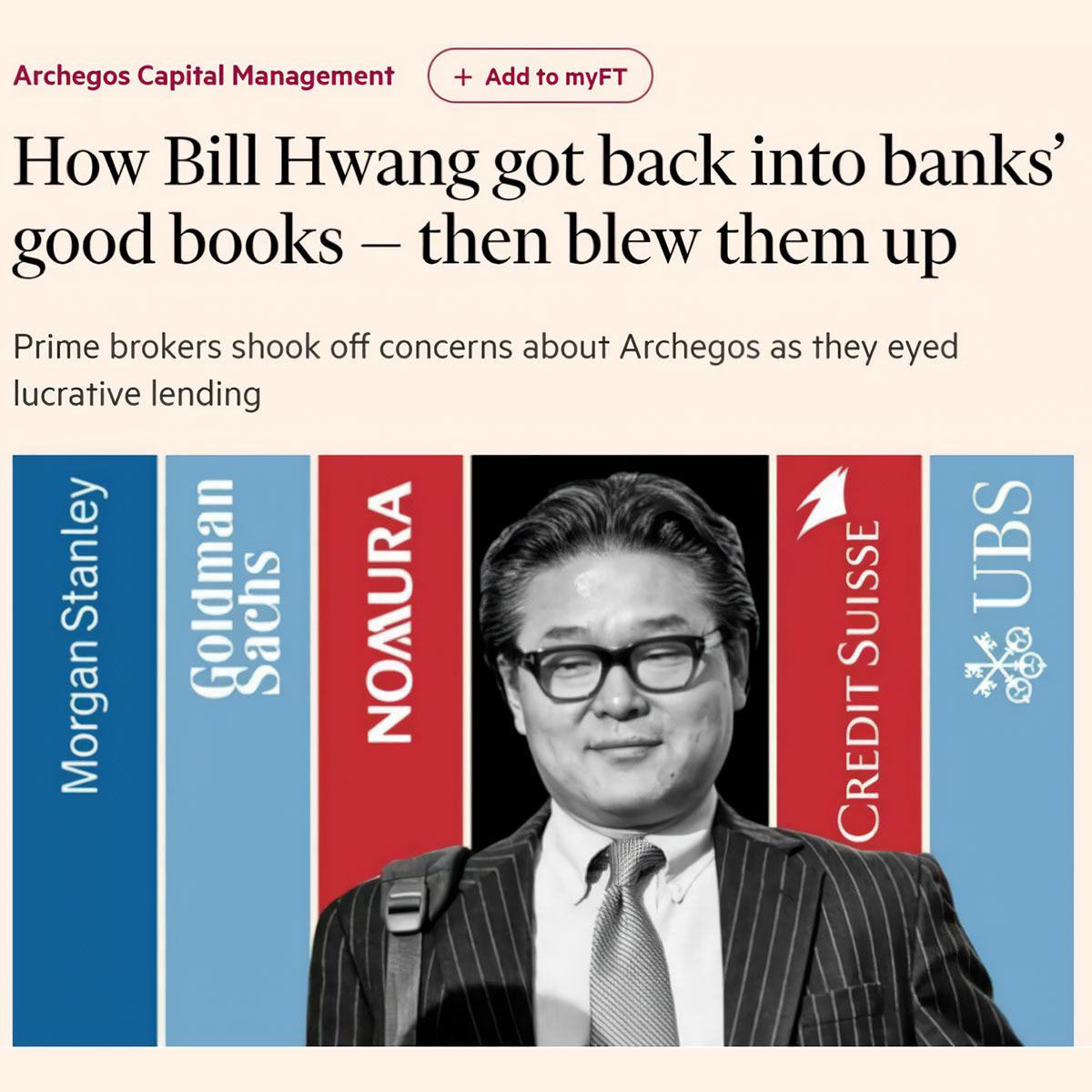
Bill Hwang’s Archegos built more than $100 billion in market exposure through concentrated equity bets and total return swaps.
The firm’s positions were tied to stocks such as ViacomCBS, Discovery, Baidu, Tencent Music and Vipshop.
Total return swaps enabled Archegos to gain economic exposure without directly reporting large shareholdings.
The collapse triggered more than $9 billion in losses for global banks and helped expose serious weaknesses in prime brokerage risk controls.
Credit Suisse suffered the biggest single loss, with more than $5 billion wiped out by the Archegos default.
In 2025 and 2026, the case remained relevant as swap-reporting rules were withdrawn and a bank-collusion probe closed without charges.
Sung Kook “Bill” Hwang was born in South Korea and later built his career in the United States. After studying at UCLA and Carnegie Mellon, he entered the hedge fund world and eventually worked for Julian Robertson’s Tiger Management.
That connection gave him credibility. Tiger alumni became some of the most closely watched investors in global markets. Hwang used that reputation to launch Tiger Asia, a hedge fund focused on Asian equities.
The first major warning came years before Archegos. In 2012, the SEC charged Hwang and Tiger Asia with illegal trading in Chinese bank stocks. Hwang and related firms agreed to pay $44 million to settle the SEC’s charges.
After Tiger Asia closed, Hwang returned through Archegos Capital Management. This time, the structure was different. Archegos operated as a family office, meaning it managed private wealth rather than outside client capital. That gave it more privacy than a traditional hedge fund and helped it grow with less public scrutiny.
Archegos did not simply buy shares in the open market. It used total return swaps, a derivative that gave the firm the profits and losses of a stock without direct ownership.
The structure was simple on the surface. A bank bought or hedged the stock. Archegos posted collateral. If the stock rose, Archegos received the gain. If the stock fell, Archegos had to post more collateral or absorb the loss.
That setup created three powerful advantages.
First, Archegos could use leverage. It did not need to pay the full value of every position upfront. Second, it could avoid appearing as a large shareholder in the usual way because the bank often held the shares. Third, it could repeat similar trades with multiple banks simultaneously.
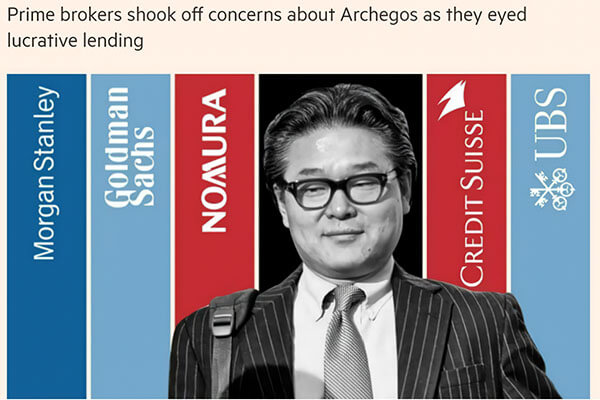
That third point was the most dangerous. Goldman Sachs, Morgan Stanley, Credit Suisse, Nomura and others could each see their own exposure to Archegos. None had a complete view of how large and concentrated the total portfolio had become.
The breaking point came in March 2021. ViacomCBS, now Paramount Global, announced a stock offering after a rapid rally in its share price. The stock fell sharply. That decline damaged one of Archegos’ largest positions and weakened confidence across the portfolio.
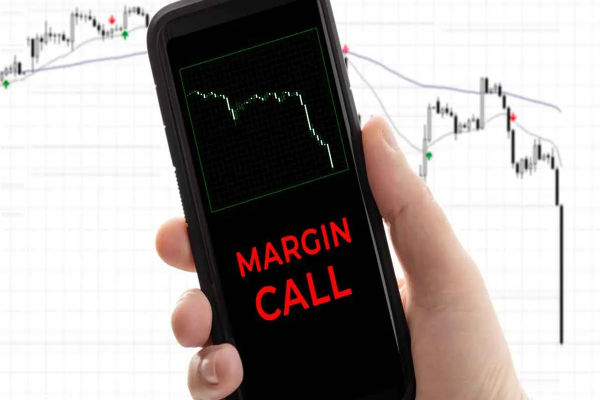
Banks then demanded more collateral. Archegos could not meet the margin calls. Once that became clear, every counterparty had the same incentive: sell first, sell fast and avoid being the last bank holding the risk.
This is why the loss happened so quickly. A leveraged position does not decline as an ordinary investment would. When prices fall, lenders demand more cash. If the borrower cannot pay, lenders liquidate the related exposure. That selling pushes prices lower, creating more losses and forcing more selling.
The result was a spiral of market structure. Stocks linked to Archegos were hit not only by changing fundamentals but by forced liquidation. In that moment, the portfolio’s actual value mattered less than the need to raise cash.
The banks were not innocent bystanders in a risk-management sense. They were sophisticated counterparties that earned fees by financing Archegos. The failure was that several treated the relationship as a profitable business before fully understanding the downside.
Credit Suisse became the clearest example. FINMA later found that the bank had seriously and systematically violated financial market law in its Archegos relationship. Its exposure reached $24 billion in March 2021, more than half of Credit Suisse Group’s equity at the time.
The bank also failed to respond properly to limit breaches. Risk warnings were not escalated forcefully enough. Additional collateral demands were too low. Limits were adjusted instead of enforced.
This matters because total return swaps are not exotic in and of themselves. Large banks use them every day. The problem was not the instrument alone. It was the combination of concentrated positions, weak transparency, repeated limit pressure and a client whose strategy depended on rising prices.
Goldman Sachs and Morgan Stanley reduced their exposure more quickly. Credit Suisse and Nomura suffered heavier damage. The difference showed a brutal truth of crisis trading: when a crowded position breaks, speed becomes capital protection.
The original Archegos story was often described as a spectacular trading failure. The courtroom version was more severe.
In July 2024, Bill Hwang was convicted after a nine-week jury trial of racketeering conspiracy, securities fraud, market manipulation and wire fraud. In December 2024, he was sentenced to 18 years in prison. Prosecutors said he manipulated multiple stocks and misled at least nine investment banks.
The legal outcome changed how the collapse should be understood. It was not only a case of aggressive leverage that went wrong. It was also a fraud and manipulation case built around misleading counterparties and distorting market prices.
Regulatory questions remain less settled. In June 2025, the SEC formally withdrew certain proposed rules on large security-based swap position reporting. The agency said it did not intend to issue final rules for those proposals and would issue a new proposal if it pursued future action.
In 2026, the Justice Department closed a criminal antitrust probe into whether banks coordinated their response to the Archegos unwind, without bringing charges. That left the central accountability with Hwang and Archegos, while the banks remained a case study in weak risk control.
The main lesson is not that derivatives are dangerous. The real lesson is that hidden leverage can make a portfolio look safer than it is.
A stock position funded with cash can fall sharply and still survive. A synthetic position funded with borrowed balance sheet capacity may not. Once margin pressure begins, the investor loses control of timing.
Concentration is the second lesson. Archegos was not destroyed because every market moved against it. It failed because too much exposure sat in a narrow group of stocks, financed by multiple banks that all needed protection at the same time.
The third lesson is liquidity. Markets look liquid when investors want to buy or sell in normal-sized amounts. They become much thinner when several banks try to exit the same linked positions together.
Bill Hwang’s rise showed how quickly private leverage can build behind the public market. His fall showed how quickly that leverage can become visible when the trade breaks.
Bill Hwang’s loss came from leveraged equity exposure at Archegos. The firm used total return swaps to build large positions in a small group of stocks. When those stocks fell, banks demanded more collateral. Archegos could not pay, triggering forced selling.
Archegos operated as a family office rather than a traditional hedge fund. That distinction mattered because family offices manage private wealth and face fewer public disclosure requirements than firms managing outside investor money.
A total return swap is a derivative that transfers the gains and losses of an asset to a client without requiring the client to own the asset directly. In Archegos’ case, banks held or hedged the shares, while Archegos retained economic exposure.
Credit Suisse had one of the largest exposures to Archegos and reacted too slowly when the portfolio began to collapse. Regulators later found serious weaknesses in its risk management, escalation process and collateral controls.
Bill Hwang was convicted in 2024 of racketeering conspiracy, securities fraud, market manipulation and wire fraud. He was sentenced to 18 years in prison and ordered to pay more than $9 billion in restitution.
Bill Hwang’s collapse remains one of the clearest warnings in modern finance. Archegos used swaps to turn private capital into enormous market exposure. The strategy worked while prices rose, but it failed once collateral calls exposed the true size of the risk.
The case endures because its mechanics are still relevant. Hidden leverage, crowded positions and weak counterparty oversight have not disappeared. The names will change, but the danger remains the same: when leverage is invisible on the way up, it becomes impossible to ignore on the way down.
Disclaimer: This material is for general information purposes only and is not intended as (and should not be considered to be) financial, investment or other advice on which reliance should be placed. No opinion given in the material constitutes a recommendation by EBC or the author that any particular investment, security, transaction or investment strategy is suitable for any specific person.