Published on: 2026-03-25
Updated on: 2026-03-25
Quantitative tightening (QT) is frequently characterised as “the balance sheet version of a rate hike.” While this analogy is somewhat useful, it can be misleading and lead to misinformed trading decisions.
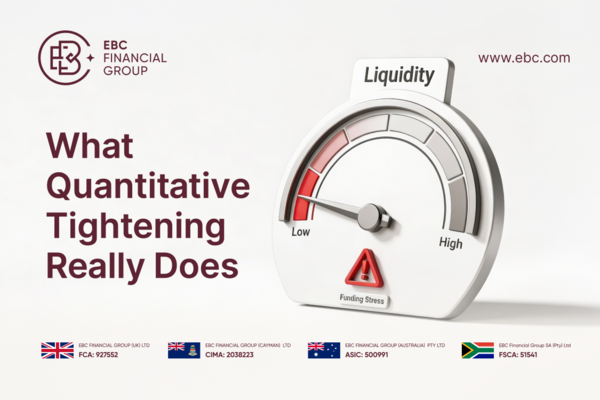
Interest rate increases primarily affect the price of money, whereas quantitative tightening primarily impacts the availability of money. This distinction is significant because financial markets may appear stable until underlying liquidity issues emerge.
In late 2025, liquidity concerns became increasingly evident. The Federal Reserve announced it would conclude the reduction of its aggregate securities holdings on 1 December 2025, in response to tightening money market liquidity. Concurrently, use of the Federal Reserve’s Standing Repo Facility reached record highs, indicating that certain segments of the financial system were experiencing elevated cash demand.
This perspective provides a clear understanding of quantitative tightening. It is a policy tool whose effects often become apparent in less-monitored areas of the financial system, sometimes only after significant disruptions occur.
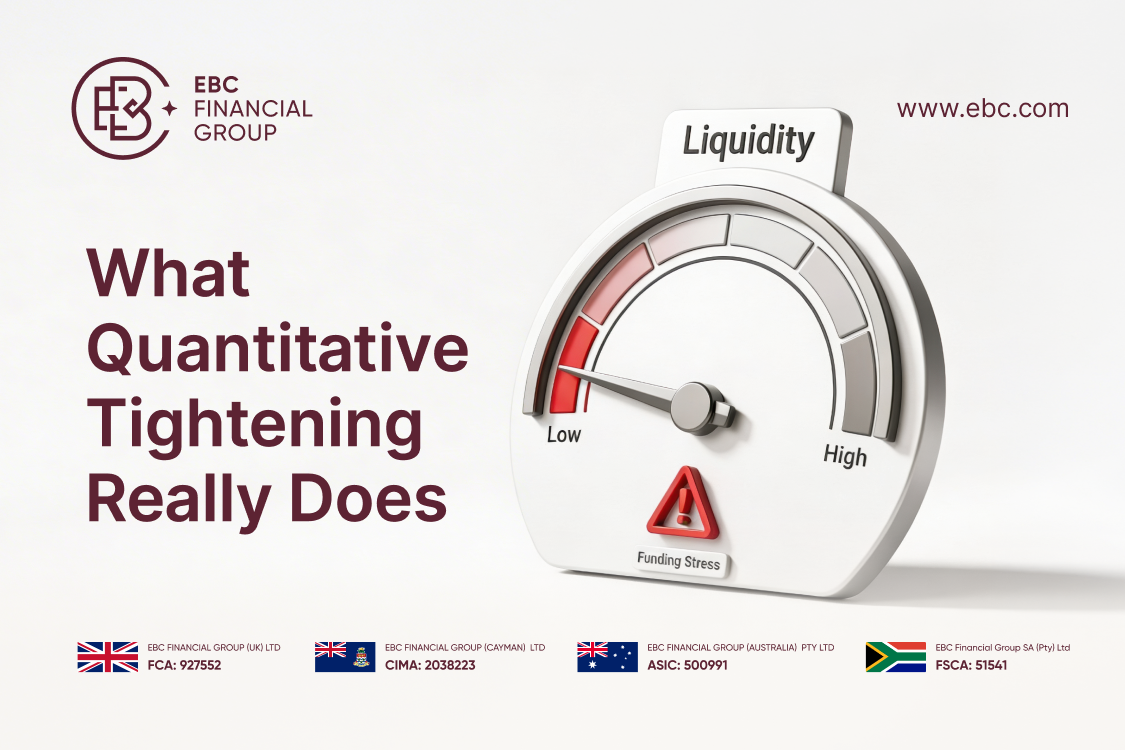
QT is a balance sheet reduction. Central banks let assets roll off or sell them, so their holdings fall over time.
Most quantitative tightening occurs through runoff, in which bonds mature, the central bank receives principal, and reinvestment is reduced relative to previous levels. This process is generally slower and more manageable. Asset sales represent a more pronounced form of quantitative tightening. They increase the supply of securities in the market in addition to ongoing government issuance, which is particularly impactful in markets with fragile demand or heightened volatility at the long end of the yield curve.
The Fed’s most recent QT cycle began in June 2022 and was guided by monthly caps on the amount that could roll off without reinvestment. The combined cap was often framed as up to $95 billion per month. In May 2024, the Fed slowed the pace by lowering the Treasury runoff cap to $25 billion per month, while leaving the agency mortgage-backed securities (MBS) cap at $35 billion.
A critical aspect for market participants is the effect on the liability side of the central bank’s balance sheet. When assets are reduced, liabilities also decline, most commonly in the form of bank reserves, which serve as the primary settlement medium within the financial system.
QT restricts financial conditions independently of changes to the policy rate. This characteristic enhances its effectiveness but also increases the risk of misinterpretation.
There are three ways QT tends to land.
It changes the bond buyer mix.
During quantitative easing (QE), the central bank consistently purchases longer-duration assets. In contrast, quantitative tightening reduces this demand, requiring private investors to absorb a greater share of government issuance. As a result, yields may rise to attract buyers, or market volatility may persist until sufficient demand materialises.
It changes liquidity and market depth.
In an environment with abundant reserves, market participants can withstand errors due to readily available funding. QT gradually reduces this flexibility, leading to wider bid-ask spreads and more pronounced price movements during liquidations.
It changes how fast stress spreads.
When liquidity is plentiful, one market can absorb pressure from another. When liquidity is tighter, markets pass stress along faster. That is when you see correlations snap back to “risk off” behaviour.
The Bank for International Settlements has summarised this dynamic succinctly: reduced system liquidity diminishes the financial system’s capacity to absorb shocks during periods of turbulence.
If you want the case study that explains why central banks watch QT so nervously, it is September 2019.
Over a few days, overnight funding rates spiked sharply due to a cash squeeze linked to corporate tax payments and Treasury settlement needs. The move surprised markets because it appeared to be a technical issue, not a macro one. The Fed later analysed the episode as a reminder that reserves can look “ample” until they are not. Research on the repo spike also points to a confluence of factors that became disruptive once reserves were less abundant.
This context underscores the significance of the Federal Reserve’s decision in late 2025 to end quantitative tightening. The action reflects a commitment to safeguarding market functioning rather than signaling a policy success.
Chairman Powell also made the longer-run logic explicit. Once runoff stops, reserves can still decline over time as other liabilities grow, and the Fed will manage holdings to maintain“ample” reserves.
Early in this cycle, the Fed’s reverse repo facility acted like a liquidity sponge. It held trillions at its peak. As that facility drained, QT stopped removing “excess cash” from that buffer and started leaning more directly on bank reserves.
By late August 2025, Reuters noted that the reverse repo facility had largely emptied, shifting attention toward the level of bank reserves and the risk that QT could tighten money markets more directly.
This represents the challenge of the new phase: quantitative tightening appears manageable until liquidity buffers are depleted.
QT encompasses a range of policy approaches rather than a single, uniform strategy.
The Fed slowed runoff in 2024, then later said it would conclude the reduction of aggregate securities holdings on 1 December 2025 as liquidity tightened. Around that shift, SRF usage hit record highs, a visible sign that parts of the funding market wanted central bank liquidity.
After ending QT, the Fed moved to stabilise reserves through bill operations. Reporting in December 2025 described bill buying aimed at smoothing money markets, with Powell framing it as a technical tool rather than renewed stimulus.
The ECB’s QT has been heavily focused on reinvestment policy. Reinvestments under the APP were discontinued in July 2023, and PEPP reinvestments were fully discontinued at the end of 2024.
On the numbers, the Eurosystem’s weekly consolidated financial statement showed total assets around €6.16 trillion in late December 2025. The ECB balance sheet series also shows an earlier peak around mid-2022, near the €8T high.
The BoE has leaned more heavily on active gilt sales than the ECB, and it has been more sensitive to market functioning. In September 2025, the MPC supported a slower pace of QT, cutting the annual pace of stock reduction to £70 billion, from £100 billion.
This distinction is crucial: quantitative tightening simultaneously represents both a policy decision and a change in market microstructure.
This dynamic underscores the relevance of quantitative tightening for market participants. It alters market conditions even in the absence of changes to the policy rate.
When central banks step back, duration has to be held by someone else. That can lift term premia, steepen curves at awkward moments, and raise volatility around auctions and supply events. QT also tends to increase the market’s sensitivity to fiscal headlines.
Quantitative tightening can strengthen a currency by tightening domestic liquidity and attracting capital seeking higher real yields. The more effective framework for foreign exchange is relative quantitative tightening: if one central bank reduces its balance sheet more aggressively than others, it can enhance that currency’s rate differential narrative. When multiple central banks tighten simultaneously, foreign exchange markets often respond more to shifts in risk sentiment.
Gold usually responds to real yields, the dollar, and the risk mood. QT can push in two directions. Higher yields can be a headwind. Liquidity stress can add a risk premium that offsetsthe yield pressure. The balance often determines whether stress is orderly or disorderly.
Oil is not a QT asset in itself, but QT can cool growth expectations through tighter financial conditions. In practice, oil still trades supply and geopolitics first, but QT can change the market’s ability to absorb shocks.
Equity indices
QT eliminates the supportive effect of abundant liquidity. While equities may continue to appreciate based on earnings, market leadership often narrows and volatility increases as liquidity conditions tighten. The market also becomes less accommodating of crowded positions.
Silver often behaves like a hybrid of a precious metal and a cyclical asset. QT can pressure it via growth and yields, while volatility episodes can support it via safe-haven-style demand. The result is often more chop.
To ensure ongoing relevance, it is advisable to provide readers with a consistent monitoring framework.
Money market rates versus the policy corridor
Signs of funding stress, including facility usage like the SRF
Central bank reinvestment headlines and any change in caps or pace
Auction tone and term premium chatter in the long end
Cross-asset behaviour: does stress stay local or spread
Quantitative tightening is fundamentally a reduction in the central bank’s balance sheet, but its market impact is more nuanced. It alters risk ownership, affects the ease of funding positions, and accelerates the transmission of localised disturbances into broader market de-risking.
That is why QT matters even when there is no rate hike. It is a slow policy lever that can produce rapid market moves, especially once liquidity buffers are exhausted.
Disclaimer & Citation
This material is for information only and does not constitute a recommendation or advice from EBC Financial Group and all its entities (“EBC”). Trading Forex and Contracts for Difference (CFDs) on margin carries a high level of risk and may not be suitable for all investors. Losses can exceed your deposits. Before trading, you should carefully consider your trading objectives, level of experience, and risk appetite, and consult an independent financial advisor if necessary. Statistics or past investment performance are not a guarantee of future performance. EBC is not liable for any damages arising from reliance on this information.