Published on: 2025-08-29
Updated on: 2026-01-02
In the forex market, the quote currency is the second currency in the pair, and it represents the price. It tells you how much of that currency is needed to buy one unit of the first currency. This matters because every price move, every profit, and every loss is measured through the quote currency.
If traders do not understand this role, they may misread prices, misunderstand risk, and misjudge trade results. That confusion usually starts with not knowing which currency is doing the pricing and which one is being priced.
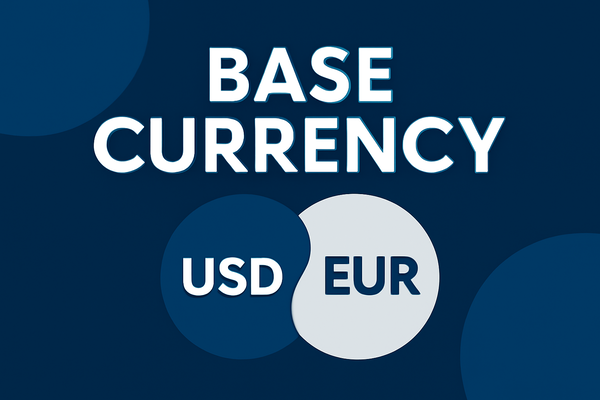
In trading, the quote currency, also called the counter currency, is the second currency listed in a currency pair. It shows how much of that currency is needed to buy one unit of the base currency, which is listed first.

For example, if EUR/USD is trading at 1.1000, this means one euro, the base currency, costs 1.10 US dollars, the quote currency. In this pair, the euro is being priced, and the US dollar is doing the pricing.
The quote currency is where traders see results. Pips, which are the standard units of price movement, are measured in the quote currency. Spreads, which are the main trading cost, are also shown in the quote currency.
When a trade closes, profit or loss is calculated in the quote currency first, then converted if the account uses a different currency.
The quote currency changes value as traders react to news and expectations. Some key drivers are easy to observe:
When the central bank of the quote currency is expected to raise rates, that currency often strengthens. When rate cuts are expected, it can weaken.
Inflation, employment, and growth reports affect confidence in the quote currency.
During stress, traders often buy safe currencies like the US dollar. In calmer markets, they may sell them.
Elections, government budgets, or trade disputes can quickly change demand for the quote currency.
When these factors shift, the exchange rate moves because the market changes how much quote currency it is willing to pay for the base currency.
The quote currency has a direct effect on trade outcomes. At entry, its strength or weakness helps determine whether prices are rising or falling. A stronger quote currency usually pushes the pair lower, while a weaker quote currency pushes it higher, assuming the base currency is stable.
At exit, your profit or loss is fully expressed in the quote currency. This also affects risk management. Sudden moves in the quote currency can widen spreads, increase volatility, and raise short-term risk.
Calm quote currency, stable spreads, smoother price action.
Uncertain quote currency, wider spreads, sharper price swings.
Understanding this helps traders decide position size, stop placement, and whether to stay in a trade during major events.
Let’s use the currency pair EUR/USD as an example.
Entry price: 1.1000
One euro costs 1.10 US dollars.
Then,
Exit price: 1.1050
One euro now costs 1.105 US dollars.
The 0.0050 rise means the euro has strengthened against the US dollar. Each euro now costs 0.0050 more US dollars than before. On a standard lot of 100,000 euros, this price change equals a gain of 500 US dollars before spreads, swaps, or commissions.
If the price instead falls to 1.0950, fewer US dollars are needed to buy one euro. The quote currency has strengthened, and the trader loses 500 US dollars. Every result comes from how the quoted currency value changes.
Before placing a trade, traders should always review the quote currency side:
Check the economic calendar for major data releases tied to the quote currency.
Review recent price trends to see if the quote currency is strengthening or weakening.
Watch spreads, especially around news and session opens.
Look at the central bank guidance related to the quote currency.
Normal conditions show steady movement and predictable costs. Risky conditions show sharp moves and sudden spread changes. It is best practice to review the quote currency outlook before every trade and again before holding positions overnight.
Confusing the base currency with the quote currency and trading in the wrong direction.
Ignoring quote currency news, even though it often drives short-term price moves.
Misreading profit and loss when the account currency is different.
Assuming only the base currency matters.
Holding trades through major quote currency events without adjusting risk.
These mistakes are common among beginners and often lead to avoidable losses.
Base currency: The first currency in a pair, set as one unit, which is priced using the quote currency. It is the currency being bought or sold, while the quote currency shows how much it is worth.
Exchange rate: The price formed by the base and quote currencies.
Pip: The smallest standard price movement, measured in the quote currency.
Spread: The difference between buy and sell prices, quoted in the quote currency.
Counter currency: Another name for the quote currency. It is the second currency in a pair and is used to express the price, profits, and losses of a trade.
No. The quote currency depends on the pair. In EUR/USD, the US dollar is the quote currency. In USD/JPY, the Japanese yen is the quote currency. Each pair has its own structure, and traders must always check which currency is listed second before trading.
Because price changes are measured as changes in the amount of quote currency needed to buy one unit of the base currency. Every pip move represents a gain or loss in the quote currency first, even if the account uses a different currency.
Not always, but in many short-term moves, the quote currency drives price action. For example, strong US economic data often moves many USD quote pairs at the same time, even if the base currencies differ.
Your trading platform converts the profit or loss from the quote currency into your account currency at the current exchange rate. This conversion can slightly change final results, especially during volatile markets.
Yes. Major news tied to the quote currency, such as interest rate decisions or inflation data, can overpower technical patterns in the short term. This is why traders often reduce risk or stay out during key events.
Yes. Long-term traders watch interest rate trends, inflation, and economic growth tied to the quote currency. These factors shape long-term exchange rate trends and help explain why a currency strengthens or weakens over time.
The quote currency is the pricing side of every forex trade. It shows how much you pay for the base currency and how profits and losses are calculated. When traders understand it, prices make sense, and risk is clearer. When they ignore it, trades feel unpredictable and confusing.
Disclaimer: This material is for general information purposes only and is not intended as (and should not be considered to be) financial, investment, or other advice on which reliance should be placed. No opinion given in the material constitutes a recommendation by EBC or the author that any particular investment, security, transaction, or investment strategy is suitable for any specific person.